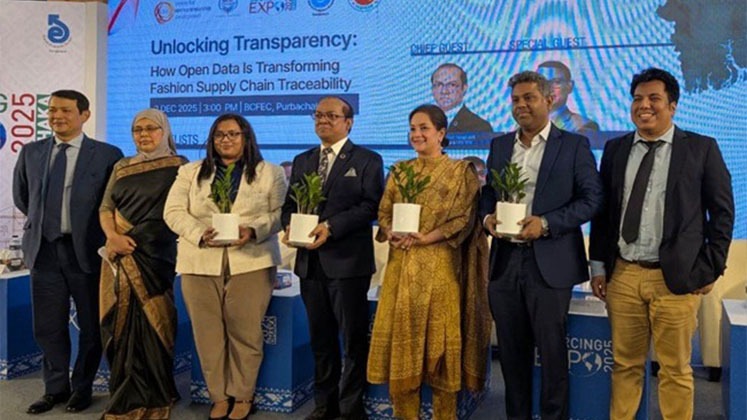
At a seminar titled Mapped in Bangladesh: Traceability and Sustainability in the Apparel Sector, BGMEA Vice President Vidiya Amrit Khan called for fair and proportionate responsibility-sharing across the global apparel value chain, warning that escalating sustainability requirements are placing an increasingly uneven burden on manufacturing countries.
She said Bangladesh’s readymade garment (RMG) sector has long demonstrated its commitment to sustainability, decarbonisation, transparency and improved compliance. However, she noted that emerging global regulations continue to shift the cost of these transitions disproportionately onto producer nations.
She explained that the industry is navigating a challenging period characterised by rising expectations around climate accountability, due diligence, recycling standards and digital traceability requirements. These priorities, she said, demand substantial financial, technological and operational investments that producing countries are expected to shoulder with little or no financial contribution from international buyers.
Referring to what she described as a persistent imbalance in climate responsibility between producing and consuming nations, she said brands frequently promote goals such as sustainability, recycling, due diligence and net-zero, but the systems needed to achieve them must be financed by those brands. Without financial participation from buyers, she said, such transitions are not economically viable for manufacturers.
The BGMEA Vice President stressed that decarbonisation, circularity, digital traceability, frequent audits and continuous reporting each introduce new layers of cost. With sustainability now becoming a prerequisite for market access, she said the pressure on manufacturers—particularly SMEs lacking capital to upgrade their systems—is intensifying. She reiterated that while Bangladesh remains committed to progress, fairness across the value chain is essential.
To reduce audit redundancies and ease compliance pressures, she advocated for a Unified Code of Conduct jointly recognised by BGMEA, BKMEA, BTMA, international brands and development partners. A harmonised framework, she said, would streamline traceability, minimise duplicate audits and significantly reduce compliance costs for manufacturers.