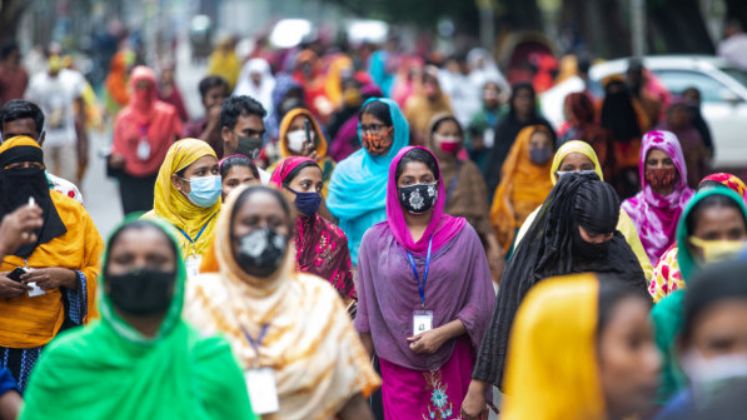
Bangladesh’s labor force saw a significant reduction of 17 lakh individuals within a year, with women making up the majority of this decline, according to the latest Labour Force Survey 2024 conducted by the Bangladesh Bureau of Statistics (BBS).
The survey reveals that the total number of workers dropped to 7.17 crore in 2024 from 7.34 crore in 2023. While male participation remained relatively stable at around 4.8 crore, female workforce numbers declined sharply from 2.53 crore to 2.37 crore during the same period.
This marks the first decrease in the country’s labor participation rate since 2010. Over the previous decade, the workforce had expanded by over 1.6 crore, primarily driven by increased female employment, which grew from 1.72 crore in 2010 to a peak of 2.53 crore in 2023.
Rizwanul Islam, a former senior adviser at the International Labour Organization (ILO), explained that women’s participation in the workforce tends to follow a U-shaped pattern relative to a country’s development level. During middle stages of development, women’s participation often declines, partly due to rising educational enrollment, which can temporarily keep women out of the labor market.
Islam noted that as countries advance, women’s participation usually rises again, especially in higher-income stages. He pointed out that for women with limited education, the reduction in urban employment opportunities, particularly in manufacturing, could be a key factor behind the recent decline.
He emphasized that for highly educated urban women, barriers such as limited job opportunities aligned with their aspirations, lack of childcare infrastructure, and social constraints are significant hurdles. To boost their participation, Islam suggested focusing on expanding employment in modern service sectors like healthcare, education, finance, and hospitality.
Economist Sayema Haque Bidisha from the University of Dhaka highlighted that the overall stagnation in women’s participation in urban and semi-skilled jobs reflects broader structural issues. She explained that the economy’s transition away from agriculture has not translated into increased employment for women, especially in formal sectors.
Bidisha identified four main reasons for the recent decline. First, overall job creation remains sluggish, a phenomenon often termed “jobless growth,” which negatively impacts women’s employment prospects. Second, increased automation and technological advancements in the garment industry have reduced women’s share from over 80 percent to approximately 65 percent, necessitating higher skills and training for women to stay competitive.
Third, women’s involvement in rural non-farm activities is limited by barriers such as lack of access to capital, markets, and information, rendering rural employment largely unpaid or temporary. Often, women take up agricultural work temporarily when male family members migrate to urban centers, only to withdraw once men return.
Fourth, while female labor force participation was reported at 43 percent in 2022, an encouraging figure, most of this growth stemmed from rural areas. Urban women’s participation remained low, with only marginal increases that did not significantly alter the overall trend.
Bidisha expressed concern over the quality of women’s employment, especially in manufacturing and urban settings, where formal and skill-based jobs remain limited. She stressed that although increased rural agricultural work isn’t inherently problematic, the real challenge lies in providing women access to better-quality jobs that align with the country’s evolving economic structure.
She concluded that while the economy shifts toward manufacturing and service sectors, Bangladesh has yet to see corresponding growth in women’s employment within these fields, highlighting the need for policies that facilitate more inclusive and skilled employment opportunities for women.