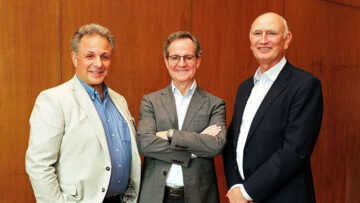
Aligning with the right partners, targeting value for money technology and responding to the needs of the industry – are the foundation stones on which Eastman Technocrafts has been built. Over the last 30 years that the company has been providing technology solutions to the garment industry in Bangladesh, it has built a formidable reputation of always keeping the customer first. “My aim is to keep my customers smiling and for that I am constantly searching the market for technologies that can support growth and give best ROI,” says Manik Chowdhury, MD, Eastman Technocrafts. In discussion with Apparel Online, Chowdhury shares the strategy that has made him one of the biggest technology providers in Bangladesh.
The evolution of any industry is accompanied by the upgradation of technology and the apparel industry is no different. From productivity enhancing machines to sustainable solutions, the industry has travelled a long way. Supporting the industry in this journey are the technology suppliers who have their ear to the ground, picking up the latest needs and future demands well in time to provide solutions. “We cannot be complacent after picking up a few good international companies to represent in the country… It is about understanding the industry and keeping pace with global trends to always have something new and value-adding for our customers,” reasons Chowdhury.
The latest that Chowdhury has introduced to the market is a European Directive 97/23/EC steam boiler from Mingazzini, Italy that addresses energy-saving needs of big factories in the most effective way. Optionally available with an economizer, the boiler claims efficiency level as high as 94-96%. “Many companies are showing keen interest in this boiler,” says Chowdhury. The acceptance of the technology is testimonial to the fact that the industry is focusing very heavily on sustainable solutions. Chowdhury elucidates that the greatest focus of sustainable solutions is in dry and wet processing, where it is not only about saving energy, but also resources like water and chemicals. Feeding this need are European standard technologies from Brongo and Mactec.
The search for sustainable solutions has moved beyond technology and Eastman Technocrafts has now also introduced a specialized chemical from SoKo Chimica, to give wonderful finishes on Knit and Denim, in washing and dyeing process, in a sustainable way. “With companies going Green, it is becoming important to study the trend as a complete movement and not get limited to only technology, so we are supporting the companies in every way possible,” avers Chowdhury.
Besides sustainability, automation is the most important direction for technology today, claims Chowdhury. “Each and every segment of the value chain is looking at how to save money, energy and resources (including manpower), and this is possible only through automation. Right from cutting onwards to packaging all processes have possibility of automation, it is for us to find what would best suit our clients,” he says. Pondering on a very important aspect Chowdhury adds, “It is not about high-end technology, because Bangladesh as a production centre is still evolving and we cannot just throw any expensive technology at the industry and say our job is done. The real challenge is to find the right balance of performance and cost that will work best for the industry at large.”
Supporting the global technology that the company has on offer are 61 skilled and fully trained engineers who are constantly in touch with customers to ensure that machines are not only running properly, but are also optimally utilized. “We have invested on creating a highly qualified team of engineers, probably one of the biggest in Bangladesh so that all needs of the customers are promptly met without having to wait for principal’s technicians who many other technology providers have to fly down in case of major faults/breakdowns,” avers Chowdhury.
While some companies have shown inclination to expand in low-cost manufacturing’s options like Ethiopia to stay competitive, Chowdhury does not see any merit in the movement. “When there are technologies available to make companies competitive on quality, price and deliveries, why should one move to a new destination that does not have even 1/10th of the required ecosphere for garment manufacturing that Bangladesh has?” questions Chowdhury. His logic is simple, invest in right technologies instead of on setting up a new unit in an emerging country and reap immediate returns from being operational in a mature industry that is appreciated by the buyers. “Quality and commitment is the hallmark of Bangladesh and no emerging country can even get close to that in a hurry,” says Chowdhury confidently.
Realising that companies are now looking for ‘solutions’ and not technology, Eastman Technocrafts has recently brought on board a Sri Lankan Technical Consultant to manage all high profile customers and give an added edge to the service which the company was already providing. “We are in all manufacturing hubs around the country and the visibility that comes from being in the industry for so long is now paying dividends, as companies look up to us for advice and turnkey projects. We want to capitalize on this credibility, so we have to put in place a person with global exposure to manage this new opportunity direction,” concludes Chowdhury.
On a parting note he hints that the next direction is going to be textile technology for which research on appropriate technology is underway.