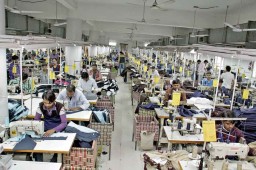
Most of the sports and leisure activities are enjoyed in a T-shirt and an equally casual lower, requiring nothing more than some protective accessories to go along. Fortunately for India, horse riding is played with proper apparels and protective gears, thus spinning off a considerable market both for equestrian apparels that are specifically engineered for the comfort and ease of movement of the rider and accessories required for protection of the body. Superhouse is amongst the frontrunners in producing breeches, and has a dedicated unit in Noida, housing 500 machines, producing 6,00,000 pieces per annum, catering to wholesalers and retailers in Germany, Denmark, UK, Holland and USA.
Out of the two style statements, western riders mainly wear jeans while the English riding is done wearing breeches. However, connoisseurs of both riding forms are unanimous that breeches are the ideal bottomwear in terms of utility and comfort. While riding, the inseam of jeans can ruin a saddle as it rubs against it, along with the chaffing on the riders skin. That is why the pattern of a breech is so designed that there are minimum seams, which is the reason why good quality breeches are made with no seam under the leg and thigh. Particularly for men, the 4-way crotch seam used in most jeans is particularly uncomfortable, while high quality breeches have a gusseted crotch where an extra diamond shaped bit of fabric is added into the crotch of the pant, making the crotch area a little wider.

Even though Kanpur is the major leather hub for both Superhouse and JPC, the major players in breeches, choose to establish themselves in Delhi-NCR. “Breeches are mostly formal or semi-formal attire in which the comfort of the customer is utmost priority, following strict standards in fabric and fit. The mid and top level management in Delhi-NCR is the right set of people who understand garment construction very well. The buyers too prefer suppliers from this region,” says Mukhtarul Amin, the Chairman of Superhouse Group, who has a huge leather manufacturing empire in Kanpur.
Mohd. Faiz, Director – Textile Division, Superhouse Group, claims that an efficient sourcing and sampling department is Superhouse’s greatest strength. “We have a very fast turnaround time in sampling with a lead time of just 60 days, and vertical integration has helped us improve it even more,” he adds. The company is also producing some ingenious products like protective jacket for riding, bullet proof jackets and workwear. All products in this ISO 9001-2000 company have acquired the necessary ASI, SATRA certifications, along with CEN 345 & DIN 4843.
[bleft]Manufacturers broadly use the term breeches also for jodhpurs and riding tights. Although breeches and jodhpurs have the same construction, breeches are riding trousers that only go three-quarters of the way down your leg. They are designed to be worn with long boots to make them more comfortable to ride in and make them easier to get on and off. On the other hand, jodhpurs are longer, go down to your ankle and are most often accompanied by straps or elastic at the bottom to go around the arch of the foot to keep the pant legs down while riding, and are therefore mostly worn by kids. Riding tights are of the same length as jodhpurs but are usually made of low-quality knit material.[/bleft]
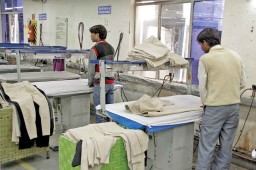
Since the product quantity is usually small, the cutting, although assisted by CAD, is mostly manual. The cutting room also has a welt pocket making automat from Duerkopp Adler, and the bundles including the welt pockets are sent to the sewing lines using chainstitch sewing machines majorly due to their increased flexibility compared to lockstitch seams, which are only restricted to waistband preparation and attachment. Also used are overlock machines for serging and flatlock machines for attaching suede or leather patches as per the design element. Out of the 13 sewing lines, few are dedicated for fulfilling the need of the very small quantity requirements of the buyers. “The product is very standardized, with not much difference in style. Therefore, a very advanced level of production planning is not required,” explains Yashpal Malhotra, General Manager, Superhouse. Decorative zigzag stitching through a Golden Wheel feed-off the arm machine is majorly used on the side seam, mostly to hide the edges appliqué works is done, sometimes even while joining the seams.
The knee is one particular area which requires extra flexibility while riding has to have loose fit which may cause the fabric around the area to be worn out and therefore breeches are often sewn with knee pads made of leather. Sewing the elastic
waist band and fly are the most crucial operations.
Every line has two QAs who report to a quality head on the floor. “The crucial reason for fewer rejections is that we have operators working with us for more than 10 years and since they are doing the same job for many years they have built a product expertise. They have stuck with us as we could give them 12 month work,” says Yashpal.
In spite of being a veteran in its segment assisted by a strong infrastructure, Superhouse has only recently made efforts for utilizing systems or management processes to their full advantage. While seasoned players like JPC are working at 140% efficiency, closely assisted by technological systems like the Switchtrack material handling system, Superhouse is fast catching up. The recent focus of the company is to work on improving its productivity by the use of automats and involving consultants. “We are already in talks with a consultant from Taiwan who has promised us an improvement of over 20% in our productivity. We realize that the best way to increase our profits is by increasing our efficiency and minimizing wastages,” continues Amin.
Faiz concludes saying, “We do recognize that to grow further we would have to improve our efficiencies and reduce our rejections, with the help of technology or consultants. For the same, we are on the lookout for consultants who can understand the nuances of our products.”