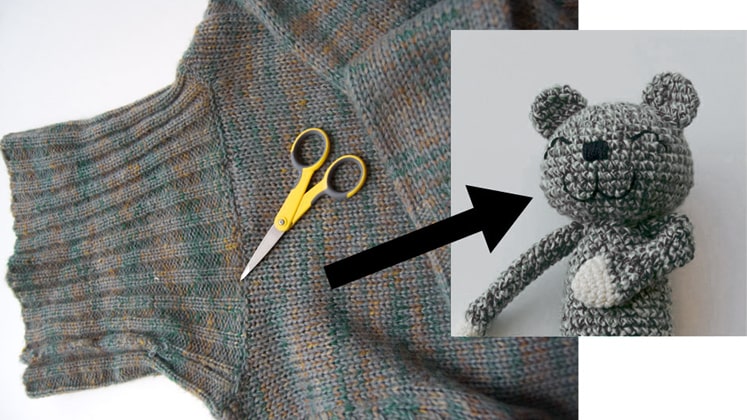
As the business of fashion is getting more sensitive towards sustainable clothing, the demand for recycled yarns is escalating. Numerous conventional yarn manufacturers have started making yarns out of waste products like PET bottles and ‘textile-to-textile’ waste such as used fabrics, garments and home furnishings. Many products such as clothing, soft toys, bed linen, towels, gloves and rugs, to mention a few are being manufactured with such yarns. Apparel Online talked to a few recycled yarn manufacturers to understand what kind of recycled yarns they are producing and how this market is moving…

Companies like Pratibha Syntex, KG Fabriks, Armstrong Spinning Mills, Polygenta Technologies Ltd. and Pashupati Polytex which are earnestly working towards sustainable production are actively involved in manufacturing recycled yarns and claim that the market is on the upsurge. “The market is steadily picking up with keen interest shown largely by the international market. Now we are also seeing some movement in the domestic demand asking for recycled yarns. So far recycled yarn was considered in India only if it was more competitive, but now other factors also translate into demand,” points out Shreyaskar Chaudhary, Managing Director, Pratibha Syntex who strongly feels that it is required to define the product application before using the material.
Earlier, the norms for importing second-hand garments were not so stringent; however now each consignment of used clothing imported by any unit shall be accompanied with a certificate from the exporter/agency in which it was generated regarding disinfection and fumigation of the containers from an agency licensed in the state of origin of worn clothing with import documents.
It is not easy to work with recycled yarns as greater manual intervention is required and quality testing of each incoming lot has to be done. “At Pratibha, we use recycled PET bottle fibre and fabric cut waste to produce recycled yarns,” adds Shreyaskar. Claiming to be a zero waste company, Coimbatore-based KG Fabriks converts its denim waste into recycled yarns and then manufactures industrial fabrics or products such as industrial gloves, socks, blankets, tarpaulin, etc. “When 100 kg of cotton comes to my factory, 100 kg is used, nothing is treated as waste,” shares Srihari Balakrishnan, President, KG Fabriks.
Textile-to-textile recycling a traditional practice…
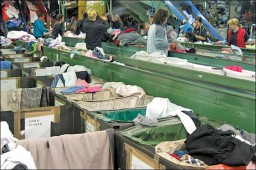
Textile-to-textile recycling is an old practice in India, and Panipat is considered to be Asia’s biggest textile recycling hub. Second-hand garments get recycled into yarns and then fabrics. Bathmats that are produced from recycled cotton yarns is an over US $ 321.54 million (Rs. 2,000 crore) industry in the hub and as per the ‘All India Woollen and Shoddy Mills Association’, the business of using recycled acrylic and woollen threads for blanket manufacturing alone generates an annual revenue of US $ 160.77 million (Rs. 1,000 crore) in Panipat.

The economics of recycling is compelling; cost of the cotton yarn that is needed to support Panipat’s US $ 1,929.26 million (Rs. 12,000 crore) furnishings business (of which US $ 964.63 million (Rs. 6,000 crore) is export turnover) can be halved by using recycled yarns. According to Handloom Exports Manufacturers’ Association (HEMA), Panipat, though the foreign customers prefer fresh cotton but majority of the manufacturers prefer to use more of recycled yarns to keep the prices low. “More than 30 units produce 500 tonnes of recycled yarns a day out of cotton pants and T-shirts and then that yarn is reused to make mats,” shares Ramesh Verma, President, HEMA, according to whom recycled yarns are production-friendly besides being cost-effective.
As in any business, the biggest challenge in textile-to-textile recycling is the raw materials which are procured from the domestic market as well as imported, particularly for those companies which are catering to international buyers as contamination is the major concern. Earlier, the norms for importing second-hand garments were not so stringent; however, the Special Economic Zone (SEZ) Division, Department of Commerce, Ministry of Commerce & Industry has prescribed a new policy to be followed by the units in SEZs carrying on reprocessing/recycling of used clothing. Each consignment of used clothing imported by any unit shall be accompanied with a certificate from the exporter/agency in which it was generated regarding disinfection and fumigation of the containers from an agency licensed in the state of origin of worn clothing with import documents. In case of misdeclaration regarding the materials being free from any toxic/hazardous substances by the importer, action would be taken as per the Foreign Trade (Development & Regulation) Act, 1992.

Recycled PET bottle yarns for high-end and high-performance applications…
Hundreds of billions of plastic bottles go as waste every year after they have served their purpose, however the innovation of recycled yarns out of PET bottles has become a ‘Game Changer’. Demand for high-quality, 100% recycled yarns made from 100% post-consumer PET waste remains very high and the market will continue to grow and comfortably accommodate more players. The awareness about recycling is spreading all over the world, and with increasing demand, the raw material prices are expected to remain on the higher side especially for those recycled products that offer very high quality of dyeing and overall performance consistency. Capability to supply micro deniers for apparels’ end-use matters a lot for supplying to premium customers.
Nashik (Maharashtra) based Polygenta Technologies Ltd. is experiencing growing demand for recycled polyester yarns in terms of both volume and application. “Interestingly, customers are now increasingly demanding 100% recycled yarns made from 100% post-consumer PET waste rather than just industrial factory waste or a blend of recycled inputs,” states Makrand Kulkarni, General Manager-Sales & Marketing, who attributes the ability to show transparency along with the entire manufacturing chain including sourcing and production as the reason for giving comfort to customers and consumers that certain recycled yarns are truly sustainable and there has been no ‘green-washing’. Whereas, historically the demand was strong from the Western retail-end markets; Polygenta is now also experiencing large interest from leading Indian brands for the domestic market at a comparable pricing to international demand.

Kashipur (Uttrakhand) based Pashupati Polytex, is an established name in recycled synthetic fibre industry in India. Being a medium-sized manufacturing organization, it produces high-end ‘recycled Polyester Staple Fibres (PSF)’ from PET recycling which is also called ‘Green Fibre’. With an installed production capacity of 2,000 tonnes per month, the company produces recycled polyester staple fibres in various deniers (1.4 to 15 dn.) in various cut lengths, both silicon and non-silicon grades, as per buyers’ requirements. “Within a very short span of time, we are now able to cater to the large requirements of our customers all over the world, at any scale. We have been regularly supplying our fibres to various leading textile mills who are using the same for producing different types of yarns (100% polyester yarn, cotton blended yarn, polyester-acrylic blended yarn, polyester viscose blended yarn, etc.) as well as cushioning products (carpets, sofa, dolls, toys, mattreses, furniture, toys, dolls, etc.). Our fibres are also used widely in geo-applications,” says V. P. Goenka, CMD, Pashupati Polytex.
Challenges of PET bottle yarns…
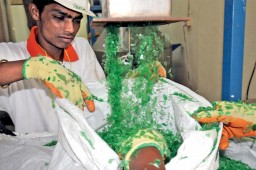
As per the industry experts, in the long run, the challenge shall be to keep the prices of recycled yarns comparable to virgin yarns. The brands shall start demanding circular loop recycling instead of today’s PET bottle to yarn recycling. The raw materials procurement is not that much of a challenge for the companies as it is done mainly within India. Polygenta is majorly sourcing raw materials from India; however, it is also importing some of the raw materials requirements. “Though there is a fairly well-established supply chain for supplying the bottles and flakes, still to procure raw materials with lesser contamination is always a challenge,” reasons Makrand, according to whom his company plans to double its production capacity over the next 24 months.
Historically, the spinning of recycled polyester filaments is always associated with many challenges like breakages, limitations on producing micro-denier yarns as well as limitations on providing dyeing guarantee for sensitive knitted products. “I feel the quality of the recycled PET bottle fibres should improve with better spinning technology. Added capacities should get balanced with increased demand. New markets, products and innovative blends will add to the overall demand,” avers Shreyaskar Chaudhary.
To overcome all the historical challenges, Polygenta’s patented chemical recycling technology helps it to produce highly uniform polymer after recycling. Today, Polygenta is able to supply even 0.6 DPF (denier per filament) micro-denier textured yarns like 100/144. The company’s yarns are mainly used for apparels and activewear segments. The long-term solution entails developing sustainable chemical recycling that is robust enough to process increasingly more complex recycled PET inputs with more intricate profiles and levels of contamination (like PET laminates, PET garment waste, etc.). Makrand believes that a properly scaled chemical recycling plant (albeit still relatively small in relation to virgin plants) can produce a technically comparable yarn to a virgin plant across a wide range of yarn specifications.