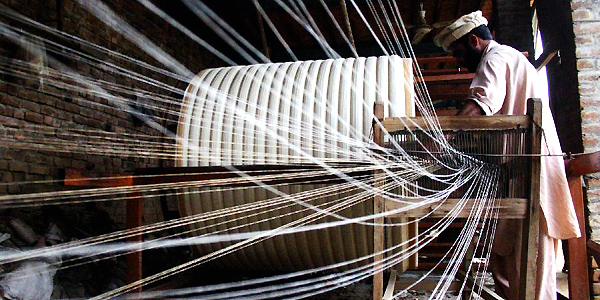
The textile industry in Pakistan is having a difficult sail owing to issues like power shortage, and its regional competitors including Indonesia, Vietnam, Sri Lanka, Bangladesh, China and India aren’t making it easier for it.
In a recently released comparison chart, All Pakistan Textile Mills Association (APTMA) has revealed that the textile mills in the regionally competing countries enjoy energy supply throughout the day every day of the week, unlike Pakistan, where the mills, particularly in the province of Punjab, continue to face a crisis. The Association has further claimed that over 100 textile mills in Punjab have stalled production due to energy shortage, among other problems.
As per the comparison chart, textile mills in Pakistan has to pay in accordance to a very steep energy tariff of 14.25 Cents/KWh. In contrast, the tariff rates in Indonesia, Vietnam, Sri Lanka, Bangladesh, China and India are 9 Cents/KWh, 7 Cents/KWh, 9 Cents/KWh, 7.3 Cents/KWh, 8.5 Cents/KWh and 9 Cents/KWh respectively. Even the bar on minimum wage rate has not helped its situation. The minimum monthly wage of textile mill workers in Pakistan is US $125, against US $74 in Indonesia, US $90 in Vietnam, US $66 in Sri Lanka, US $68 in Bangladesh, and US $90 in India. Other factors contributing to the derailment of Pakistan’s textile sector, as cited in the chart, were high duties and taxes and surcharges on exports.
Also Read – Pakistan textile industry needs innovation & value-addition
The Association data has also divulged that there is a lack of investment promotion of scheme/park across the region in Pakistan, an area where all competing countries are investing. APTMA also claimed that Pakistan is showing no interest in the export promotion incentives/schemes.
However, the data maintains that the textile industry in Pakistan enjoys equal treatment on the matrix of interest/policy rate. It says that the interest/policy rate for the textile industry in Pakistan is 6 per cent against 7.5 per cent in Indonesia, 6.5 per cent in Vietnam, 6 per cent in Sri Lanka, 5 per cent in Bangladesh, 4.6 per cent in China and 6.75 per cent in India.
APTMA’s statistics also show that Pakistan’s share in the world textile and clothing export market had slid to 1.6 per cent in 2014 from 2.23 per cent in 2005.