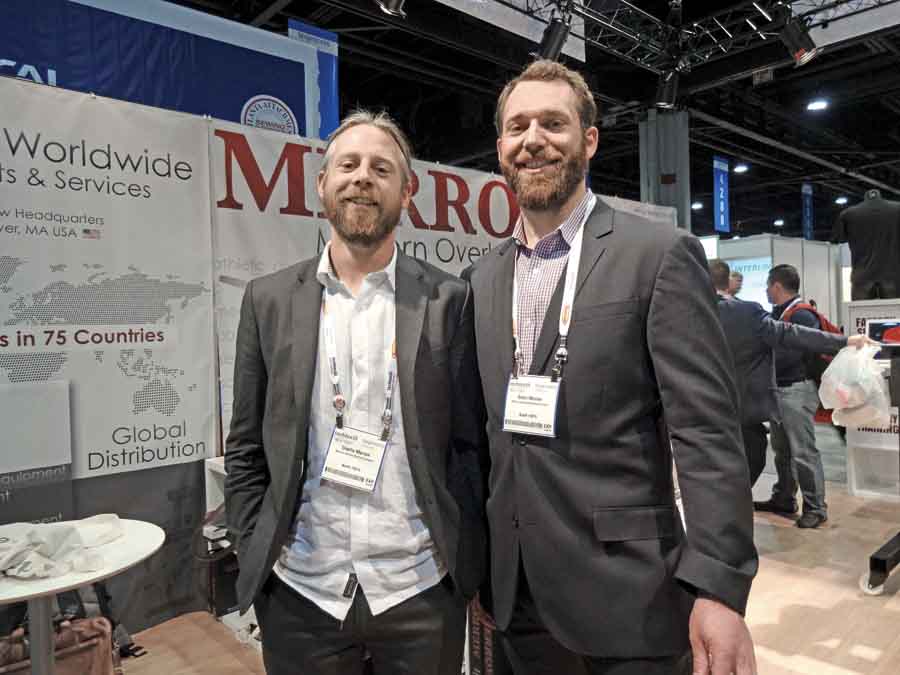
A man, into computers and programming with no real interest in the sewing industry in his youth, Charlie Merrow, CEO, Merrow Sewing Machine Company, got the opportunity to take control of the family business, ten years ago. The same was true for his younger brother, and interestingly what worked wonders for them was the fact that they brought an altogether outsiders perspective into their very old business. In the process they have succeeded in building a brand, a technology and a company that is trying to get people excited about not only the things they can do, but also about what the customers themselves can do with
those things.
“When I went to my first trade show, soon after I joined the business, I asked a group of my peers when was the last time something new and exciting happened in the sewing machine industry?” recalls Charlie, who clearly remembers the bunch of people scratching their chins, unable to think of anything worthwhile in the last 20 years. That very moment marked the beginning of the redefined Merrow we know today, which is run by brothers Owen and Charlie Merrow, the great-grandnephews of Joseph M. Merrow, who first started the company back in 1838.
“Taking over Merrow, I looked at the things that I thought I could do more with the company. What I saw was a brand that was well enough known around the world, but it surely needed an identity. Back in the middle of the 1900’s the company did have an identity, as we invented the overlock stitch, but then by the time I looked at it, we were just a small brand in a sea of other brands which came into the market over time from Asian and Japanese companies. So we needed a change,” shared Charlie.
Building a new identity and a new structure for the company became the focus. “Ever since 2004, we have worked really hard to try and create something exciting and this is what really formed the genesis of the much popular active seam, by the company that could inspire the customers and also get them excited about sewn products in a meaningful way. To achieve our goal we asked help from our old associate, an 85 year old man, and together we played and experimented with many different seams and finally could achieve what we had set out to do,” shares Charlie.
What stood Merrow apart was also their new strategy that took active seam directly to the brands like Nike, Under Armour and Adidas, getting rid of an entire layer of industry and companies in-between them and their clients. “To be successful in India we have to replicate the same strategy. Therefore working with HCA and IIGM makes us work directly with the brands as they provide us with the technical detail of when and who brings their production to India. So we are no longer as dependent on the agent in that area and it becomes our responsibility as well to sell the sewing machine,” says Charlie.
Journey into the future
Charlie shares the journey of creating the active seam. “Today we have a team of 8 people for R&D who are sewing engineers and industrial designers. By involving people who were the developers of the sewing industry, we are able to pick their minds and rework to created innovations, instead of just improving upon existing technology,” shares Charlie. In the pipeline is the work the company is planning to do with bonded seams – the combination of using a sewing solution with the bonded solution to be able to create a very interesting technical garment. While the bonding does not stretch as much as a sewn seam, it has the advantage of being strong, and therefore the company has been experimenting with bonded solutions coupled with active seams.
“As we look at the future of sewn products we are going to find more of this fusion of bonding and sewing. Where the sewing will be complimenting the bonding, and not fighting it. So instead of making an all bonded product necessarily, we will be finding the best technical combinations of both,” says Charlie.
While last year it was all about introducing the active seam, this year will be more about exploring the active seam further. Explaining that the active seam is a stitch that should disappear on ones skin, Charlie claims that the best type of garment for the stitch to disappear can only be a really delicate one, for products like ‘lingerie’. Next the company plans to go in an entirely different direction, targeting the utility pack for the active seam which allows it to be tough on the outside and soft in the inside. One product that is bound to see a lot of changes is the second layer in the fleece garments and in the soft shell. “Till now there is no fancy stitching in a soft shell and fleece, when there is no real reason not to. So we burry a stitch into both of these, in order to use the decorative impact of an active seam and also create a very durable outer exposed seam, and on the inside we use the delicate thread. This way we can fundamentally change the aesthetic of the second layer by adding a visible seam that doesn’t distract the design of the garment but adds to the aesthetic of it,” concludes Charlie.