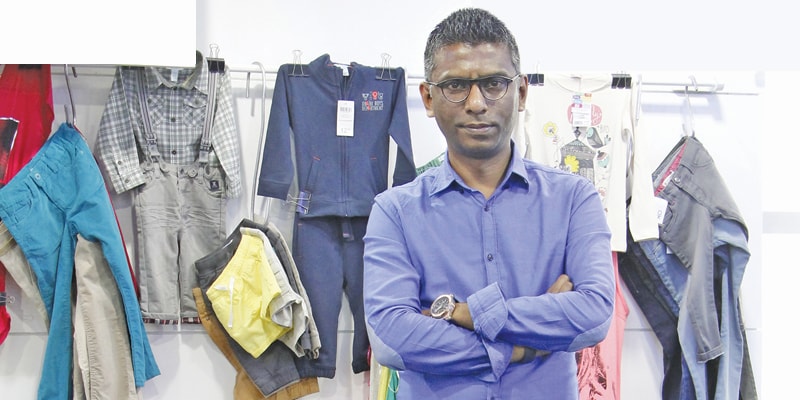
Joining the company in 2006 as a merchandiser, Mohammad Nadim Haider Rouf rose up to the ranks quickly by contributing significantly in increasing the company’s (Bangladesh arm) turnover, which according to him is set to touch US $ 65 million soon. Today, Haider owns 50 per cent stake in Market Fit Dhaka and is its Managing Director.
“In 2010, Market Fit was sourcing everything basic. One of the measures I undertook was to introduce an in-house lab to help us do our own fabric testing, followed by introducing garment technician/pattern maker. Our sample selection has gone from strength to strength; from approval rate of 2 out of 20, it has improved to 10 out of 20 now. Moreover, we don’t source from a factory unless it is fully compliant one. We have our own code of conduct and send samples to the buyers at our own cost,” elucidates Haider, while mentioning that he sends his team every day to supervise whether factories are working according to the company’s directives or not.
Based out of Hong Kong, Market Fit Group is one of the pioneers of global apparel sourcing which began its operations as a family-owned business in 1974 and has steadily expanded across the world. It has marketing offices in the UK, France and Spain, besides sourcing entities in India, Pakistan, Vietnam, Shanghai, Cambodia, Istanbul and Bangladesh (Market Fit Dhaka). Despite the group’s principal domain being leather earlier, over the years it has shifted focus on apparels, dealing in diverse categories – womenswear, menswear, kidswear, sportswear, maternitywear, uniforms, etc. Catering to European markets alone, FOBs of Market Fit’s offerings are: for woven US $ 5-5.50, Tee shirts US $ 2, polos US $ 3-3.50, and for sweaters US $ 5-5.50.
“Bangladesh industry is still in the middle of development. We have a long way to go. Everything has a lifecycle and we still have 15-20 years to reach the pinnacle of that cycle,” reckons Haider, whose target now is to increase the turnover to US $ 100 million per year by the end of 2018. Haider, who is somewhat unsatisfied with the product design and development scenario in the Bangladesh apparel industry, has no immediate plans to explore new markets except for UK.
Underlining the challenges faced, Haider expressed concern over rising labour wages, lack of expertise in design and development and scarce availability of fabrics locally. “In fact, 70 per cent of the fabrics are still coming in from countries like China, Pakistan and India,” stated Haider, who attributed his success to hard work, honesty, respect and accountability, and dedicated the same to his mother.