While the growth of business in the Bangladesh garment export industry continues to pose challenges for Indian apparel exporters, the same growth is a major opportunity for Indian textile mills exporting yarn as well as fabrics to the country. Indian textile giants catering to this market from years, have witnessed huge demand and are expanding their capacities to grab a share in the growth of this market targeted to be worth US $ 50 billion by 2021 (this year export is expected to be more than US $ 27 billion). Encouraging the demand from Bangladesh is evolving and moving towards value-added yarns rather than basics, which is in favour of Indian companies as fancy or value-added yarns is their strength.
Indian textile giants like Arvind and Vardhman are already established names in the Bangladesh industry with growing operations for greater share. In fact, Arvind had even declared its intention to set-up a manufacturing unit in Bangladesh in 2010, but opted out a year later, citing issues of infrastructure, mainly shortage of gas supply. This however did not deter them from continuously increasing their volumes of exports and today 60 per cent of Arvind Mill’s production capacity in denim is exported to Bangladesh every month, despite growth capacities and capabilities in the segment. For Vardhman Textiles, which set up its own office in the country six years ago to offer solid and yarn dyed shirting fabrics along with stretch fabrics, year-on-year growth of 15-20% is an expected norm.
In yarns, the lack of spinning mills to feed the huge requirement for the knitting and weaving industry has created opportunities for Indian spinning mills, and recently Mumbai-based Damodar Industries Limited, proudly announced that it would be the first-ever Indian spinning mill to start production in Bangladesh. The mill is slated to be set up in Sylhet and will initially start functioning with 50,000 spindles, expected to be operational by the end of this year. Currently, producing 100 tonnes of yarns everyday, the company is operating 1,00,000 spindles in India. Another unit, of 25,000 spindles, has recently been added to the capacities. The company targets to export 2,000 tonnes of yarn to Bangladesh each year for the next three years, increasing it from its current annual export level of 500 tonnes.
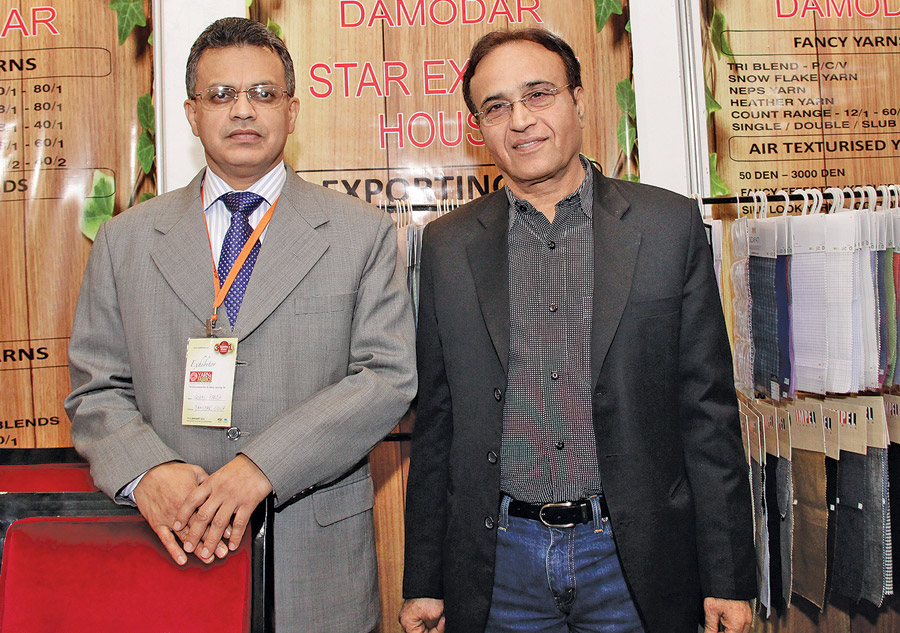
The company is one of the largest fancy yarn makers in India, and strength of the company is injection yarns, nap yarns and slub yarns among others. “We are getting repeat orders, and the customers seem quite content with the product variety and quality we are providing. We have been very consistent in product development and every quarter, we come up with a new range of yarns. This is further increasing our customer base, which makes us even more confident that we’ll be able to cope up with increasing demand only if we put up a spinning mill,” informed S C Tandon, CEO, Knits Division, Damodar Industries Limited who was recently in Dhaka to attend an industry exhibition. He further added that the company has been successful in Bangladesh from the last 4-5 years and is looking at the country for much thrust in business, and while previously it was focused on only yarn, but now it would be looking at options in fabrics as well. Already supplying fabric to companies like Madura, Future Fashion and Raymond, it is now trying to export its fabric into Bangladesh also. The company feels that the growth potential is better if it positions itself as a composite solution to the textile buyers.
With major investments happening in spinning, Bangladesh is now more-or-less self-sufficient in basic yarns and wants fancy yarns from India. The export of yarn from India to Bangladesh has also witnessed the change, as now value-added and fancy yarns are dominating the basket. With more and more companies in Bangladesh moving towards backward integration and their first priority being production of basic yarns, requirement of commodity yarn has shrunk considerably. According to industry experts, 4 lakh spindles are expected to be installed in Bangladesh this year with 8-9 companies going for backward integration, adding spindles to their operations. Though the Bangladeshi companies are selling basic yarns at a price that’s a bit higher than what their Indian counterparts are offering, they have an edge over the latter for being locally available as well as being able to deliver faster than the latter, apart from getting Government support in the form of incentives.
Not only the textile giants, but even small- and medium-level yarn agents of India are also aggressively working in Bangladesh market and adding clients by the day. It is also a fact that Bangladesh market is mostly working through agents and only a few Indian textile companies are having offices in Bangladesh.
In the meanwhile, Bangladesh is also moving from basic garments to value-added ones, focusing more on product development which attracts them towards fancy yarns. Garg Acrylics, Ludhiana claims a growth of 50 per cent in the past 2 years, and expects a growth of 50 to 60 per cent in the coming years because of its value offerings. According to Rakesh Dhir, VP (Marketing), Garg Acrylics, “The current demand in Bangladesh is mainly for value-added yarns; so we are now focusing only on value-added yarns like slub, injected slub, mélange and such similar yarns for this market. We have a complete range of these value-added yarns.”
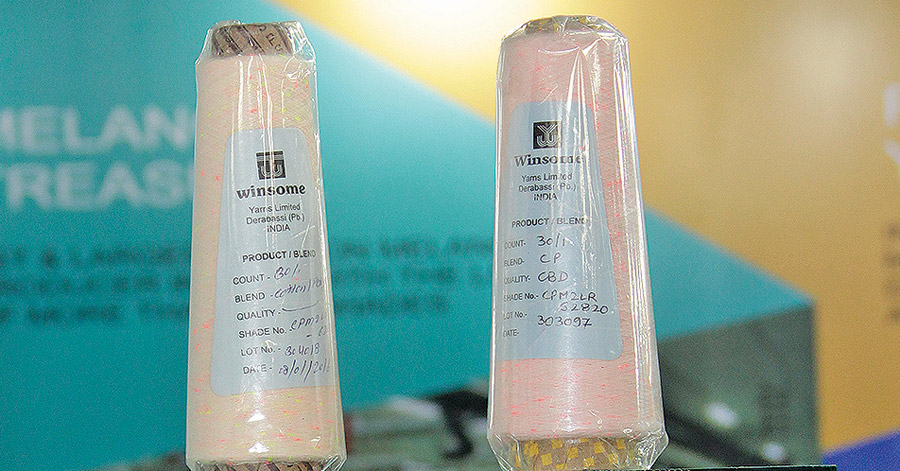
Winsome Yarns Ltd., Chandigarh, which has been in this market from more than two decades now, claims to have introduced mélange yarn in Bangladesh. “Bangladesh is the only replacement of China in terms of volumes as the demand here is huge,” says Rachin Lamba, AGM (Export), Winsome Yarns Ltd. He further adds, “This shift has been taking place for the past three to four years. But now, more and more companies are asking for fancy yarns. They want to learn more about it, and we, on our part, discuss with them and guide them suitably.” Winsome Yarns Ltd. has a lot of variety in mélange yarns.
On an average, order size of value-added yarns is not more than 5-10 tonnes per order, and since no containers are required for an order less than 23 tonnes, therefore the companies prefer to ship by road and normal delivery time is 10 days. But for bigger orders in container loads, shipments by conventional methods are preferred. Indian companies working in Bangladesh predict that at least for the next 2 years Indian companies that are ahead in product development for fancy or value-added yarns, need not to worry that Bangladesh-based mills can give any strong competition on fancy yarn front, no doubt this augurs well for growth potential of companies looking to venture into the market.