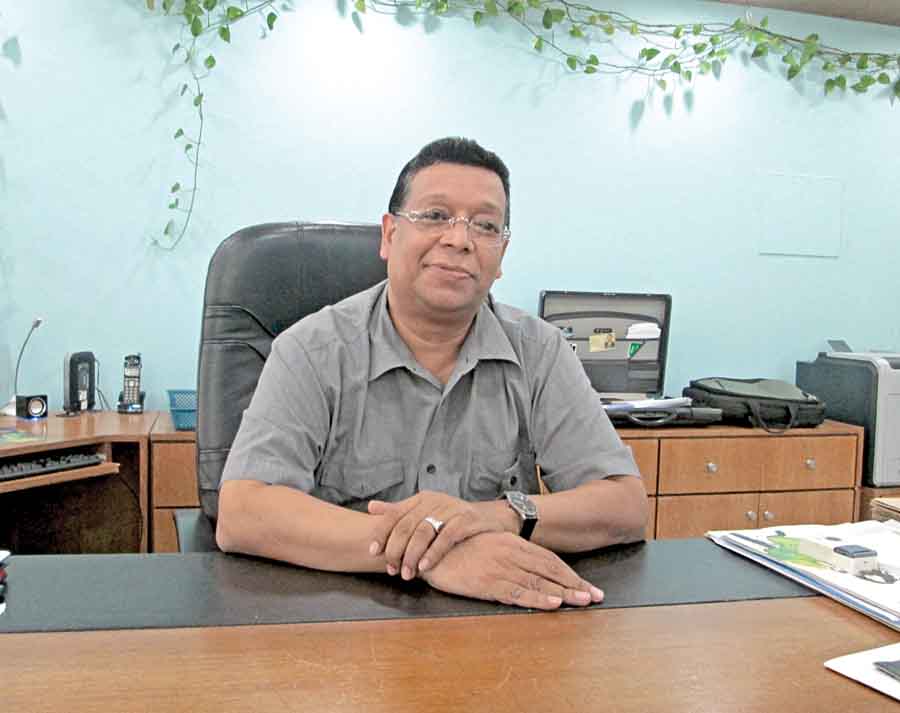
 It came as a big surprise that Grameen Knitwear is part of the prestigious Grameen Bank project under the leadership of Nobel Laureate Prof. Muhammad Yunus, which has moved beyond micro finance to help the poor earn a respectable and dignified livelihood. Team Apparel Online in conversation with Md. Ashraful Hassan, Managing Director of 5 companies that come under the aegis of Grameen Bank including Grameen Knitwear Ltd., Grameen Telecom, Grameen Distribution Ltd., Grameen Fabrics and Fashions Ltd. and Grameen Telecom Trust, talks about the concept behind Grameen and the company’s most ambitious green project – Grameen Fabrics and Fashions Ltd.
 The origin of Grameen Bank can be traced back to 1976 when Prof. Muhammad Yunus, a Fulbright Scholar at Vanderbilt University and Professor at University of Chittagong, launched a research project to examine the possibility of designing a credit delivery system to provide banking services for the rural poor. The organization and its founder, Muhammad Yunus, were jointly awarded the Nobel Peace Prize in 2006; while the organization’s Low-cost Housing Program won a World Habitat Award in 1998. For years, the example of microcredit in Bangladesh has been touted as a model of how the rural poor can lift themselves out of poverty and the Grameen Bank project has spawned over 50 other firms in sectors that stretch from textiles to mobile phones.
 Remembering his initial years in the group, Hassan speaks highly of Prof. Yunus. “Those who have been with Prof. Yunus from the start of this organization are very dedicated to the concept of Grameen,” asserts Hassan. Hassan, academically an Engineer himself, has diversified knowledge in textile sector, in particular composite knitwear. He started his professional career with Grameen Bank and during his 15 years tenure with the Bank has contributed in many ways to its development.
 A profit-generating unit owned by Grameen Fund and Grameen Kalyan, both ‘not for-profit’ companies, Grameen Knitwear Limited was established in 1997 with the aim to maximize the welfare of the poor instead of maximising profits unlike any other profit earning enterprise. Both these units work with the sole purpose to support and implement sustainable programs aimed at providing better livelihood to people especially in rural areas in order to minimize inequality and disparity. “All the profit earned by Grameen Knitwear is owned by another ‘not for profit’ company. Since these companies cannot accept money from the donor agencies or any other agency, therefore they have created certain companies like Grameen Knitwear which are only for making money to help them work towards healthcare, mothercare and childcare for the rural population,” informs Hassan.
[bleft]The Grameen Group owns subsidiaries in diverse areas viz. Banking Services, Communications, IT Solutions, Power, Tele Communications, Cyber Services, Rural Mass Education, and Business Promotion Services.
As of July 2013, the Grameen Bank has 8.4 million borrowers, 96 per cent of who are women, and till date has lent around US $ 14 million since it began operations in 1976 with a loan recovery rate of 97 per cent.
[/bleft]
A 100 per cent export-oriented company, Grameen Knitwear, supplies majorly to Europe and believes in quality products and timely delivery. It manufactures high quality of knit fabrics and garments for children, men and women. The fabrics and garments are made of yarn dyed 100 per cent cotton, TC, CVC, Polyester with Lycra, etc. of various counts. With a turnover of US $ 22 million from 36 circular knitting machines and 24 lines of sewing machines, Grameen Knitwear caters to brands such as Laura Stein, Marcel Clair, Medico, Umbro, Slazenger, Pierre Cardin, Georgio Armani and many others. Though it is only a profit-generating unit for the Grameen Bank, yet “we are doing all our business in an ethical manner. Our ultimate goal is development of the society so there is no harm in having a business module, where certain units are only for generating money to support the society,” avers Hassan.
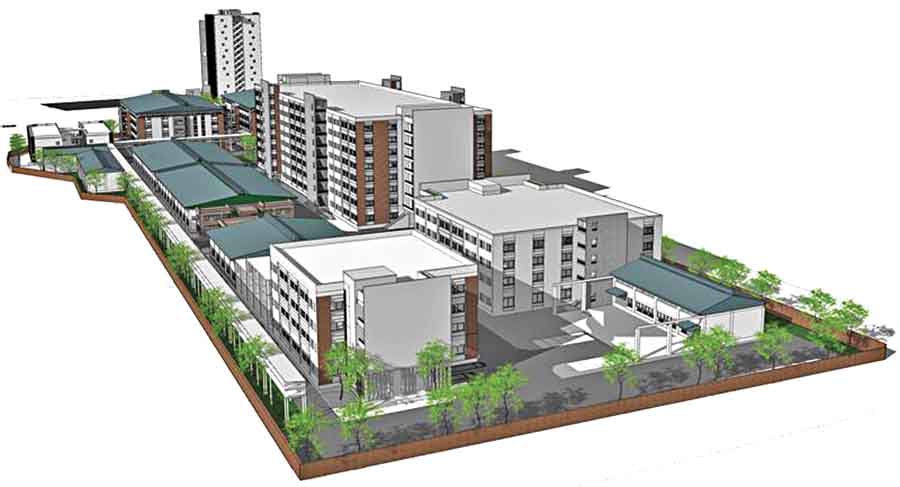
Always thinking about people welfare, the Grameen Group is going ahead with a major expansion plan by creating Grameen Fabrics and Fashion Limited (GFFL), which is green from inception. The US $ 60 million Fabrics and Fashions setup comprises of two basic units, one to produce goods to encounter specific social problems and its solutions such as manufacturing long lasting insecticide impregnated nets under the brand name Interceptor® that can prevent malaria and another to produce goods for export in order to generate employment and earn foreign exchange. “Earlier we were planning to have a joint venture with Adidas for shoe manufacturing but it could not be materialized due to our limited capacity that’s why we are setting up the Fabrics and Fashion Division,” maintains Hassan. Also included in GFFL is a composite knitwear factory with production capacity of 20 tonnes fabric and 60,000 pieces of garments per day along with all accessories right from yarn to finished garments. “I am very much for the idea of green fashion through green production that is why Fabrics and Fashion is setup to be more social and environmentally sustainable for the people,” adds Hassan.
[bleft]The objectives of Grameen Bank
- Extend banking facilities to the rural poor
- Eliminateexploitation of the poor by moneylenders
- Create opportunities for self-employment for the unemployed in rural Bangladesh
- Bring rural women within the fold of an organizational format which they can understand and manage by themselves.
- Reverse the age-old vicious circle of “low income, low saving and low investment,” into a virtuous circle of “more investment, more income, and more savings.”[/bleft]
Since inception, the GFFL factory is going to incorporate green sustainable measures such as reducing water and energy consumption through eco-friendly innovations in collaboration with Dr. Wolfran Engel, President and CEO of the Green Project W.S.T Limited. The project aims to ensure optimum use of energy and resources from fibre to readymade garments in production process and also reduce load on combustion of fuels used for generating heat energy, steam and electricity. “This can be possible through using energy efficient products, recycling water and proper maintenance of utility service line,” reiterates Hassan.
Each stage of the entire textile chain has been closely examined to understand where all the energy and water can be saved. At the yarn stage, the company is using quality yarn to avoid bio-polishing or enzyme wash creating healthy working conditions for the workers by reducing 10-15 per cent consumption of dyes and chemicals and water consumption. Also, in the processing stage, majorly high exhaustion dyes are used instead of low exhaustion dyes. “This is the first time in history that in the textile sector a company is getting the Clean Development Mechanism (CDM) benefits from the Government of Japan. Though it is not a huge amount of money but still it is a recognition that we are incorporating green in our units,” says Hassan. Currently, the Green Project WST is also being implemented in Grameen Knitwear and two orders of cotton and CVC are already in bulk production.
Recently, the Bangladesh Government has decided to bring the Nobel prize winning Grameen Bank under its jurisdiction to exert influence over the organization. This decision comes despite international hue and cry as many global leaders like Richard Branson, Paul Volcker, etc. had earlier urged Bangladeshi Prime Minister Sheikh Hasina Wajed not to seize control of the bank. The seizure of Grameen by the Government is seen by many as a tragedy, not only for Bangladesh, as it sends out a wrong message to every other developing country who is following this proven model to provide loans to its borrowers. Though Grameen has done tremendous amount of work for the rural population especially women, but still a lot more needs to be done. It remains to be seen what changes are brought about by the Government for an organisation that was earlier owned by the people… for the people.