The transformation of a small, obsolete and uncompetitive garment industry into a strong export industry may seem a madman’s dream to most people, but not to sector observers who in the past witnessed the steep rise of the garment industry in countries like Bangladesh and Cambodia. Until recently, the Ethiopian Government and a couple of pioneering Turkish textile companies stood nearly alone predicting that Ethiopia would become the next big garment sourcing hub. However, 2015 was the year of Ethiopia’s take-off.
In 2014 and 2015, the early birds of Foreign Direct Investment and garment sourcing in Ethiopia were joined by a group of foreign investors (mainly from Turkey, India and China) and of Western buyers, which has upscaled the pace of developments, prompting the Government and the textile and garment sector in Ethiopia to set very ambitious targets to continue expanding rapidly.
In 2014-15, Ethiopian exports of yarns, grey fabric, garments and traditional handloom products together totalled a modest export amount of just over US $ 65 million. The target for 2020 is to export US $ 1 billion of textiles and garments. The sector, which now represents 6 per cent of the country’s total export value, wants to achieve a share of 22 per cent in 2020.
The Ethiopian Textile Industry Development Institute (ETIDI) was embarrassed when it had to announce that textile exports for the first six months of Ethiopian fiscal year 2015-16 were lagging behind the planned target. The target was to obtain US $ 60 million exports, while only US $ 41.1 million was achieved, meeting less than 70 per cent of the plan.
However, optimism continues to reign since companies such as H&M, Tesco, Gap, Belk, and Walmart, among others, are now sourcing textile products from Ethiopia. Europe is Ethiopia’s main export market for garments (with around 60 per cent of the total export). Half of Ethiopian textile and apparel companies are SMEs of 500-1,000 workers who are able to handle small-run orders for European mid-segmented fashion retailers. Sweden’s H&M was a sourcing pioneer in Ethiopia.
 Early birds
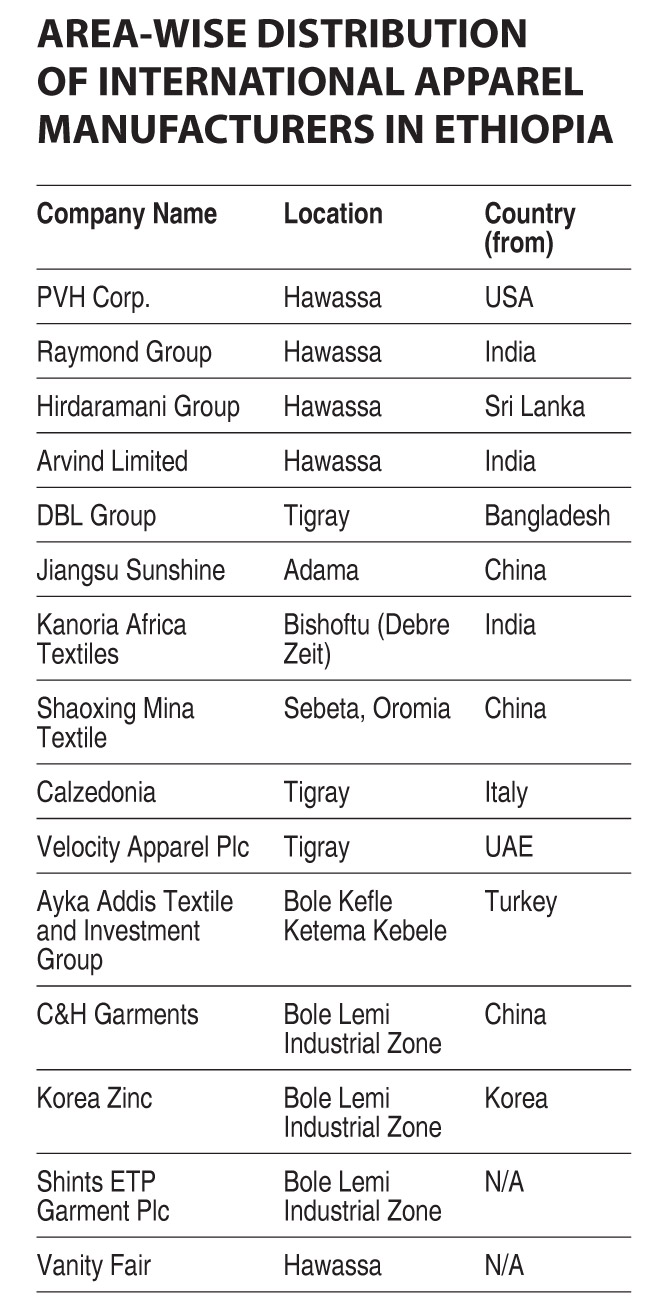
The vertically integrated Turkish textile companies Ayka Addis and Saygin Dima, both of which entered Ethiopia in 2008, are the two key FDI pioneers in the sector. Ayka Addis, currently the biggest textile group in Ethiopia, is eagerly working on a plan to relocate some 20 Turkish textile and garment companies to Ethiopia. Saygin Dima seems bullish about its future in Ethiopia. The management thinks that within two years a turnover of US $ 150 million per annum is within reach. Saygin Dima wants to extend its activities towards garment manufacturing which will increase current employment of 1,200 people to around 3,000 people.
Clothing retailers and brands from Europe and the US moved in slowly and cautiously. H&M started test runs in three Ethiopian factories in 2012, and then relied partially on the Swedish taxpayers to upgrade its Ethiopian suppliers via a partnership with Swedfund which reportedly injected US $ 8.6 million in ‘the development of a responsible textile industry in Ethiopia’. The American clothing group Phillips-Van Heusen (PVH), which owns brands such as Calvin Klein and Tommy Hilfiger, strategically helped in building an East African supply chain by bringing in some experienced Asian investors in Kenya and Ethiopia.
The place to be
In spite of some striking flaws in Ethiopia’s politics, economy and infrastructure, as far as the production of garments for the Western markets is concerned, there’s a feeling that the country has a great future. Many sourcing specialists who have explored the global opportunities agree that today Ethiopia is the place to be. The country is currently the No. 1 sourcing location, according to the apparel sourcing company Duty Free Sourcing Inc. Also the Indian entrepreneur Sidarth Sinha, the Founder and Owner of Vogue and Velocity Group, who is in process to create a ‘garment township’ in Ethiopia, believes that no other country can presently beat Ethiopia.
The principal arguments to move into Ethiopia are well known: the abundant availability (at least theoretically) of cotton and hydro-energy, the free entrance of Ethiopian textile products to the US-market under AGOA and to the EU-market under the Everything But Arms system, the strong engagement of the Ethiopian Government as formulated in the Second Growth and Transformation Plan (2015-16 to 2019-20) and demonstrated by the establishment of the Ethiopian Textile Industry Development Institute (ETIDI) and the industrial area Bole Lemi, both in Addis Ababa, and of course the very competitive labour cost.
The low Ethiopian labour cost (average monthly wages for operators reportedly vary from US $ 45 to 60/month) are, however, significantly offset by low labour productivity and high personnel rotation. The extension of AGOA for 10 years, in June 2015, was of course of crucial importance as well for foreign textile and garment manufacturing groups as for American buyers to bet on Ethiopia for the long-term.
Ethiopia is one of the few countries which is utilizing the duty-free and quota-free export benefits under AGOA to the fullest, and where 95 per cent of the garment imports are open to the ‘third country’ fabric rule of origin, which allows garment manufacturers to utilize raw materials from any origin for export purpose. In addition to this, preferential tariff rates have provided Ethiopia the freedom to export to the Common Market for Eastern and Southern Africa (COMESA) agreement, indicating that majority of ‘Made in Ethiopia’ products are eligible to enter into these markets which are quota- and duty-free.
Besides, availability of land on a leasehold basis of up to 99 years depending on the geographical region, type of investment and class of land, is also aiding the country’s growth in the apparel sector. In order to expedite foreign investments, regional Governments are putting efforts and are able to allocate land to investors within 60 days of receiving their applications.
Mostly Asian investments
In October 2015, the Indorama Group, the world’s largest integrated manufacturer of polyester, was said to be discussing with the Ethiopian Government the setting up of a polyester plant in the country. This rumour has not yet been confirmed. In March 2015, the Indian denim giant Arvind started manufacturing denim bottoms, 12,000 pcs/day in the textile industrial zone of Bole Lemi (near the airport of Addis Ababa). Exports were initially destined to the US, but at the end of 2015 negotiations were underway with potential European customers like H&M and Benetton. Besides, Arvind was said to be working on an integrated supply chain in Ethiopia, starting from cotton cultivation to spinning and weaving.
However, beating Arvind to the pole, Kanoria Africa Textiles, a subsidiary of the Indian group Kanoria Chemicals & Industries, on 24 October 2015 inaugurated a brand new denim fabric factory – the first in Ethiopia – with an annual capacity of 12 million metres in Bishoftu, 37 kms from Addis. The factory, started with less than 500 workers, has plans to extend activities to jeans manufacturing. Kanoria will ultimately employ some 2,000 people in Ethiopia. According to Ethiopian media, India’s Raymond Ltd., the world’s largest integrated manufacturer of worsted fabric, has concluded an agreement with the Ethiopian Investment Commission to invest US $ 100 million in Ethiopia. The East African country hopes that Raymond’s engagement in Ethiopia will attract other investors.
The vertically integrated Taiwanese group New Wide Garments, which is already employing more than 1,000 people in a knitwear factory in Addis, plans to ultimately employ 5,000 people in three factories in Ethiopia. The Dubai-based Atraco Group started manufacturing woven and knitted clothing in the Bole Lemi Industrial Park in Addis in October 2014. In the course of 2016, employment is planned to increase from 400 to more than 2,500 workers. Also Shin Textile Solutions of South Korea moved into the factory park at Bole Lemi in October 2014, with the intention to gradually employ 3,000 people.
Foundation Garment Pvt. Ltd. (Jinadasa Group), from Sri Lanka, is currently investing in Kenya where it will reportedly put 6,600 workers on the payroll (3,600 in Nairobi and 3,000 in Mombasa). However, it also has firm intention to invest in Ethiopia, where a factory employing 3,000 workers is scheduled to start in January 2018. The Ethiopian factory should produce 1.75 million pieces of clothing per month, for companies like H&M, PVH and Victoria’s Secret. The Turkish garment manufacturer Ayka has also set up a branch in Ethiopia, in which it has invested US $ 160 million. It employs around 7,000 people and plans to scale up to 10,000.
Several important investments are taking place in Mekele, in the north of Ethiopia. This is the case for investments by DBL and Velocity, among others. DBL Group, from Bangladesh, a vertically integrated knit garments manufacturer and exporter, is investing some US $ 100 million in a factory (garments, knitting, dyeing) in Mekele. The factory should be operational in the second half of 2016. Initial employment is estimated at 5,000-6,000 workers. Among DBL’s customers are H&M, Esprit, Puma, and Walmart.
The most ambitious investment project in Mekele is that of the Indian entrepreneur Sidarth Singa. His company Velocity intends to keep its existing five factories in Egypt at work, with around 4,000 employees, but it will expand forcefully in Ethiopia. A new garment factory in Mekele with 3,000 workers will mainly manufacture knits and denim articles. Velocity plans to ultimately employ some 10,000 people in Ethiopia. Customers of Velocity are brands like Levi’s, Vanity Fair, Target, Zara, and H&M.