“Often, I am asked why I do denim! I say it’s because it is a specialized product category, versatile enough to be worn as casual wear and corporate wear, and as a manufacturer you are valued only if you are a specialist,” says Pavan Kumar Soni, Chairman, Armana Group that manufactures 2 million denims per month. What began as a buying office in 1992 went on to be a denim bottom wear manufacturer and exporter by 1994 under the name Armana Group. Today,the Group has 5,000 sewing machines across six facilities, two washing plants and an upcoming 2,000 machine sewing facility near Savar. The Group’s turnover stands at US $ 150 million and is set to grow by 20 per cent in this fiscal.

The Group has grown in the past three years with its focus on automation for improved productivity and line efficiency and creating environmentally and socially compliant conditions. “Now since every penny spent counts, we have managed to minimize recurring costs of manpower on operations that can be eliminated or automated with technology,” tells Pavan.The growth has been trailed closely with an expanding clientele. “While GAP continues to be our leading buyer, utilizing 40-45 per cent of our capacities, we have grown really well with Levi’s as well in the past two-three years. Currently, 20 per cent of our capacities are utilized by Levi’s,” shares Asad Ali, Director, Armana Group. Apart from Levi’s and GAP, Armana caters majorly to the EU based buyers, such as Next, Benetton, H&M, Gantt for basic denims, along with Spanish retailer Zara for its premium segment denims at FOBs that range between US $ 6-17.
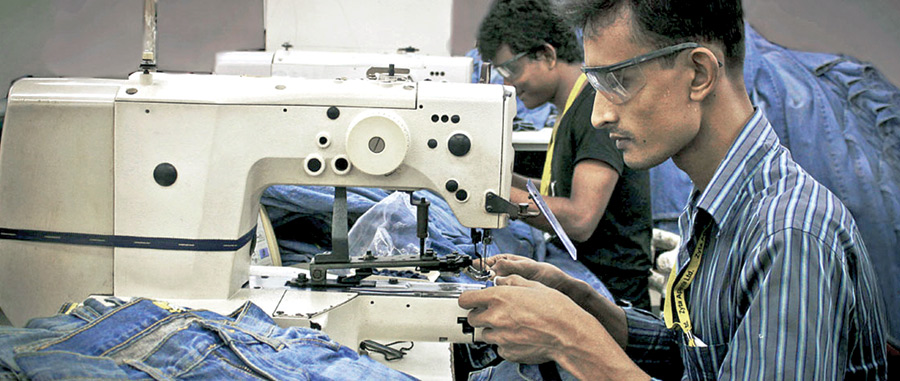
While the Group continues to flourish in times that are characterized by slowdown for retailers, Asad avers that the pursuit of efficiency to offer competitively priced quality products reaches a saturation point and therefore it becomes important to create new areas of excellence and innovation. One such area that has been identified and developed by Armana is its “virtual” vertical integration program for Levi’s with Envoy mills. Now, instead of sending fabrics developed by mills to buyers one after another for their approvals, the Group has created a channel of direct communication between its fabric vendors and buyers. “We are having a PD team from mills to travel and meet the buyers directly and discuss the design inputs and negotiate the price,” explains Pavan. “Enhancing and shortening the process of denim fabric development is important, because the denim market is actually driven through extensive R&D by denim mills,” he adds.

Armana chose to bypass the vertical integration option with virtual tie-ups with fabric mills because Pavan and Asad consider that a backward linkage is very limiting to its expansion programmes. “A textile unit in Bangladesh will always have the disadvantage of lack of availability of raw materials and spinning facilities. Further, while the denim apparel business continues to move out of India, the mills have stayed. And, it is not easy to compete with India, Pakistan or Turkey,” elaborates Pavan. Further Asad feels that setting up a mill in such circumstances will lead to a compromise on their ‘CM’ costs because of the ‘need’ to sell their fabrics to buyers. “Setting up a mill despite these factors when we already have a rich and reliable sourcing network will not be a sound decision,” explains Asad.
Armana complements the fabric received from all kinds of sources with its latest in-house washing units capable of delivering any kind of washes. However, Pavan credits Pakistan for its superior quality cotton and finish development capabilities that were augmented during the period it was exporting duty-free to Turkey and the know-how has now been transferred to Pakistan. “Following that period, Pakistan can now bring in a good product at an economical cost,” he says. Manufacturing denims, Asad and Pavan too are very well aware of the environmental consequences of water consumption by the washing plants and are now planning for a green factory with a target to reduce water and energy consumption. Female denims for Levi’s using super stretch fabrics (98% cotton, 2% elastane) is another example of Armana’s capabilities. “The nature of the fabric for its shrinkage quality after sewing and washing can alter the entire fit of the garment. On regular denim, you can close your eyes and sew but this fabric keeps you on your toes. For example, if the fabric is not relaxed enough before cutting the final garment, it will twist at the legs,” continues Pavan.
“Armana has a truly pan-South Asian staff. While our commercial team and administration is led by a Bangladeshi, the merchandising wing comprises of Indians, and the technical staff is led by a Sri Lankan national. We have got a great team and that is what matters.” – Pavan Kumar Soni, Chairman, Armana Group
Another opportunity captured by Armana was born out of a combination of export surplus generated by the company and booming domestic market in India by launching the brand called “Rookies”. Pavan’s brainchild, Rookies is a three-and-a-half years old men’s denim brand retailing at INR 2,000-3,000 (US $ 32-48) across India through online and offline channels. Developed with an in-house team of designers, the fabric for these denims comes from Turkey. “It is the real value-added product and developed to be at par with Diesel! We are looking at taking it to the buyers next,” reveals Pavan.
In order to keep all these multiple units together, the operating structure of Armana has been decentralized. Monitoring all the units online through a cloud ERP, Armana’s systems are designed with an emphasis on a proper hierarchical structure and a proper reporting system empowering each unit head to work as an independent business head. “The key people like DMMs are empowered to take their decisions. So every person who matters to this company has a very strong sense of belonging. That in the true sense is our biggest strength,” tells Pavan.
The Group is now looking at getting a foothold in the EU markets for the value-added business and is working closely with Per Fredriksson, a well-known face in the European denim circle and the Owner and Founder of Swedish brand Circle of Friends (COF Studio), for driving the value-added business in the EU. Apart from denims, the Group might soon venture into outerwear and other categories in bottomwear like cargoes and trousers.
While the Group has forayed into high-end denims, its growth path will be guided by value-added, medium segment and basic denims. “While I may do all the high-end brands, the backbone of my production will continue to be the volumes from Old Navy and Denizen. Even the retailer’s business is fuelled by the volume business and naturally we continue to partner in that,” reasons Asad. Value addition business on the other hand will be a small segment business-driven by Asad and Pavan’s passion for the product. “If we profess to have the capabilities to do all kinds of finishes, we should be able to make product with the same ease that Turkey or China will. It is important for us to be on our toes, value-added denims ensure that,” explains Asad. “We are really passionate about denim. We do not want to be slaves to our capacities. The day we feel the need to drive our business to fill the capacities, it will be the day when we will call it quits. That will be our exit strategy,” concludes Pavan.