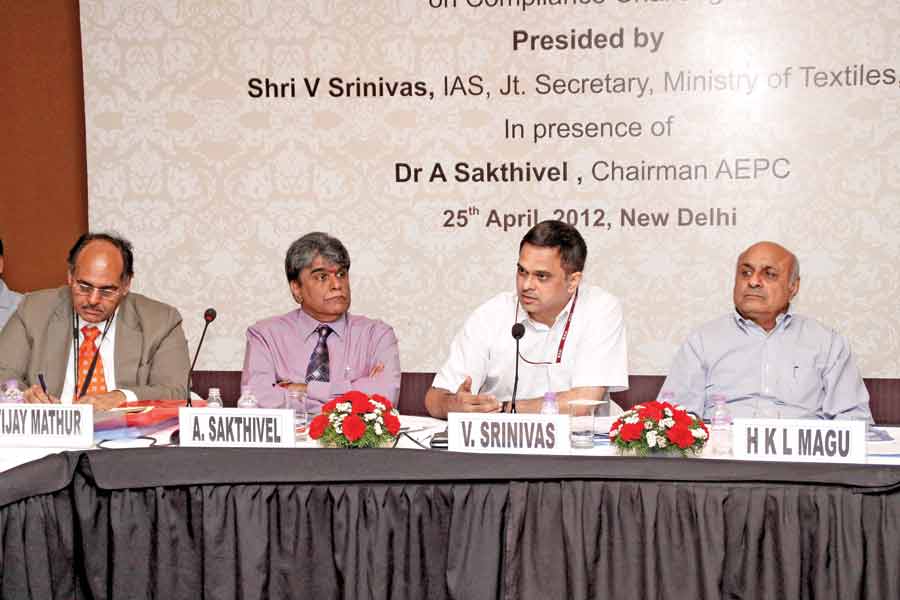
In the last issue of Apparel Online, some very pertinent questions being asked by the industry was put forward with regards to the AEPC-led Disha project. Many in the industry reacted to the story and AO invited the AEPC to clarify their position on the many doubts that were casting a shadow on this unique project, which the Ministry of Textiles claims is the only industry-led project of its kind and magnitude in the world. It is of course obvious when such a huge program is initiated many queries erupt and for healthy evolution of the program, free interchange of ideas is very important. In a frank and open letter AEPC Chairman Dr. A Sakthivel replies to the queries that AO had put forward.
Since the project is the brainchild of the Ministry of Textiles, the Joint Secretary of the Ministry of Textiles V Srinivas has been closely involved in the conceptualization of the project and no shortcut was taken with many man hours spend on understanding what the industry needed and the direction that the program should take before it was actually presented to the industry in December 2011. Realizing that various stakeholders of the apparel industry hold different perspectives and positions on these challenges, stakeholder consultation was adopted as the best mechanisms to build consensus on these challenges, for which the AEPC formulated an AEPC stakeholders forum inviting NGOs, trade unions, third party accreditation agencies, multi-stakeholder institutions, brands, retailers, buying houses and relevant government departments to give their inputs.
The interactions and feedbacks from the AEPC Stakeholder Forum have been deeply looked into and the team behind Disha is very positive, and certain course corrections have been made to make it more effective.
Has the basic agenda of Disha changed?
No, the basic agenda is to improve the social compliance benchmark across the industry, which DISHA is confident to achieve. Criticism only makes our resolve stronger to show results and demonstrate that enrolling with Disha can and does make a difference.
Also, one must appreciate that a programme like this, with no precedence, is always an evolutionary process. We have done some course corrections and improvements in our journey so far, which should be viewed as our commitment to create the best social compliance programme.
Why are big exporters enrolling when they clearly have nothing to gain?
[bleft]The focus of DISHA is small exporters, who cannot afford capacity building activities and hence are being encouraged to avail of this programme at subsidized fee. Also, there was no such programme for job workers. But DISHA has recently expanded its scope to include training of job workers. [/bleft]
As per the present enrolment statistics 19% are units with over 1000 workers, 10% with 500 to less than1000 workers, 25% with 500 to less than 200 workers, and 46% with less than 200 workers. Many of the bigger exporters also have expressed interest in better management systems based approach, and effective documentation management to be more efficient. There are obvious long-term gains from this programme, once it gets the due global endorsements – gains which will be equally relevant to big players.
In the short-term, we encourage their participation as demonstration of their confidence in this programme and as much needed flag bearers of this programme. Some of them are the Executive Committee members of AEPC, and are keen to demonstrate that it is a truly “industry owned -industry driven” programme.
If the program no longer promises a common code for the garment industry then what is the basis of evaluation…?
DISHA goes into the details of “what’s” and “how’s” of complying ‘with the Indian laws’ – which, from our assessment of the buyers and suppliers requirements, is very relevant and critical. Even today, many SMEs are unable to export, mainly because of the absence of understanding of the compliance requirements, and ‘demonstratable’ ways of complying with the law of the land.
Compliance requirements give instructions that are vague… factory should have appropriate lighting, proper ventilation, proper space for storage of chemicals, etc… but what is appropriate and proper… Disha aims to fill this understanding gap so that exporters can go in for audits in a more informed manner.
There are already systems and agencies in place to ensure that the laws of the land are properly followed…, then why do we need Disha?
We are not auditing or monitoring as to whether factories are following laws, that is not our role; Disha trains factories on how to comply through detailed manuals and toolkits. Such standardized toolkit and training programme for a sustainable compliance at factory units is not available at the moment. There is no conflict of role or interest on this issue.
Why the need of Disha at all, if they will work on similar lines as the audit agencies?
At this foundational phase, DISHA is not about auditing as much as ‘capacity building’. The objective and methodologies are very different. The major objectives are three – first analyzing through self-assessment the problem areas; second, providing a customized toolkit to minimize/eradicate the problems; and third, build strong management systems to ensure that the problems do not crop up again.
Will the buyers accept Disha certifications as creditable is another key concern.
The DISHA programme was evaluated by International Trade Centre, Geneva during May 2012 and a comparative analysis done of the DISHA codes, against 8 major codes of ethics presently existing in this sector. The DISHA codes were found to be very strong in social issues and aligned to international systems. ISEAL Alliance has also appreciated the programme after a similar analysis. They have appreciated the strong stakeholder consultation mechanism in place, in this programme, which in their opinion is an important part of the Code formation. Taking DISHA as a comparable model is a matter of pride for AEPC.
We are in constant touch with the buyers and are proactively listening to their concerns. In the meanwhile, the due processes to be followed to ensure greatest acceptability and credibility of this programme are being followed, which gives us confidence that buyers will accept this programme. Further, more and more buyers want to reduce the cost of compliances, so if a single project has the credibility to ensure compliances, buyers would love to associate; this is also the feedback we are getting.
How can the project move ahead on in the midst of such uncertainties…?
AEPC is confident that the programme will be a national pride in years to come. We request that the required time be given to it to mature and demonstrate tangible results. For a programme with such scope and intent, it is too premature to make such judgmental decisions. After all, our proposal has the confidence of Ministry of Textiles.
Our confidence is not based on just ‘expectations’ but what we are experiencing at the grass root when the Disha team meets the smaller exporters. There is no doubt that the expectation levels are high and everyone is critically evaluating our role and intention, but the core Disha team, the expert institutions and individuals supporting the project are well equipped to respond to industry needs on compliance and all of them have a long history of working with the industry. Each partner has been chosen with care and together we all are committed to see the project achieve its goal.