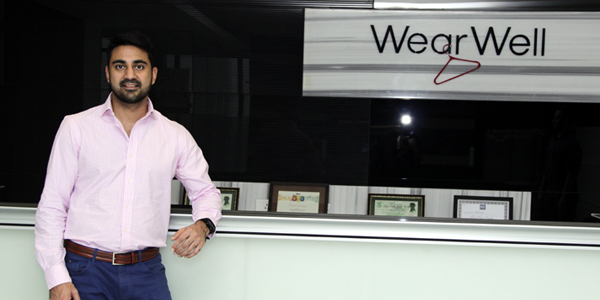
 Wear Well India, a Noida-based ladies and kids wear exporter, is aiming to cross the US $ 22 million-mark with its practices in place for increasing efficiencies of the current setup. Led by three young bloods – brother Bharat and Akshay Sahni, and Nitin Jain, the company currently has three factories, one of them being in Okhla, New Delhi and the other two in Hosiery Complex, Noida. The company has recently hired a senior member in their HR department, and a senior designer each for women’s wear and kids’ wear in a move to form a more organized and efficient organization.
The apparel exporter plans to move forward with a multi-pronged strategy, with equal efforts being exerted on the marketing-, production-, HR- and product development-end. While Akshay handles the production end of the company, Nitin and Bharat take care of the marketing front. Since Akshay joined the company in 2011, he has been working on developing a good production planning and control (PPC) team and an efficient industrial engineering (IE) team. He believes that as the margins are decreasing and there is a lot of dependence on fabric supplier and other vendors, the only way to increase profits is by increasing the efficiency of the operators. In order to be in a situation to push the operators for better efficiency, the company needs to assure regular and uninterrupted supply into the assembly lines, for which Wear Well has constantly been working on its PPC team. The PPC team was formed to fully utilize the capacity of the facility and making every employee of the organization realize that their work eventually affects other peoples’ work and the working of the organization. Formation of this department improved the on-time deliveries to 90 per cent.
Also Read – Naval Exporters a start-up growing by leaps and bounds
The IE department, along with conducting time studies and hourly monitoring, is also taking care of maintaining the efficiency and operator hiring. The new interventions by the IE team include developing a skill matrix of the operators, according to which operators will be put under three grades, namely A++, A+, and A. The IE department has also started shorter assembly lines of 22 to 23 machines which are usually of 45 machines, in a move to reduce the WIP in the line and reduce the style changeover time, which shoots up to three days currently. “We will keep a combination of both, the 45 machine lines and 23 machine lines, and give the smaller orders to the smaller assembly lines, because for small order quantities like 2,000-3,000 pieces, style changeover time of 3 days is not profitable,” explained Akshay.
Apart from that, whenever a new style is introduced, target efficiencies are set according to the Operation Bulletin (OB) of that style, and Time Study is conducted on the third or fourth day of the style running in the assembly line. The results are then compared to the figures established at the beginning of the style and thereafter, the actual efficiency is calculated. Currently the apparel exporter is running at an average efficiency of 55 per cent.
Apart from the IE department, the Indian apparel exporter is also strengthening its HR department, under which it is planning to take up a worker engagement initiative, which plans to engage the management with a certain group of workers every week. The management would inform the workers about their expectations and explain them their roles and responsibilities, and would also hear from the workers about their expectations from the organization. The upgrades that the Indian apparel exporter plans next are – in-house computer embroidery machines and digital printing machines to reduce time wastage in outsourcing, and installing Fast React software for production planning which is currently being done using Excel Sheets.
Also Read – B K Fashions to establish its fifth unit with 500 sewing machines
Wear Well is currently catering to the European market majorly, with 90 per cent of its goods being exported there, and the rest 10 per cent to the US market. European buyers to which the company caters, like M&S, Zara, Next, Massimo Dutti, and Mango place orders ranging from 1,000 pieces to 50,000 pieces sometimes, and are more design forward, explains Akshay Sahni, Director. With a capacity of producing 400,000 pieces every month, the company produces about 50,000 knit garments and rest, woven garments from its three factories housing a total of 1,400 machines.