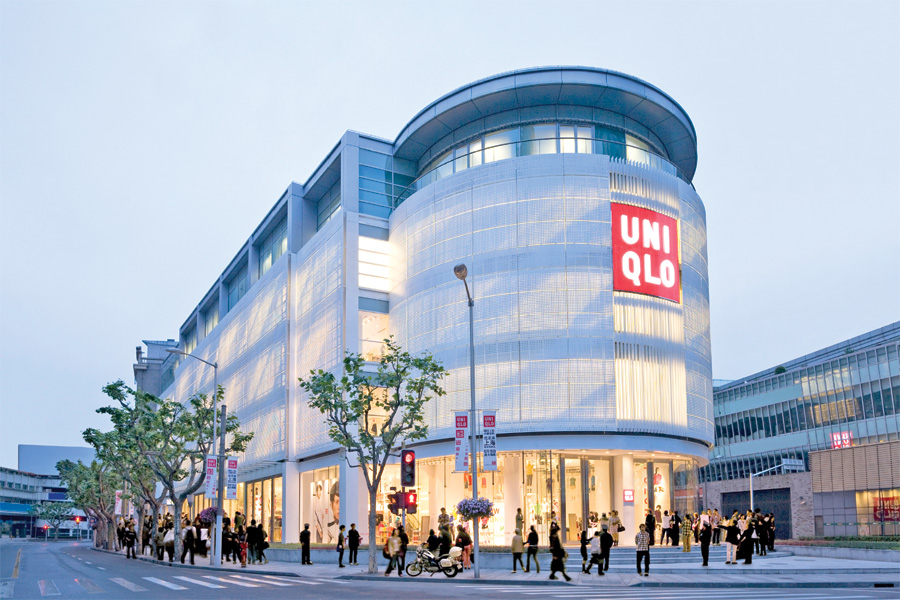
 Ranked as the fourth largest buyer of garments in the world, after Inditex, Gap and H&M, Uniqlo, an iconic brand from Japan that has taken the global market by storm, today has sales from international operations standing at a whooping ¥ 400.00 billion (US $ 3.36 billion) with the number of Uniqlo stores located outside of Japan rising to 632 stores. In fact, Uniqlo International already accounts for over 30% of total Uniqlo sales, and new-store expansion in the Asian region has proved to be the key driver of recent growth. In recent times, the attention is on another promising location for future expansion: the United States. Recent developments also indicate that India is on the sourcing and retailing radar of the global retail giant.
‘Specialty store retailer of Private label Apparel (SPA)’ means that the company’s activities are fully integrated from manufacturing through sales, including material procurement, design, product development, production, distribution, inventory management and final sales.
Soon after the Modi Government took charge about five months ago, the Fast Retailing Group Chairman & CEO Tadashi Yanai held a meeting with the Prime Minister, Commerce & Industry Minister Nirmala Sitharaman and Minister of State for Textiles (I/C) Santosh Gangwar expressing intention to source garments from India. Recently AEPC gave a presentation to the Uniqlo team, which asked for a list of Indian exporters who could commit at least 30% of their capacities to them. In continuation of the effort, a strategic team from Uniqlo met owners of top 40 export houses and the EC committee of AEPC at its headquarters, Apparel House, Gurgaon, and discussed various aspect and specializations of the exporters. Though no clear commitment has been made, the expectation is that Uniqlo will associate with 10 exporters besides Shahi, which is already working with the company.
Currently, Uniqlo has formed business relationships with partner factories in China, Vietnam, Bangladesh and Indonesia. These operations are controlled by production offices in Shanghai, Ho Chi Minh City, Dhaka and Jakarta to ensure that clothes are made to the highest global standard of quality. As of now, there is a buying office in India and the sourcing will be controlled initially through the Bangladesh office.
Business model at Uniqlo
Among the fastest growing retail companies, Uniqlo has refined its SPA (Specialty store retailer of Private label Apparel) business model, allowing for control of the entire business process – from planning and design to material procurement and sales. With a production factory in China, Uniqlo is continuously developing products of exceptional quality, in order to “create clothing with new and unique value and to satisfy customers worldwide.” Customer opinions and needs play a vital role in the product development process and the Uniqlo Customer Center receives approximately 90,000 comments from customers annually.
The Uniqlo Material Development Team is able to procure high-quality materials at low costs through direct negotiations, with bulk purchases from material manufacturers globally. For instance, denim fabric that is nearly synonymous with Uniqlo is woven, dyed and manufactured to meet Uniqlo’s specifications by the global denim manufacturer KAIHARA Co. Ltd. In addition, it is efforts like these that have made it possible for Uniqlo to secure high-quality, long-staple cotton – which can only be harvested from three per cent of the world’s cotton plants – for Uniqlo’s popular extra-fine cotton plain T-shirts.
In order to produce millions of products of standardized quality, it becomes important to implement quality control across factory production technology and management. Uniqlo has a team of technical specialists, known as the Takumi Team, boasting many years of experience in the Japanese textile industry. These specialists are sent directly to its partner factories in China to offer technical instruction and share their abundant experience. At the same time, the supervisors from the Production Department, based in the Shanghai office, make weekly visits to partner factories to check the quality and progress of production.