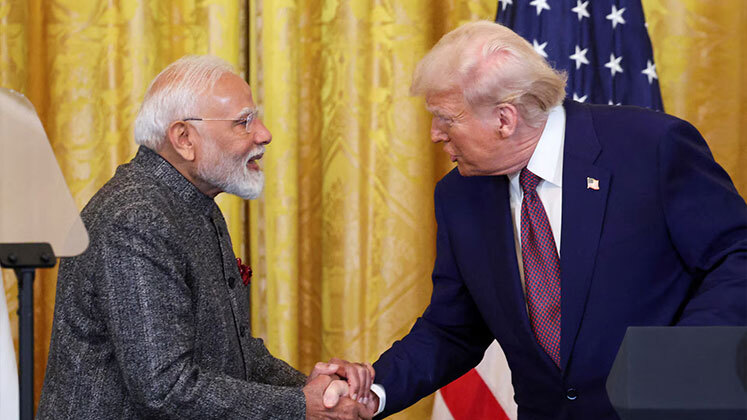
India and the United States on Friday announced a framework for a bilateral trade deal aimed at reducing tariffs, strengthening energy ties and deepening economic cooperation, marking a significant step forward in trade relations between the two countries. A joint statement issued by both governments said the framework establishes a clear pathway towards a comprehensive agreement, while noting that further negotiations would be required to finalise the deal.
Earlier in the week, US President Donald Trump had said the United States would reduce tariffs on Indian goods from 50% to 18% under the proposed trade arrangement, in return for India halting purchases of Russian oil and lowering certain trade barriers. Of the earlier 50% tariff, 25% had been imposed specifically in response to India’s imports of Russian oil, which Trump said were indirectly supporting Russia’s war effort in Ukraine. On Friday, he signed an executive order revoking this additional 25% duty after India agreed to redirect oil imports towards suppliers such as the United States and Venezuela.
Under the framework, the United States will retain an 18% tariff on most imports from India, including textiles, apparel, leather and footwear products. The two sides also agreed to work towards finalising, within six months, a mutual recognition arrangement for US or internationally accepted safety and licensing standards for imported products. The US indicated it would consider India’s requests for further tariff reductions in subsequent negotiations. Both countries also committed to closer cooperation on export controls for sensitive technologies and to jointly address non-market policies of third countries, a reference widely understood to point to China.
India’s Minister of Commerce and Industry, Piyush Goyal, welcomed the framework, saying it would provide Indian exporters, particularly micro, small and medium enterprises, improved access to the US $ 30 trillion US market. He said the formal trade agreement could be signed by March, after which India’s tariff reductions on US exports would come into effect.
The Confederation of Indian Textile Industry (CITI) said the reduction of US tariffs to 18%, effective 7th February 2026, was a major relief for the sector. CITI Chairman Ashwn Chandran said the earlier 50% tariff had been the single biggest challenge for India’s textile and apparel industry, for which the United States is the largest overseas market. He said the revised tariff would allow Indian exporters to compete more effectively in the US market and would also provide a marginal tariff advantage over competitors such as Vietnam and Bangladesh.
Chandran added that the industry was seeking greater clarity on cotton-related provisions. He said there was strong complementarity between the US and India in cotton, which remains the primary raw material underpinning India’s textile and apparel exports. CITI believes that removing import duties on cotton of all varieties would help narrow the gap between domestic and global prices, restore competitiveness in India’s spinning and textile segments, and allow minimum support price mechanisms for farmers to function without distorting downstream prices. He noted that during the current cotton season, the minimum support price for kapas had risen by nearly 8%.
Separately, Apparel Export Promotion Council (AEPC) Chairman A Sakthivel said the industry welcomed the India–US joint statement and the revocation of the additional 25% duty imposed earlier under Executive Order 14239, effective from 7th February 2026. He said the trade agreement represented a historic milestone for India’s textiles and apparel sector, creating significant opportunities across the value chain and generating substantial employment, particularly for women and MSMEs. He added that rural farmers were also expected to benefit, supporting more inclusive and sustainable growth.
Dr Sakthivel further said that tariff reductions and improved market access would significantly enhance the global competitiveness of India’s textile and apparel industry, strengthening India’s position as a reliable and trusted sourcing hub. He added that the agreement would also help address non-tariff barriers, reduce compliance burdens and procedural delays, and enable faster movement of goods into the US market.