A parachute is a device used to slow the motion of a person or object to Earth through an atmosphere by creating a drag. Parachutes are normally used both in the military and civil areas. They are often used by soldiers, in rescue missions and also for transporting the goods. The purpose is to bring down the load safely from a high altitude or from the atmosphere. Textile material used in its making, its shape and the packaging are the most important elements for the parachutes. Claudia Ollenhauer-Ries, Correspondent from Germany, explores the role played by technical textiles in the manufacturing of parachutes.
There is a long list of applications for parachutes, ranging from descending space ships on planets, saving the life of pilots, illumining areas by night, bringing down supply with the GPS (Global Positioning System) or mere sports. Some of the parachutes can be directed by pulling on the lines by the person or by a mechanical steering system with GPS (autonomic) and/or by remote control.
Design
Parachute designs are driven by “loads” (the forces that parachute experiences as it fully inflates). Loads are calculated by using atmospheric density, velocity, parachute drag area and mass of the transported person(s) or goods.
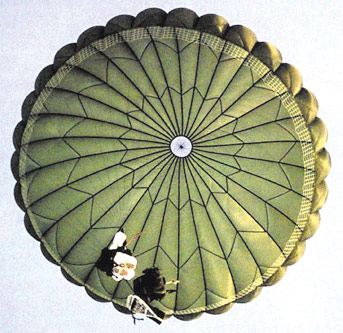
Well known is the classic round shape of the parachutes, which trap the air from the bottom. Almost all of them have a hole in the zenith; those to be directed have also open areas on the rear side. The annular shape is a recent development as well as the jellyfish form. We also find cross, square and rectangular forms. Some of them have a warp knitted net fringe on the bottom line, which would prevent the parachute to inverse or the lines to friction the dome.
There are also the two-layered paragliders, ram-air parachutes or parafoils. The rectangular self inflating construction traps the air coming from the front. Ram-air parachutes or parafoils are used for military and rescue missions, while the paragliders represent the airborne sport gear. Paragliders have much greater lift and range, but parachutes are designed to handle, spread and mitigate the stresses of deployment at terminal velocity.

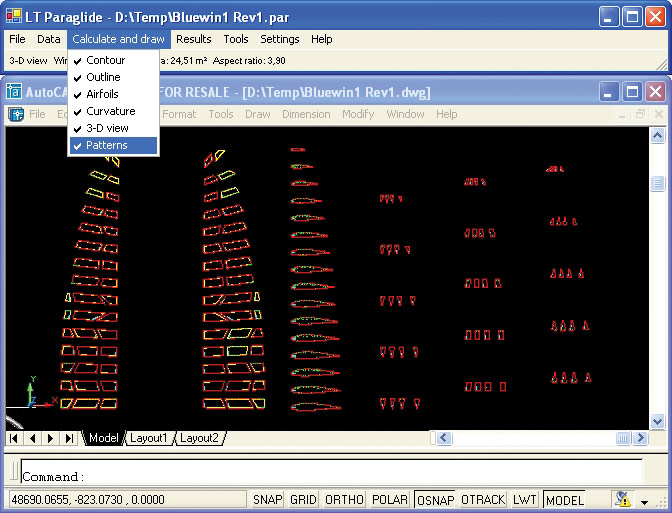
Even as computer aided design (CAD) helps create and design these technologies, but real life tests are a necessity. The first step is to use the CAD programmes to design the shape of the parachute in 3D. The second step literally peels off the 2D pattern from the 3D construction. These 2D shapes can be exported in a dxf-format (a vector design format) into nesting software. AutoCAD from AutoDesk, San Rafael/USA, is the most widely used 3D/2D design system. Bruce Goldsmith, a British world champion in paragliding and designer of paragliders for the company Airwave, Mieders/Austria, says, “Most paragliders design software works using AutoCAD itself acting as an addition to AutoCAD. Others work independently as stand alone software.” Bruce created his own programme, which takes into account the elasticity of the lines. Today, commercially available programmes cost approx. 10,000 Euro, depending on what features are included. Some of these are LT Parafoil from Living Things, Diepholz/Germany (www.living-things.com), and FlyCad FD, used and sold from Independence, Eisenberg/Germany (www.independence-world.com), which includes a digital wind tunnel, and PG Design, used and sold by Mac Para UK (www.mac-paragliders.co.uk).
Materials
The typical material for the canopies is a Nylon rip stop woven fabric, which has almost no elongation. It is used in several qualities, with and without coating and with a variety of air transmission values, according to the place of use. When the parachute deploys, the fabric will have to resist to the load. So it is important that the trapped air can get out through the hole in the zenith of canopy as well as through the fabric near the zenith. On the sides of the canopy, the cfm (cubic feet of airflow per minute) value could be less. For the canopy of a parachute, the value could be 0 to 3 cfm, a tensile strength of 400N, the tearing strength of 22N, the weigth 40g/m².
For a paraglider, the top layer would be of coated Nylon (polyamide 6.6), with the coating working against UV radiation and for waterproof qualities. The ribs between the top and bottom layer will be stiffened.
The Solarmax polyamide 6.6 is a brand of Invista for fabrics and sewing threads. Among the weavers are Performance Textiles, Greensboro/USA (www.perftex.com), HLC Industries, Bala Cynwyd/USA (www.hlcindustries.com), Pertex, Waddington/UK (www.pertex.com), formerly Perseverance until 2005, when Mitsui from Japan took over, and Precision Fabrics Group, Roanoke/USA (www.jumpmaster.com).
The armies use camouflage colouring like shades of brown, beige or white (in snowy situations). For rescue purposes, bright colours like white, red, orange or yellow apply. Neon colours are not used much as they fade in the sunlight. The leisure and sport canopies are done with bright colours and special design patterns by sewing as well as printed designs.

The lines are made of Aramid/Kevlar braids in different strength and dimensions – according to the load to be compensated. Also Dyneema, Vectran and Dacron braids can be used. The braids connect the parachute with the parachutist, the goods to be transported or paraglider, so they are of utmost importance. The dimension and strength of every braid corresponds to the load which tears upon the parachute: air, wind, speed and weight of the transported person or goods. The actual load is determined by the most sophisticated software, which simulate the stress on the single parts of the parachute. In any case, especially with less top-end software, the experience of the parachute designer has a significant part in the choice of the braid.

The colour of the lines on paragliders varies from row to row and helps to entangle the lines. A crucial point is the elongation and the tearing values of the lines. Both are severely tested during the production. A leading supplier is Offray Specialty Narrow Fabrics (OSNF) Chester/USA.
The belts are made of polyester 6.6 and meet the same requirements as the safety belts in cars. All the belts are narrow woven fabrics in order to get the maximum tearing strength and a minimum of elongation. All the belts are narrow woven fabrics in order to get the maximum tearing strength. Buckles are made of aluminium, which is light yet very strong. All the bags, rucksacks and seats are made in heavier materials such as Cordura.

Regarding the sewing threads, bonded polyester or polyamide is the choice, as the material has a good resistance against UV-light. Yet this material is not immune to ultra violet degradation and it may deteriorate from continuous or prolonged exposure to the elements, temperature extremes or chemicals. Among the suppliers are American&Efird (100% polyester bonded, Anefil Bonded Polyester), Coats (100% polyester bonded, Star Ultra Dee, Guetermann (100% polyamide 6.6, Zwibond in sizes 40, 20 and 13), Amann (100% polyamide 6.6, Onyx in sizes 40 and 60Nm). Another thread used is Tenara, which is also resistant to weathering and pollution. Pioneered by Amann’s product development partner W.L. Gore and Associates for use in making space suits for the US National Aeronautics and Space Administration (NASA), Tenara yarns are based on 100% expanded polytetrafluoroethylene (e-PTFE). These are strong and abrasion-resistant threads that carry a warranty of 10-15 years against seam failure.

Cutting and Sewing
Depending on the size of the series, the parachute manufacturers use single ply or multiple ply spreading. The German company Paratec, Wallerfangen, is one of the smaller manufacturers of parachutes and paragliders. General Manager Stefan Ertler describes that they use either laser cutter for online cutting processes or hot knife cutting with patterns for offline manual cutting processes. The target is to melt the borders of the parts and avoid fraying. In both cases they use single ply spreading. The sewing is done with stitch type 301 (lockstitch) and 2 to 3 stitches/cm for the seams and bar tacking to fix the lines. Lockstitch offers the 2 systems of threads and a firm entanglement of the threads. The potential seam elongation is compensated by the elasticity of the sewing thread and, obviously, by the right tension of the sewing and bobbin thread. The sewing thread used is bonded polyester 6.6 in 40/3 and 30/3.
[bleft]PASSIVE for UAS (Parachute Assisted Safety System for Internal Vehicle Emergencies). The increasingly congested National Airspace System in USA will see more and more pressure from government and private agencies wanting to utilize it for UAS operations in congested areas.[/bleft]
Independence gliders are produced in one of the biggest manufacturing plants in the world, “Sky Sport Lanka”, which is based in Sri Lanka. Here, the nesting software plots directly on the fabric, also marking the fixing points for the lines. A cutting device on the plotter is only used for small series or prototypes, as it works only on single layers. Stefan Kurle, General Manager of Independence, says: “Normally we use templates as basis for the cutting, so that we are able to cut about 30 layers of cloth with an electronic knife. To fix the cloth while cutting we load the material with electrostatic energy and glue it in this way to the cutting table.” The next steps are checking the parts on a light table in order to find material faults, after that the sewing. While the sewing is done, the lines are cut for the different gliders, sewn and numbered. For the setting up, the braided lines hang down from the roof in bunches. To be saving that all braided lines have the correct length they stretch them with a norm weight before cutting them.
Quality checks are of highest importance, Stefan Kurle explains: “The lines are fixed to the canopy and we again check the line lengths. If there is more than 2 millimetres difference, the line is sorted out and will be destroyed. Now we make the symmetry check. For this we hang 10 kg weights at the end of the lines and wait an hour. After this all loops are stretched and a special computer measuring system checks the line lengths again.” For the last check the glider is placed on a special scaffold so that they can see if the lines have turns. The glider is now ready and is packed and sent. All check-results are noted down on a paper which is sent with the glider. A last check is made by the Independence team in Germany before the glider is sent to the customer.
Transportation of the large semi finished parts inside the plant asks for a hanging solution. Eton Systems, a world’s leading provider of unit production systems (UPS) for the sewn-products industries, installed at Aerostar International at its Huron, South Dakota (USA) plant a complete system in 2006. The conveyorized system, which is custom configured to accommodate the large parachutes within the 13 foot high ceilings at Huron, consists of 21 workstations and is designed to eliminate manual transportation throughout the assembly process and reduce individual operator handling. The Eton system features special purpose product carriers designed specifically to provide Aerostar workers with more convenient access to the parachute assembly points without the traditional lifting and handling of the bulky products. Airborne is also another company which works with an Eton system.
Exemplary Manufacturers of Parachutes
Among the manufacturers for national and international armies is the French company Zodiac. Its Parachute & Protection Systems Division comprises arresting and deceleration products such as military and sports personnel parachutes, brake parachutes, cargo-load parachutes, and ejectable-seat equipment. In cooperation with NASA, Zodiac also works on parachute systems to ease the landing of space ships on planets. Zodiac parachutes enabled the Spirit and Opportunity rovers to land on Mars in 2004 and the Stardust spacecraft to land on Earth in January 2006 carrying particles retrieved from the comet “Wild 2”. Recently, the new Pioneer parachute systems are what enabled Phoenix to touch down on Mars.
[bleft]Gradient, the Czech-based company, is one of the leading paragliding brands worldwide employing the most up-to-date technologies and materials in designing their paragliders. They have developed an international reputation for producing paragliders of exceptional quality, performance and value for money.[/bleft]
Airborne Systems, headquartered in Pennsauken/USA, designs and manufactures high quality parachute products and provides world class engineering services. Airborne Systems brings to the market and its customers a history and legacy that embraces four of the world’s leading parachute companies, combining the resources of GQ Parachutes, Irvin Aerospace, Para-Flite, and Aircraft Materials (AML). Today, Airborne Systems is comprised of these brands. No other company has the combined resources of Airborne Systems and, for almost a century, compiled a proven track record of precedent setting milestones that demonstrate scope of capability, quality of product and successful performance. Airborne Systems leads the industry in the use of sophisticated simulation analysis software application for parachute design, flight and performance optimisation. These leading edge simulation tools deliver important value by reducing time to use and containing unnecessary costs that are often critical to the success of the customer programme. These computer analysis applications provide the most advanced insight into system performance and resulting design solutions. Their range of analysis capabilities include: parachute trajectory modelling and simulation, finite element analysis of metal parts, fabric structure and impact dynamics analysis, fluid structure interaction and floatation stability.
Since 1980, BRS Inc. (Ballistic Recovery Systems, Inc.), South Saint Paul/USA, has developed a line of whole-aircraft recovery systems credited with saving hundreds of lives and minimizing property damage. These unique safety systems are designed to provide a parachute-assisted descent that facilitates recovery of a disabled unmanned craft with minimal-to-no damage to onboard sensors. The documented success and acceptance of this technology has evolved into a robust product line of engineered systems and has become standard equipment on the world’s best selling certified General Aviation aircraft. For government applications, BRS has developed two innovative product lines: PASSIVE and MAVEREC:
PASSIVE for UAS (Parachute Assisted Safety System for Internal Vehicle Emergencies). The increasingly congested National Airspace System in USA will see more and more pressure from government and private agencies wanting to utilize it for UAS operations in congested areas.
Gradient is one of the leading paragliding brands worldwide. Based in Czech Republic, the company was formed in 1997 to win immediate acclaim; from the beginning, it concentrated on its own development and production. By employing the most up-to-date technologies and materials in the design of their paragliders, Gradient has developed an international reputation for producing paragliders of exceptional quality, performance and value for money.
Windtech is a Spanish company which was founded in 1995 and is now one of the largest paragliding manufacturers in the world. It manufactures almost all of its wings in Europe. Windtech has a new state of the art manufacturing facility ideally situated right next to both Atlantic coastal soaring sites and the Pyrenees mountain thermal sites.