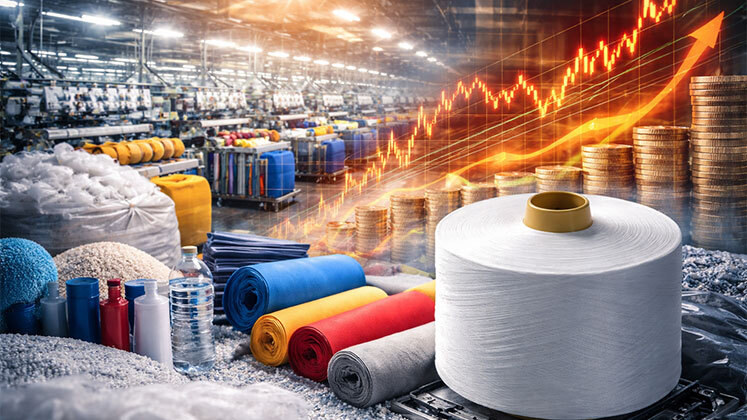
Sharp fluctuations in the prices of key polyester raw materials—Purified Terephthalic Acid (PTA) and Mono Ethylene Glycol (MEG)—have created uncertainty across India’s synthetic textile value chain, with downstream manufacturers warning of rising cost pressures.
Prices of PTA and MEG, essential inputs used in the production of synthetic fibres, filament and yarn, increased by Rs. 20.48 (US $0.22) per kilogram on 10th March before falling by Rs. 14 (US $0.15) per kilogram on 12th March. Despite the partial correction, industry stakeholders said the sudden spike has already begun to affect manufacturers further down the value chain.
Madhu Sudhan Bhageria, Chairman and Managing Director of Filatex India, stated that the recent geopolitical tensions had introduced short-term volatility into the polyester value chain, primarily through fluctuations in crude oil prices. He indicated that polyester is a petrochemical-based product, meaning movements in crude oil markets typically translate into higher raw material costs for producers.
According to Bhageria, the prices of polyester feedstock have increased by around Rs. 23 (US $ 0.25) per kilogram over the past two weeks, rising from roughly Rs. 80 (US $0.87) per kilogram to about Rs. 103 (US $1.12) per kilogram. He noted that major industry participants generally consider the surge to be a temporary development linked to geopolitical uncertainty, rather than a structural change in underlying costs.
Bhageria also highlighted supply chain adjustments affecting MEG availability. He explained that a portion of the feedstock is sourced from West Asia, where shipments have faced disruptions, while domestic producers have been prioritising internal consumption, resulting in tighter availability in the spot market.
Durai Palanisamy, Chairman of the Southern India Mills Association, observed that PTA and MEG are imported not only from West Asia but also from China. He indicated that ongoing logistical disruptions had forced domestic manufacturers to rely more heavily on local supply, adding that it remained uncertain how much of the price increase the market would ultimately be able to absorb.
Concerns have also been raised by downstream industry representatives. R. K. Vij, President of the Textile Association of India, stated that the sudden rise in the prices of PTA and MEG melt had placed a significant financial burden on the downstream textile value chain.
The price volatility coincided with sharp movements in global crude oil markets. Oil prices briefly surged to US $ 118 per barrel on 9th March before falling to around US $ 92 per barrel soon afterwards. Despite the decline in crude oil prices, producers of PTA and MEG implemented price increases.
The impact has already begun to cascade through the polyester ecosystem. Producers of man-made fibre and polyethylene terephthalate (PET) raised prices by around Rs. 20 (US $0.22) per kilogram from 10th March, while manufacturers of synthetic filaments increased their prices by about Rs. 6 (US $0.06) per kilogram.
Bhageria noted that the higher feedstock costs were gradually being reflected across the broader man-made fibre value chain, including polyester yarn and related textile products, raising concerns about margins for downstream textile manufacturers.