The Cotton Corporation of India Ltd (CCI), a public sector undertaking under the Ministry of Textiles, recorded a turnover of Rs. 20,009 crore (US $ 2.18 billion) in the financial year 2024–25, marking one of the highest revenue performances in the organisation’s history.
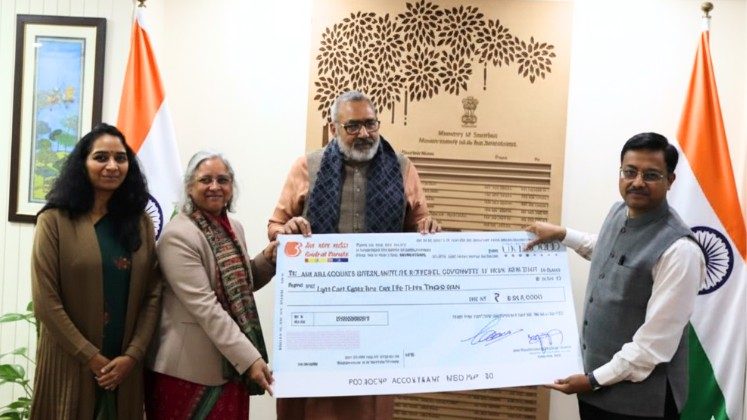
As part of its financial disclosures for the year, CCI presented a dividend cheque of Rs. 8.89 crore (US $ 970,000) for FY ’25 to the Union Minister of Textiles, Giriraj Singh, at a ceremonial function held in New Delhi. The event was attended by the Secretary, Textiles, Neelam Shami Rao, and Joint Secretary, Textiles, Padmini Singla. The cheque was handed over by Lalit Kumar Gupta, Chairman and Managing Director of CCI.
The Union Minister of Textiles acknowledged CCI’s sustained performance and highlighted the need for continued focus on growth, operational efficiency, transparency and innovation to further strengthen India’s cotton and textile value chain. He reiterated the corporation’s critical role in ensuring remunerative prices for cotton farmers through minimum support price (MSP) operations, while also maintaining stability in the domestic cotton market.
Reviewing the initiatives undertaken during the year, the Secretary, Textiles commended the efforts of CCI’s management and workforce, and reaffirmed the Ministry’s support for the organisation’s future objectives, including enhancing the global competitiveness of India’s textile sector.
The Secretary also underscored CCI’s central role in scaling certified cotton production in India. During the year, nearly 97% of certified Kasturi Cotton Bharat—1.51 lakh bales out of a total 1.58 lakh bales—was produced by CCI, reinforcing quality assurance, traceability and India’s positioning in premium international cotton markets.
To improve outreach and effectiveness under MSP operations, CCI expanded its procurement network by opening 571 procurement centres across 150 cotton-growing districts, up from 508 centres in the previous season. The liberalisation of norms for setting up procurement centres has improved last-mile access, particularly for small and marginal farmers, while also reducing transportation costs and waiting times.