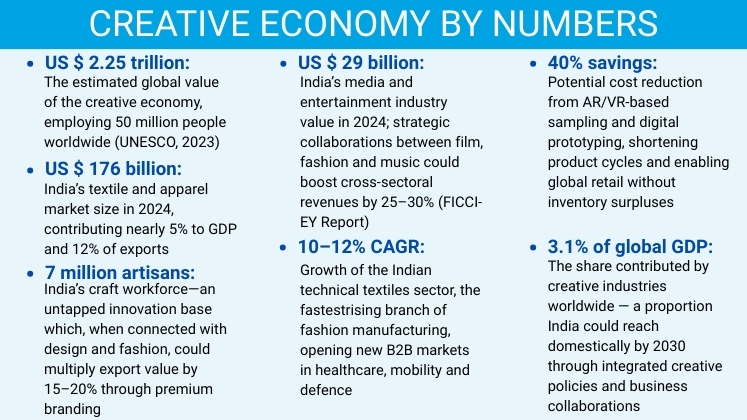
Across the world, creative industries are not only shaping culture but driving commerce. They contribute over US $ 2.25 trillion to global GDP (about 3.1%) and employ 50 million (about 6.2% of employment) people, a scale that serious investors can’t ignore. Even in India, the creative economy is no longer a peripheral story of art, culture and craft. It is emerging as a serious business opportunity. Though as yet, these sectors remain fragmented. The commercial potential lies not in these sectors functioning separately, but in how they can operate as a unified value chain.
The creative industries are far broader than design schools or IT-driven AR/VR start-ups. They span India’s crafts and handlooms, performing arts, cinema, publishing, architecture, advertising, animation, heritage tourism and fashion ecosystems. Each of these sectors has enormous potential but is currently constrained by fragmented governance.
If India were to take the step of forming a Ministry of Creative Industries integrating these creative sectors under one coordinated platform, the outcome can be transformative. The agenda for such a Ministry could include: building creative clusters and hubs; offering fiscal incentives for creative start-ups; creating global branding campaigns for Indian crafts and cinema; embedding design education into crafts and tourism; supporting international co-productions in film and music; developing creative infrastructure such as museums, studios and incubators; and ensuring intellectual property protection that truly supports creators.
Crucially, it would also link India’s creative economy to global networks – from co-production treaties to international design fairs, from UNESCO’s heritage programs to digital IP exchanges.
| “India’s 7 million artisans represent a living design laboratory, masters of material, technique and innovation. If the textile and fashion industry were to integrate their skill base into contemporary design processes, the result would be high-value artisanal luxury that could rival Japan’s Kyoto fabrics or Italy’s heritage leather. This is already happening in fragments. |
Let me illustrate this taking the case of fashion and textile industry. India’s fashion and textile sector, valued at nearly US $ 175 billion, spans everything from apparel to home fashion, fashion accessories, home décor, technical textiles and functional fashion. It employs over 45 million people and accounts for more than 12% of the country’s exports. But most of its value is trapped at the lower end – manufacturing and sourcing, while higher-margin activities such as brand development, fashion media, design innovation and cultural storytelling are dominated by global players.
The sector’s greatest untapped advantage lies in its creative interconnections. Behind every product is a story – a craft technique, a design process, an artistic collaboration and when these stories are told, they create value. Imagine if the fashion and textile sector were systematically linked to the crafts, performing arts, film and design industries; not just as inspiration, but as business partners.
Start with crafts. India’s 7 million artisans represent a living design laboratory, masters of material, technique and innovation. If the textile and fashion industry were to integrate their skill base into contemporary design processes, the result would be high-value artisanal luxury that could rival Japan’s Kyoto fabrics or Italy’s heritage leather. This is already happening in fragments – luxury brands sourcing Banarasi silks or Kanchipuram weaves, but it remains boutique rather than systemic. A unified creative ecosystem would scale this connection, creating product lines that marry handcrafted excellence with industrial design precision and global branding.
The performing arts and cinema industries can take this collaboration further. Costume design, set aesthetics, music and dance have always been intrinsic to Bollywood, but rarely have they been leveraged as structured commercial partnerships with fashion and textile brands.
Then comes technology, the silent enabler that turns creativity into commerce. AR/VR-based fashion shows, digital sampling, 3D prototyping and AI-driven trend forecasting are already reshaping the global fashion landscape. When fashion brands partner with India’s burgeoning animation, gaming and AR/VR industries, the result is not only operational efficiency but also
new consumer experiences: digital twins of garments, immersive heritage storytelling and virtual retail. Imagine an AI-personalised saree woven from both traditional Banarasi motifs and modern tech-enabled fabrics, viewable through a virtual showroom where buyers can explore its story, provenance and craft lineage.
Beyond apparel, home fashion and interior textiles can benefit immensely from such creative crossovers. Interior design, performing arts and crafts can combine to create immersive décor experiences – spaces that tell stories of heritage and innovation. The line between ‘fashion’ and ‘home’ is dissolving globally, with soft furnishings, lighting and functional textiles now being branded as lifestyle statements.
For industry leaders, this isn’t about art or philanthropy, it’s about business expansion. Integration multiplies margins. Every rupee invested in design or storytelling amplifies returns across multiple sectors – from crafts to media to tourism. The UK’s creative industries model and Italy’s ‘Made in Italy’ strategy both demonstrate how design, film and cultural branding can lift entire economies, not just individual brands. India already has the scale and creative depth; what it needs is cohesion.
The creative economy is not about aesthetics; it is about advantage. The world is moving towards value systems driven by ideas, experiences and identity. India, with its craft heritage, cinematic reach, digital competence and design energy, is uniquely placed to lead this new economy.