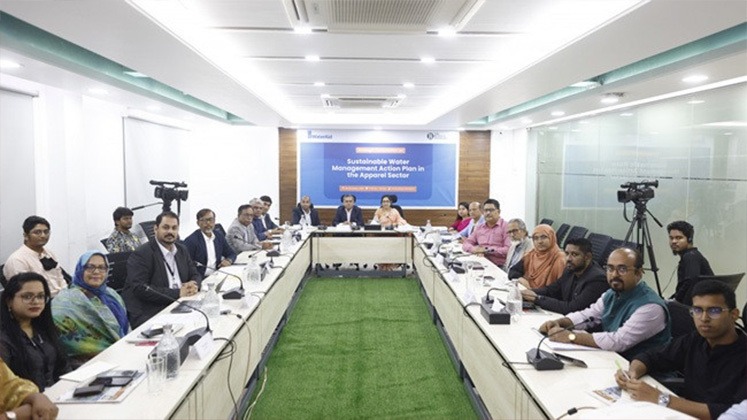
Bangladesh’s key industrial zones are facing an escalating groundwater crisis, with levels in Gazipur reportedly dropping by two to three metres each year — a rate experts describe as “alarming” and potentially catastrophic for the country’s manufacturing base. At a high-level roundtable in Dhaka, water resource specialists warned that industries could soon struggle to secure the water required for production unless extraction is curbed and conservation becomes mandatory.
WaterAid Bangladesh Country Director Hasin Jahan said water must be treated as an economic commodity, not a free input, if wasteful usage is to be reduced. She noted that introducing regulated charges for industrial water could drive efficiency, encourage alternative sourcing and reduce dependence on groundwater, which remains the dominant supply for textile and RMG production.
Experts at the roundtable stressed that despite longer monsoon seasons, natural recharge capacity is weakening due to urbanisation, soil compaction and unplanned industrial expansion. As a result, rainfall is no longer replenishing aquifers at expected levels, raising fears that reserves are shrinking far faster than they can recover.
A major operational challenge also emerged: while many factories have effluent treatment plants (ETPs), the high cost of running them means they are often kept idle and used only during inspections. Specialists called for digital monitoring systems, stricter inspections and compulsory metering to ensure genuine compliance.
Concerns deepened as discussions turned to zero-discharge readiness. More than 70 per cent of factories reportedly lack the physical space for advanced treatment systems, while smaller firms face significant financing barriers to adopting sustainable water solutions. Industry representatives added that green investments increase operating costs by around 30 per cent, yet brands rarely offer price incentives, weakening motivation for environmental upgrades.
Proposed solutions included enforcing industrial water pricing to curb reckless extraction, improving water governance, offering financial incentives, enabling private-sector operation of treatment facilities and scaling up rainwater harvesting. Stakeholders warned that without urgent pricing and metering reforms, both industrial operations and surrounding communities could face severe water shortages in the near future.