From the USA to Europe, Australia and far off, fashion retailers have pushed the pause button. With more than half the global population under lockdown, brands have shut down stores in thousands.
All major brands and retailers have cancelled or postponed orders (including those already produced) across supplier bases, thereby disrupting the entire fashion development, order and production cycle. And things aren’t expected to improve any time before August or September this year, underline industry insiders and many surveys.
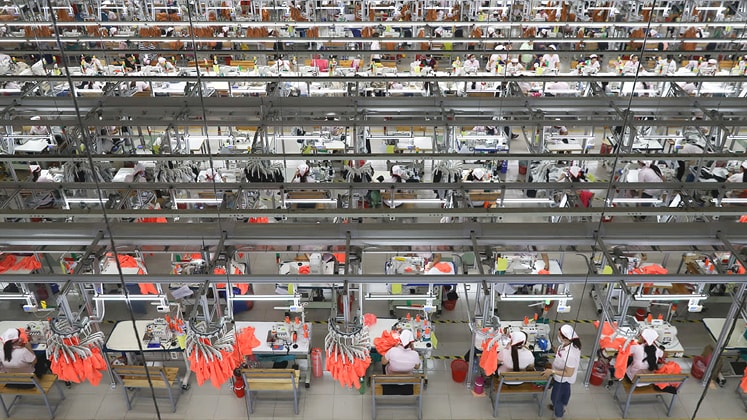
This has put manufacturing nations under peril. China, the world’s biggest exporter of readymade garments, has not been spared either. In February, they were unable to produce for orders already received in view of the lockdown in China. And by March when things started improving slowly and factories hoped to make up for the lost business, the coronavirus pandemic turned into a full-blown crisis, forcing retailers to cancel orders en masse.
Figures collated by Apparel Resources’ data team found China’s market share in the US apparel import market alone dropped to 21.3 per cent in February 2020, a new record low, which is in addition to the export loss of around US $ 1.19 billion in textiles and apparel shipments in the first half of 2019 due to the trade war. An estimated 18 per cent of China’s textiles exports go to the US, making this China’s largest export market for textiles, valued at around US $ 50 billion. This also makes China the largest exporter of textiles and apparel to the US, accounting for 38 per cent of the nation’s total imports. As per Apparel Resources’ data, what’s even more worrying from China’s perspective is its lost market shares have been picked up mostly by other Asian suppliers, particularly Vietnam (18.8 per cent YTD in 2020 vs. 16.2 per cent in 2019) and Bangladesh (9.1 per cent YTD in 2020 vs.7.1 per cent in 2019). In Europe too, the scenario in not much different.
Even though China has managed to get a large part of its economy up and running from a standstill in February, worries still remain. Around 86 per cent of large and small manufacturers in 28 textile industrial estates across China resumed work by March-end (according to the China National Textile and Apparel Council) but as per a survey conducted among 190 firms in the last week of March, more than 60 per cent of exporters have reported orders half the normal.
It may be mentioned here that in China, SMEs make up over 60 per cent of the GDP, and what makes things all the more complicated is the fact that they are not typically financed by the mainstream banks and financial institutions, rather by what experts call the shadow banking system, which doesn’t receive Central Government bailouts.
“All those (small) businesses are going to be severely impacted,” feels James Nolt, an Asia specialist at the World Policy Institute.
The Jan-Mar 2020 data released in April by the National Bureau of Statistics underlined that China’s GDP in the first quarter fell by 6.8 per cent year-on-year. Among them, the added value of the secondary industry, including the textile industry, suffered relatively great damage with a year-on-year decrease of 9.6 per cent. Meanwhile, Moody’s has forecast China’s real GDP growth at 3.3 per cent for 2020, adding the weak external demand would continue to constrain China’s export growth as the rest of the world struggles to combat the COVID-19 outbreak.
“The entire export-oriented supply chain is facing pressure,” maintains Jeremy Maclaurin, who runs China Textile Traders (which helps brands source from the southern Chinese manufacturing hub of Guangdong province), while speaking to the South China Post.
The cascading effect of the current standstill situation in the manufacturing sector has also hit the employment market with urban unemployment rate feared to reach as high as 15 per cent by the end of the year. Layoffs, too, are not ruled out.
However, even as apparel exports have hit a stumbling block, some manufacturers have resorted to making face masks and PPE, which are in high demand across the globe, while many others have pinned their hopes on the local market to tide over the trying times. But that is not good enough to keep all garment manufacturers and ancillary industries engaged, whereas there are several countries that are still in lockdown – which leads to the question, ‘who is buying’?
Also Read: What manufacturers have to say on the industry crisis
“Even though exports are down, garment makers are now catering to the huge domestic demand,” Vincent Djen, Director of Cheng Kung Garments, Shanghai (China), shares with Apparel Resources.
The size of China’s apparel market is approximately around US $ 330 billion (as of 2019), which is second only to that of the USA, with a market size of approximately US $ 345 billion.
Many economists are of the view that China’s strong domestic market could play an effective supporting role going forward, and there is still room left for macro hedging policy to give the economy a further boost.
However, the concern remains that even after everything goes back to normal, China’s repute and standing as an apparel manufacturing hub may not remain the same with buyers resorting to a dynamic sourcing strategy, which may not augur well for the dragon nation.
“Multiple shoring is going to be the new trend. They (buyers) won’t take any risk to place orders in bulk in any one particular country, rather they would distribute it amongst the manufacturing destinations,” Vincent explains.
Now, if and when the brands and retailers are able to come out of the COVID-19 crisis, resume business akin to pre-endemic days, and most importantly, whether they would keep their dependency on China unchanged, are open to conjectures still.