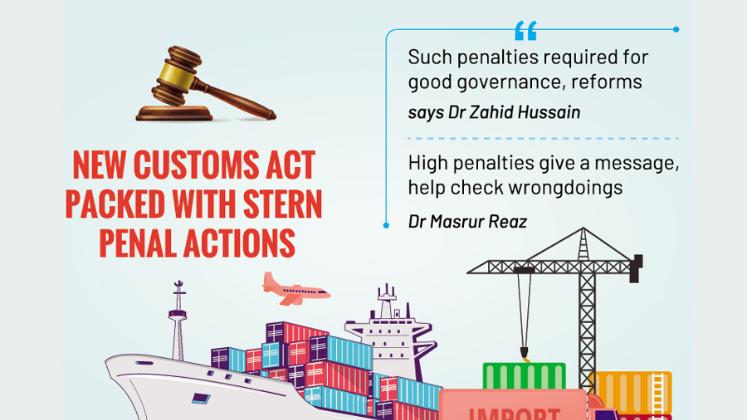
Import and export-related violations may face more severe consequences as a result of the new customs statute, which calls for a wide range of severe punitive measures against offences related to commerce.
The Finance Act 2024 may be used to execute the law, which was approved by parliament on 25th October 2023, according to officials.
They said that the National Board of Revenue (NBR) is currently in the process of writing the regulations needed to put the new act into effect.
Comparing the new act to the Customs Act 1969, a recent analysis by Business Initiative Leading Development (BUILD) reveals a significant increase in the number and severity of the harsh penalties.
However, economists find it justified to curb the volume of misdeclaration, under-invoicing, and over-invoicing and check trade-based money laundering.
According to Global Financial Integrity, US $ 8.27 billion had flown out of Bangladesh on average annually (between 2009 and 2018) through under-and over-invoicing in export and import trade.
The BUILD review has found 98 subheadings of penalties in the Customs Act 1969 while the latest customs act contains 45. Nonetheless, the new law has generally increased the severity of the punishments.
For example, under the new act, customs authorities have the authority to impose fourfold penalties, instead of the current twofold, for false statements made in import-export (unreal statement section 33).
Customs will impose a 10-per cent penalty (in the form of interest on the tax) if duties, taxes, or other modifications are not paid by the deadline following import-export transaction. Any remaining balance would likewise be subject to the same penalty.
However, the analysis concludes that the penalty clause is absent from the existing act.
In an attempt to unload or load goods from customs points other than declared ports, the new act has reduced the penalty but increased the time of imprisonment for at least one year, keeping a maximum of six years in jail unchanged.
However, the penalty has been reduced to two times from the existing ten times on the value of the goods.
Fines have also been increased for irregularities in the transshipment of goods, temporary stock of import goods, boat notes, declaration of cargo or arrival time of transport, routes, crew, passengers, names of customs stations as arrival of goods.
As per the Trade Facilitation Agreement (Article ii: (b) additional fees, charges, etc beyond customs duty will be considered as ODC, which is contradictory to the TFA agreement and WTO rules.