Uncertainty is one word that perhaps best describes the current state of Bangladesh readymade garment sector! On one hand, there are allegations of mass order cancellations, while on the other, rumours have it that garment workers are also being laid off en masse.
What’s more, the countrywide shutdown implemented by the Government to contain the further spread of coronavirus was first extended till 25 April, and then until 5 May.
The consequence, work in thousands of garment manufacturing units excepting a handful that are making the Personal Protective Equipment (PPE), have come to a grinding halt. Even though the Government has announced a coronavirus bailout package of Taka 50 billion to pay the salaries of the workers, businesses in general have nothing much to talk about when it comes to the much-needed fiscal support to tide over this situation.
Also Read: What goes into making a body coverall?
Amidst this all-engulfing confusion and business uncertainty, Apparel Resources caught up with some prominent names amongst the stakeholders to get insights into the existing situation and how they foresee the business of apparel manufacturing and exports going forward. Here are the excerpts…
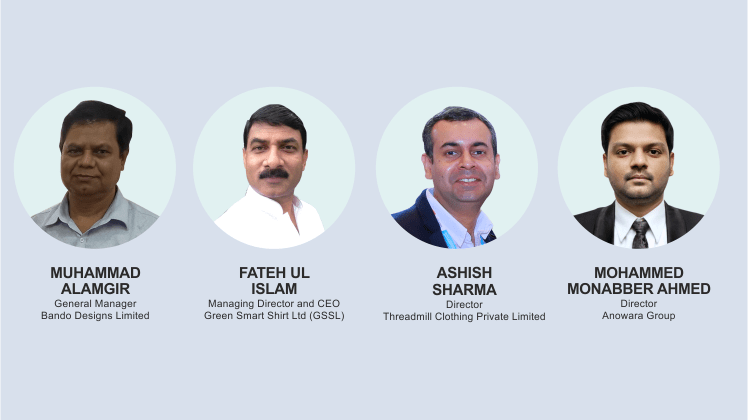
Muhammad Alamgir, General Manager, Bando Designs Limited
Current state of COVID-19 in Bangladesh
The medical situation is scary, as only around 1,000 people are being tested per day for coronavirus. The country is in complete shutdown and the two major hotspots are Dhaka and Narayanganj, which are amongst the major apparel manufacturing hubs.
Business and buyers’ support
There are not many cancellations from the buyers. We have a total order volume of three million pieces and drop order would be to the tune of approximately 300,000 units. So, we have 2.7 million pieces of orders intact.
We work majorly with H&M, JCPenney, C&A and Walmart, and none of them have posed as any challenges or given us a tough time. What’s more, Walmart has taken all the shipments even in the time of lockdown. Besides, our buyers are in constant touch with us through emails and over phone.
However, as the lockdown has been further extended till 5 May, we might face some difficult situations with the buyers. European buyers have assured that the orders will be placed by mid-June and the shipments will be due in November 2020.
We are also carrying out Product Development (PD) through virtual designing. Digitisation is playing an important role in designing and PD now, and buyers are sending us techpacks with images. They are also sending fabric development packs to the factories and the fabric mills (buyer nominated mills) with the count and construction, along with the colour codes mentioned on them. So, when we are out of the countrywide shutdown, we would be ready with the confirmed designs and approximate costs, and only the fit sample stage will have to be taken care of then. However, there are chances that when we start operating, some of our production capacity might be idle.
Contingency plans/Government support
We can plan things once new orders start coming in. Speaking to the buyers, we feel that the order scenario will be clear by June as the buyers would also start operating by then and also then they would be assessing purchasing capacity of the customers, which will help all to get a clear picture and help us to plan things accordingly. However, till then nothing concrete could be said.
As of the current scenario is concerned, we feel the Government will have to plan some contingency roadmap, especially for the workers, as most of the factories are shut and there are no orders.
Supporting the workforce/CSR
Most of the factories, in their individual capacities, have rolled out plans to help the workers in whatever way possible. Also, all the garment exporters with the help of the Bangladesh Garment Manufacturers and Exporters Association (BGMEA) have created a fund to feed and take care of the needy. The privileged class of the society is also contributing to ensure that the poor and underprivileged are not abandoned in this time of crisis.
Fateh Ul Islam, Managing Director and CEO, Green Smart Shirt Ltd (GSSL)
Business and buyers’ support
The business looks difficult for the next 6 months. Overall, 2020 will be a year that is best written off from the business calendar, as we don’t hope to make much profit as there won’t be substantial order placements, we feel. We are also not sure if we would be able to make up for the loss suffered during the first two quarters, in the next two quarters even though we, as a group, have business for the remaining two quarters.
Even though we were able to ship most of the goods, there were some cancellations and some push backs as well. Primark had initially cancelled in the beginning of the coronavirus crisis, but later restored the same but with longer deferred terms. Some push backs, we feel, are genuine as the buyers had placed orders for SS20 and the selling period is now over. The buyers now wish to take goods for SS21. However, some customers like Bestseller are asking for discounts as high as 25 per cent, which we are negotiating on.
Considering the current scenario, we feel both the manufacturers and the buyers have to reach an understanding and be in reasonable terms in such difficult times. How one comes across and deals with another in such times is very important that reflects one’s ethics as well.
The BGMEA has been very supportive and vocal with the buyers about the 4 million people whose livelihood depends on the RMG sector and that has helped the exporters to restore their orders.
Contingency plans/Government support
Our short-term goal, i.e. for the next 6 months, will be to just sustain and after that we would like to foray alliances with the buyers in a way that they help cut costs for the buyer as well and ensure long-term business relationship. We will also try partnering with a few of our customers with robust quantities and ensure growth.
The Government has allocated a bailout package of Taka 5000 crore to pay the workers’ salary for the following months but it comes as a soft loan. This loan is only for salary and the amount will be directly paid to the workers’ accounts. The exporters will not get any benefit out of it. The Government has, however, announced some other packages to help the exporters.
Supporting the Workforce/CSR
We don’t have any contractual labour in our organisation. As of those who are in the payroll, we have already paid them the salaries for the month of March. Besides, as part of the CSR initiative, we are planning to open a part of the factory to produce half a million pieces of PP Gowns and 5 to 6 million pieces of face masks for the people of Bangladesh.
Ashish Sharma, Director, Threadmill Clothing Private Limited
Current state of COVID-19 in Bangladesh
The scenario currently is a bit worrying, as not enough testing is taking place so cases are also going under/unreported.
Business and buyers’ support
Most of the orders are being cancelled or put on hold, as stores are shut in the West. Many Australian buyers are also refusing to release goods under the force majeure clause. However, as far as we are concerned, the positive part is that our bulk buyers are from France and Italy, and these two countries have allowed to ship. Overall, the situation is very tricky and we cannot go ahead and produce the goods, as it’s a very vulnerable market.
The Government support is imperative, and right now without any clarity, we have not thought of a contingency plan.
Contingency plans/Government support
The Government has extended support of Taka 50 billion in the form of soft loan to pay the workers’ wages. Many factories have paid the salaries for March, but without further Government support, it will be difficult to pay the wages going forward. As it is a ‘take it or leave it’ kind of situation from the buyers’ end, salary cuts and layoffs are happening in the liaison offices with higher paid expats, to start with.
The major challenge towards making any contingency plans will be the issue of order reduction/cancellations, as the buyers are not yet clear about store openings.
Also Read: COVID-19: What the stakeholders are doing to prevent worker layoffs
Mohammed Monabber Ahmed, Director, Anowara Group
Current state of COVID-19 in Bangladesh
The situation does not look good, as the testing rate is pretty low in Bangladesh currently.
Business and buyers’ support
Business has been affected with buyers asking for delayed shipments/reduction in order sizes. Also, buyers are offering deferred payment options seeking a payment period of 90 to 120 days. Even though we have some orders in hand but with lockdown, we have no idea on how and when we can start production. Also, we won’t have orders going forward.
Further, when the work starts again, there is a doubt that the buyers will be placing similar quantities like before. That is why we are planning to reduce production capacity by around 50 per cent, so that we don’t have to incur huge fixed costs by running full capacity. I, personally, am not in favour of this, as there are emotions attached with the people working for us for years together and running at 50 per cent of the capacity will mean letting go of almost 50 per cent of the workforce. So, we are in a wait and watch state currently.
Contingency plans/Government support
We are currently putting some capacity towards producing masks for helping in fighting COVID-19 and supplying them across the world. But if the current situation lingers for long, layoffs cannot be ruled out in the worst-case scenario. We have already paid the workers for March, and also April, based on the temporary layoff rule.
We appreciate the Government support of Taka 50 billion soft loan towards the export sectors at a low rate of interest of 2 per cent. However, there is a need to support the workers further, especially those who work on contractual basis.
Supporting the workforce/CSR
When the COVID-19 came to light, we as a company planned to make PP Gowns and cotton masks as part of CSR activity to support the society, but that plan couldn’t materialise, as the factories had to shut down soon after.
I feel the buyers should have asked the vendors to produce masks as a deed done in favour of humanity, but sadly, no one has taken that initiative.
Also Read: Factories implement safety protocol as industry gets back to work