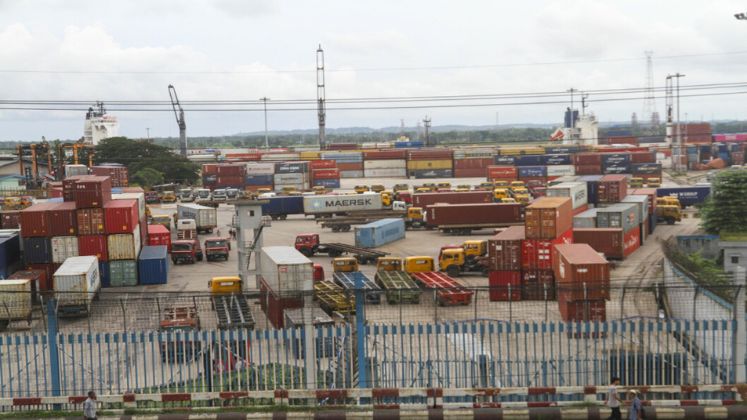
To lessen container congestion, the Chittagong Port Authority and Chattogram customs have taken the initiative to keep operations running around the clock, even on weekends and public holidays.
The purpose of the action is to reduce the backlog of containers and expedite import-export procedures, which were severely hindered by the statewide unrest, curfew, and protests over quota reform, as well as the ensuing five-day internet outage.
The Chittagong port typically handles between 30,000 and 32,000 TEUs (twenty-foot equivalent units) of containers, according to port officials. On Tuesday, though, that number was 43,578 TEUS, or more than 81 per cent of the port’s 53,518 TEU total capacity.
According to port data, 4,338 TEUs of import containers were discharged while 3,955 TUE containers were shipped for export in the 24 hours till 8:00 am on Tuesday.
Md Omar Faruk, secretary of the Chittagong Port Authority (CPA), told the local media, “Import and export container congestion is decreasing day by day. We still have fewer containers than capacity. However, efforts are underway to bring it to below 40,000 TEUs. We have taken several steps and hope to bring it under control in the next three to four days.”
Container congestion is also being witnessed at the 19 private inland container depots, which handle around 90 percent of the Chattogram Port’s exports.
Although these depots normally have around 6,000 to 7,000 TEUs of export containers, they are currently storing nearly double the amount, averaging around 15,400 TEUs.
These depots, constructed to alleviate the pressure on the Chattogram Port, release 38 different types of imported goods and store empty containers.
Furthermore, the port’s designated container storage area, which holds containers for freight rail transportation, is currently overflowing with 2,470 TEUs—nearly three times the 876 TEU capacity.
In addition to costing importers money, the congestion is interfering with the port’s ability to operate, since about thirty percent of the yard needs to be kept free to facilitate the easy transfer of containers.
To alleviate some of the burden, importers will have the option to release their products via the ports of Chittagong and Pangaon rather than the Kamalapur ICD, according to the port and customs authorities.
The customs and port authorities also demanded that the railway authority ensure at least 200 TEUs of containers are transported from the port daily, up from the existing 80-100 TEUs. To this end, they said the number of railway engines as well as the number of wagons should be increased.