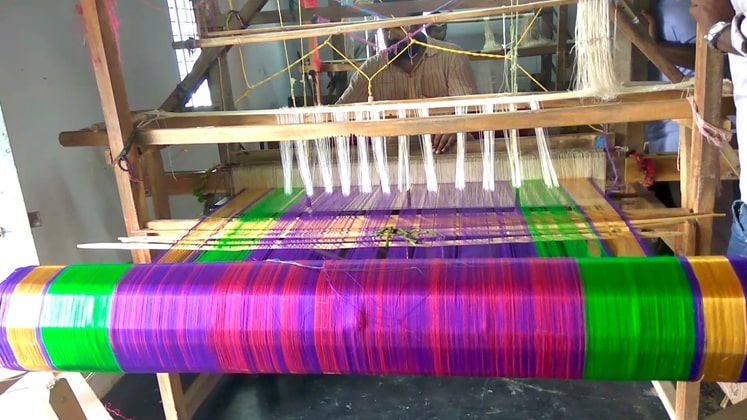
Today the country is celebrating the National Handloom Day (7th August) with nationwide events planned for the day. India is celebrating the occasion for the fifth year. Right from the Prime Minister Narendra Modi and the Textile Minister Smriti Irani to many other stakeholders of the textile/fashion value chain, everyone keeps promoting handloom from time to time. But ground realities are not worth celebrating, and there are many reasons for the same including decreasing export of handloom products, reducing number of weavers as well as their income, etc. Around 66 per cent of handloom weavers in India earn less than Rs. 5,000 per month.
On this day, Apparel Resources takes a closer look at the reasons as to why handloom is important, the efforts to promote the same, and why it is not growing despite all these efforts.
The prime concern to promote handloom is the welfare of Indian weavers, artisans, craftpersons, and to preserve India’s rich and diverse heritage and legacy. In order to ensure this, there is a large network of government organisations like the Office of the Development Commissioner for Handlooms (assisted by 28 Weavers’ Service Centres across India), National Handloom Development Corporation (NHDC), Handloom Export Promotion Council (HEPC), and Indian Institute of Handloom Technology (IIHT) among others. These have taken various steps, from time to time, and have also launched many schemes for the development of the handloom sector. Few major initiatives include India Handloom Brand, The Handloom Mark Scheme, Yarn Supply Scheme, Comprehensive Handloom Cluster Development Scheme, National Handloom Development Programme, Cluster Approach, Hathkargha Samvardhan Sahayata, and Capacity Building under SAMARTH, etc.
Apart from these, there are also various other organisations under State Governments like Karnataka Handloom Development Corporation (KHDC), which has its own brand called ‘Cauvery’.
As per the Ministry of Textiles (MOT), under the MUDRA loan, in 2019-20, there were around 3,69,456 beneficiaries who got a loan of Rs. 1,876 crore. Leading e-commerce portals like Flipkart are also associated with the State Governments to promote handloom. Often, few designers have also taken some initiatives to promote handloom. NIFT and its students are also part of handloom promotion.
Under various State Governments as well as on individual levels, some efforts deserve appreciation; for example, Himachal Pradesh government associated handloom with tourism so as to benefit the overall economy. In Andhra Pradesh’s Narsapur town, handmade crochet lace-work is one of the most common forms of industry. Few individual firms from this town are doing well in export also.
Handloom sector is undoubtedly important, as it contributes nearly 15 per cent of the fabric production in the country, and 95 per cent of the world’s handwoven fabrics come from India. At the same time, this segment is also important from the employment point of view, as it provides direct or indirect employment to around 4.3 million weavers and allied workers. Majority of these workers are women. The contribution of the handloom sector to the Indian economy is as high as Rs. 50,000 crore.
But despite such financial and traditional importance and plenty of efforts, why is the condition of weavers not improving?
As per the official data based on around 5,457 units (non-household) covered under the Fourth Handloom Census, there were 1,16,724 working looms, while 31 per cent (37,053) were idle. The main reasons for the idle looms were the lack of market demand (49.6 per cent), non-availability of weavers (27.5 per cent), and lack of capital/funds (22.9 per cent). The working loom is a loom that has been operated during the last one year, while the idle loom has not been operated during the last one year.
The fact that there is a lack of market demand for handloom products is also strengthened by the product categorisation. The same report also says that saree is the single largest product (22.9 per cent) after shawls, Mekhla Chadder, Loi, stole, scarf, muffler (26.7 per cent), while dress material (salwar, kameez, etc.), suiting, shirting, and the long cloth is just 3.2 per cent. Overall, these products (saree and shawls, etc.) don’t have high demand in export as well as for masses in India.
As far as export of handloom products from India is concerned, from 2013-14 (US $ 370.2 million), it is going down. The same was valued at US $ 343.69 million in FY19.
As per the fourth All India Handloom Census (2019-20), export contributes only 0.4 per cent as far as the source of sales by handloom households is concerned, while local market contributes the maximum (64 per cent).
Weavers and allied workers have been in great distress across the country for years, and the MoT officially accepted that the number of handloom weavers is declining sharply. It has low productivity in comparison to the power-loom and mill sector. And there is a very limited scope of technological upgradation and improvement in weaving activities. Whatever little business is there, weavers, and especially their younger generation, are not much keen to continue their business.
Amidst a time like this time when all the focus is on skills and increased efficiency, how can a sector with low productivity even think to grow?
It is also important to note that the Government’s budget is also reducing for the handloom sector. In the last Union Budget (2020), the Government allocated Rs. 485 crore to the handloom sector which is even lesser than the budget of 2014-15 that was (Rs. 621.51 crore).
The unorganised nature of the business has led the handloom sector to become one of the worst-hit due to demonetisation, GST, and now the pandemic. Whatever schemes, efforts, and promotions are already there or being demanded further by this sector, it must be kept in mind that the handloom sector should be self-sustained. Otherwise, sooner or later, this sector might end up in an even worse situation which will not be in anyone’s interest. It is good to see that some initiatives have already started with this approach. The Women’s Indian Chamber of Commerce and Industry (WICCI) will launch its National Handloom Council, which will have a chapter in every state, and it also plans to work on many other initiatives. If the handloom sector will not be self-sustained, it is sure that all the efforts will be wasted.
Apparel Resources highlighted earlier also that there is a strong need to increase the design intervention in the handloom sector. Several organisations/departments have also contributed to the downfall of the sector, as it gets difficult to create and manage one single goal. So, one nodal agency for every intervention would be better – also, it will save a lot of manpower, money and even quicken the decision-making process.