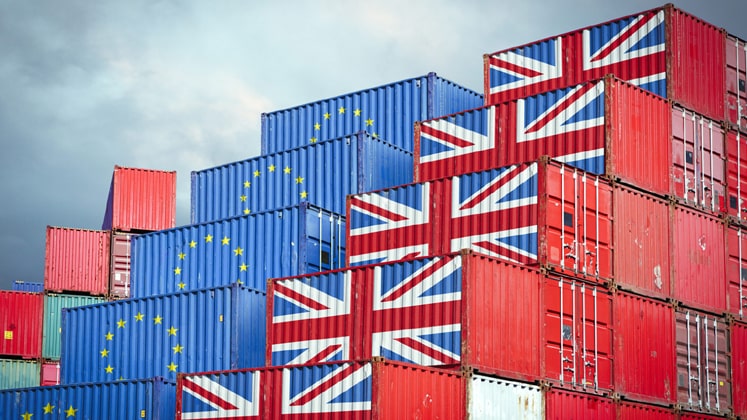
Apart from the USA, the European Union (EU) is a major apparel export hub for Bangladesh. The country exports around 90 per cent of its garment products to the US and EU markets and ranks third in the EU market, after China and Turkey. It also enjoys trade benefit in EU under the GSP regime, despite some cloud of uncertainty hovering over it lately on account of labour law reforms in the country.
Nevertheless, in 2018, Bangladesh’s total apparel export to the EU was around US $ 19.32 billion, up 11.17 per cent year-on-year, and this good run continued well into 2019. However, the outbreak of COVID-19 seems to have put the economy of EU block in disarray that could pose serious challenges to Bangladesh in the export front in the days to come.
A report published recently forecast that the eurozone economy would contract by a staggering 7.7 per cent in 2020, warning the wreckage from the coronavirus outbreak could endanger the single currency. Calling it a ‘recession of historic proportions’, the EU executive said the 19-member single currency zone would rebound by 6.3 per cent in 2021, but in a recovery that would be felt unevenly across the continent.
And as per another study, consumption in the EU market is expected to fall by 59 per cent, which further forecast that the economy of the EU would shrink by 5 to 6 per cent.
The saving grace in all these is perhaps the uneven nature of the recession across the block and individual countries’ ability to recover from it. There’s worry in Italy and Spain that wealthier Germany and the Netherlands have the means to swiftly turbocharge their own recoveries, leaving the south trailing in their wake.
A major concern for the block, the speedy recovery of Netherlands and Germany seems to hold some ray of hope for Bangladesh for sure.
Recently, amidst large-scale order cancellations by western buyers that had put Bangladesh’s apparel manufacturing sector into jeopardy, the Netherlands along with Sweden had come forward to pledge solidarity with Bangladesh.
The Dutch Minister for Foreign Trade and Development Cooperation Sigrid Kaag, during her telephonic interaction with Bangladesh Foreign Minister AK Abdul Momen, underlined that buyers from her country would not cancel or suspend any orders. She gave this assurance to AK Abdul Momen when the Bangladesh Foreign Minister raised the issue of large-scale order cancellations by the European buyers, amounting to a staggering US $ 3.18 billion, and how the same has impacted Bangladesh’s readymade garment sector and millions of people who are dependent on the industry for their livelihood, directly and indirectly.
Swedish Prime Minister Stefan Löfven also confirmed to his Bangladesh counterpart Sheikh Hasina that his country would continue to import apparels from Bangladesh and there won’t be any order cancellations.
Now that the Netherlands is expected to come out of the recession earlier than many of its European counterparts, Sigrid’s assurance of order continuance is surely something for Bangladesh to look up to.
“Germany will open soon and Sweden is already open,” said Khosru Chowdhary of Nipa Group, which is a clear indication that these countries are not only working on plans to come out of COVID-19 lockdown phase successfully,but are also looking at reviving their economies – which is definitely a welcome development for Bangladesh. What’s more, the recovery from the recession is expected to be much enhanced for Germany’s economy, which was predicted to sink by 6.5 per cent in 2020 and recover 5.9 per cent in 2021.
During fiscal 2017-18, Bangladesh’s apparel export to Germany amounted to US $ 5.89 billion – a major surge of over 7.5 per cent. Bangladesh fetched over 16 per cent of its total apparel export revenue from Germany during the period while during the July to January 2020 period, Bangladesh’s apparel exports to Germany amounted to US $ 3.51 billion – an increase of 9.6 per cent from the same time last year.
Buyers from Germany also came in for some praise from Khosru for their payment handling in these trying times.
German buyers have been the best and there was no delay or deferred payments from their end, claimed Khosru, who along with Rumana Rashid of East West Industrial Park and Arshad Jamal of Tusuka Group agreed that there would be some dip in the order volumes nevertheless.
“There will definitely be reduction in order quantities for few quarters. Market will be slow and price points will be more competitive,” underlined Rumana, while Arshad on his part maintained that business in the coming 6 to 12 months will see a 20-30 per cent drop in the volumes, but eventually, if manufacturers and the buyers act proactively and are able to successfully cut cost, businesses will prosper again.
Meanwhile, the national governments in the EU have deployed trillions of euros to keep businesses open, while the commission is currently drawing up a recovery plan that would boost the EU’s common budget and help the European Union come out of the recession at the earliest possible.
Also Read: What manufacturers have to say on the industry crisis?