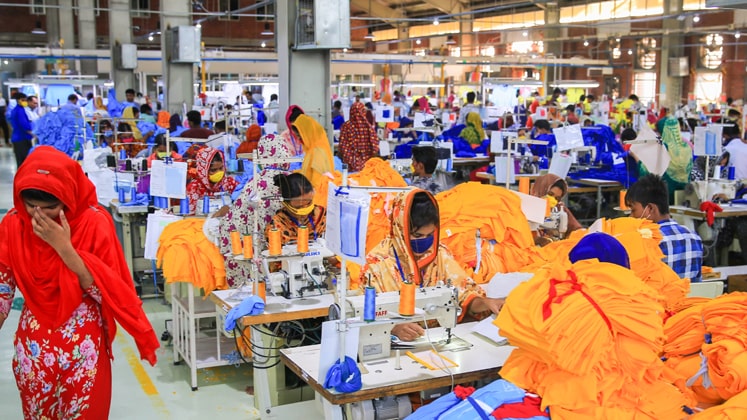
It was a dark year for the industry, said the President of the Bangladesh Garment Manufacturers and Exporters Association (BGMEA), Dr. Rubana Huq adding to put things into perspective, the Christmas sales in the Western world were the lowest in recent memory for the second round of lockdowns in much of the Western world even as Executive Director of the Policy Research Institute of Bangladesh, Ahsan H Mansur, on his part said, “To sell products, you have to have a buyer. With people dying or falling ill, who would buy goods?”, thereby summing up the bleak overall scenario.
However, 2021, experts and industry insiders hope, could bring in the much-needed change, the industry is waiting for. “We expect the garments sector to recover from June 2021,” expressed hopes the BGMEA President, adding, “We will mainly consolidate our business by decreasing operational expenses through restructuring while focusing on product diversification and securing new markets in 2021.”
It would not be an exaggeration to maintain that the year 2020 has really been an unprecedented one in every respect! The Coronavirus pandemic has left the country’s readymade garment (RMG) sector with scars — uncertainties, anxieties, fears and trepidations — which will take time to heal.
The apparel industry ran into trouble right from the beginning of the year after the virus was first detected in China in November 2019 as Bangladesh is largely dependent on China for the raw materials and the complete supply chain breakdown that ensued had disastrous implications on the industry. The subsequent turn of events, marked by countrywide shutdown, manufacturing units bowing out of business for good, workers’ retrenchment, largescale order cancellations by brands and buyers, rising demand for discounts and not to mention the export debacle, combined together to leave the industry in a rather vulnerable position.
According to BGMEA data, a total of 1,134 member factories of the trade body reportedly faced order cancellations or holding up of export orders due to the pandemic while as per another report, a total of 418 garment factories met with temporary or permanent closure from March to May due to the pandemic.
Export debacle of ’20
Bangladesh’s overall export earnings in 2020 fell by 14.57 per cent to US $ 33.60 billion from US $ 39.33 billion in the previous year due to a lower shipment of readymade garment products as the Covid-19 outbreak hit hard the global business. According to the Export Promotion Bureau (EPB) data, export earnings in the first half (July-December) of the current financial year 2020-21 fell by 0.36 per cent to US $ 19.23 billion from US $ 19.30 billion in the same period of FY 2019-20.
Overcoming an unprecedented supply chain disruption in March-May of 2020, export earnings began to increase from June but the second wave of Covid-19 started taking its toll on the earnings from October, exporters said. They also said that the country’s export business faced a dire situation in the first half of 2020 as global buyers halted and cancelled their import orders for readymade garment products due to the pandemic.
Export earnings in the second half (July-December) of 2020 almost came back on track but for the second wave of the outbreak in the United States and European countries, which caused more woes to the exporters. The EPB data showed that the export earnings in December 2020 fell by 6.11 per cent to US $ 3.31 billion from US $ 3.52 billion in the same month of the previous year.
The readymade garment export in 2020 decreased by 16.94 per cent to US $ 27.47 billion from US $ 33.07 billion in 2019 and out of the US $ 27.47 billion earnings from RMG in 2020, US $ 11.92 billion came in the January-June period and US $ 15.54 billion in the July-December period, the data showed.
Further, export earnings from woven garments fell by 10.22 per cent to US $ 7.02 billion in July-December of FY ’21 from US $ 7.81 billion in the same period of the previous fiscal year. The earnings from knitwear export in the first half of FY ’21, however, increased by 3.90 per cent to US $ 8.52 billion from US $ 8.20 billion in the same period of FY ’20.
“We should not count or consider the figure as it is,” underlined the Managing Director of Giant Group, Faruque Hassan, adding 2020 was an abnormal year for the global economy.
This brought down the demand for fashion goods as well as other non-essentials, explained Faruque, adding the crisis deepened further as the second wave of the pandemic compelled several countries in Europe and the US to go into fresh lockdowns.
“Thus, we lost our exports,” he explained.
However, it’s just not the garment exporters who had to suffer losses, the workers, who propel this industry (considered the lifeline of Bangladesh’s economy), did not suffer any less.
Workers face the heat!
The year pushed the workers through daily nightmare of losing job and income due to the pandemic-induced economic downturn.
The 41 lakh people engaged in the sector faced uncertainties and the entrepreneurs who built their factories with the hope of expansion and future growth faced a dark time, the BGMEA President said, adding, “Eventually, after the brands reinstated 90 per cent of their orders, we still had to face the back-to-back liabilities of US $ 1.96 billion, which remained unpaid, because of non-payment by buyers or their bankruptcy.”
The BGMEA President identified uncertainties over the placement of orders from buyers’ end, lack of working capital for small and medium enterprises, bankruptcy of brands, deferred payments and price discounts as the challenges for the RMG sector that employs the largest chunk of the country’s women workforce even as labour leaders claimed that more than one lakh RMG workers have lost their jobs amid the pandemic while the BGMEA said that the figure was 76,000 with nearly 40 per cent of them reinstated in recent months. The global labour rights advocate Clean Cloth Campaign (CCC) estimated that the RMG workers in Bangladesh lost US $ 501 million or 29.5 per cent of their total monthly wages from March to May.
The former Secretary General of IndustriALL Bangladesh Council, Towhidur Rahman, said 2020 was a year of uncertainties for the workers, adding while more than one lakh RMG workers lost their jobs, thousands of others suffered wage cuts in the year.
The Government and the BGMEA, Towhidur said, have provided health guidelines for the workers but many factories have failed to comply with the guidelines. He also blamed the international buyers for not following ethical business practices, saying the cancellation of work orders and reducing the unit prices of products took a toll on the workers.
Clamour grows strong for extension of support package
Appreciating the Government’s stimulus packages announced in March 2020, the BGMEA President said majority of the factories might have faced closure if they did not receive the support.
Had the bureaucrats not supported the private sector, we might have been in a dire strait, underlined Rubana while seeking a fresh wage support for another four months effective January 2021. The new package with 2.0 per cent service charge should be given for a payback period of five years with a moratorium of 12 months, she underlined while seeking extension of the current package’s tenure to five years and an extension of moratorium up to 12 months, saying it would be of immense help to the sector.
“The support will help the sector go to the next level as we think will be excelling by June, because, our other competitors — Ethiopia with its political instability, Cambodia with its loss of GSP and Vietnam with its limited production capacity — will not be in a better position,” she noted.
Rubana further explained that the temporary support would help revive the industry and take it to a far superior level, which would help them in product diversification, recycling, value addition and preparing for the 4th industrial revolution and in the process, help their workforces achieve better skills as well.
What 2021 looks like?
Economists see a promising 2021 for Bangladesh because of the rollout of Coronavirus vaccines globally and manageable impacts of the pandemic on the country, while sounding out alarms about the bumpy road the economy has to ride before full recovery takes place.
Several business leaders and entrepreneurs have also expressed hopes that Bangladesh’s economy will start to recover from middle of 2021 after the Covid-19 vaccine arrives. “We expect the garments sector to recover from June 2021,” said Rubana, while adding the ongoing crisis has exposed the garment sector’s vulnerability to forced closures and contract losses.
“We will mainly consolidate our business by decreasing operational expenses through restructuring while focusing on product diversification and securing new markets in 2021,” she added.
With a vaccine already being disbursed in the UK and USA, the Bangladesh Government has signed a trilateral deal with Beximco Pharmaceuticals and the Serum Institute of India for three crore doses. “We are very optimistic about 2021. The pandemic will be handled through the import of vaccines,” underlined Prof Shamsul Alam, a member of the Planning Commission, who added that the economy received a shock in 2020 because of the pandemic, but the good thing was the country has recovered rapidly.
If we can handle the new Coronavirus strain well and execute mass vaccination through proper regulation and management, we will be able to recover from the damages we incurred in 2020, claimed Sayema Haque Bidisha, Professor of the Economics Department at the University of Dhaka even as the distinguished fellow of the Centre for Policy Dialogue (CPD), Mustafizur Rahman, on his part said the activities of the economy would largely depend on how the country deals with the availability, access and distribution of vaccines.
There is an expectation that the stimulus packages would be repaid and recycled in 2021, so it would also have an impact on the economy, Mustafizur said, adding a weak point is the private sector investment, which was stagnant at about 24 per cent of GDP even before the pandemic.
Meanwhile, Managing Director of Plummy Fashions Limited, Fazlul Hoque also hopes that the country’s economic recovery would start from June next year as the vaccine is all set to roll out soon. “We experienced some negatives and a lot of positives amid the Coronavirus,” said Fazlul adding, “But we have learnt that we could reveal our internal strength and resilience so after the first wave infections, we were recovering fast even though the second wave has started affecting us.” While speaking to media, Managing Director of Pacific Jeans, Syed M Tanvir said the apparel industry has been one of the worst affected industries by this pandemic, adding although Bangladesh’s initial recovery has been good, it is too early to gauge exactly how far the country has come given that its major export markets have been badly hit by a second wave of infections.
For many years now, the International Labour Organisation, retailers and brands have taught lessons on compliance but during the garment sector’s darkest hour, their lack of follow-through has been exposed, reportedly underlined Mohammad Hatem, Senior Vice-President of the Bangladesh Knitwear Manufacturers and Exporters Association (BKMEA).
So, even as many challenges remain, still, 2021, as most industry insiders and economists believe, could bring in the much-needed turnaround the readymade garment sector has long been waiting for.