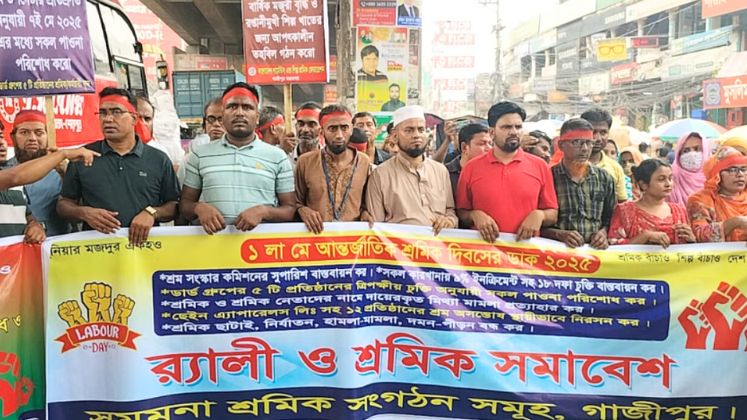
At protests, rallies, cultural events, and discussion meetings, thousands of workers in Savar, Ashulia, and Gazipur celebrated International Labour Day by calling for the reopening of shuttered factories, the settlement of arrears, and the strict observance of labour laws, including those pertaining to the minimum wage.
In Savar, protests were held at the Hemayetpur tannery industrial area, the site of the Rana Plaza disaster in 2013, and other significant places. Workers from different factories came together to call for the reopening of closed factories, the reinstatement of workers who had been wrongfully fired, and the application of the Labour Reform Commission’s recommendations. Under the banner of the Bangladesh Garments and Industrial Workers Federation, more than a hundred workers marched from Bishmail to Rana Plaza at around 8:00 am, demanding the payment of allowances and arrears.
The Bangladesh Garment and Sweaters Workers Trade Union Centre, meanwhile, held a rally at the Bypail crossroads in Ashulia’s Unique neighbourhood, where demonstrators restated their demands. At the Rana Plaza location, a cultural event with performances by the Udichi Shilpi Goshthi focused on the theme of Build a Non-Exploitative State to Establish Workers’ Rights.
At 10:00 am, the Savar Upazila Administration and the Ministry of Labour and Employment jointly conducted a discussion meeting at the Savar Upazila Parishad auditorium. Upazila Nirbahi Officer Md Abubakar Sarkar was the main guest, and the ceremony was headed by Md Atiqur Rahman, Deputy Inspector General of the Department of Inspection for Factories and Establishments.
The Tannery Workers Union organised a march and meeting in the Harindhara neighbourhood of Hemayetpur, where they demanded that a minimum wage structure be properly implemented across the industry’s five pay categories.
The local chapters of the Bangladesh Garments and Industrial Workers Federation organised lively rallies in Gazipur at various venues, such as the Gazipur roundabout and the Dhaka-Mymensingh highway. Under a flyover, more than 20 garment factories, rickshaw pullers, street vendors, and other workers in the unorganised sector took part in cooperative initiatives.
At the gathering, BGMEA-backed garment factory owners were accused by Shafiul Alam, joint general secretary of the federation’s central committee, of blacklisting workers who made valid demands, making it impossible for them to find new jobs. He denounced these actions as human rights violations and demanded the adoption of an 18-point charter that calls for the prosecution of those responsible for the Rana Plaza and Tazreen factory tragedies, six months of paid maternity leave for female employees, trade union rights in all factories, including Export Processing Zones, rationing in industrial areas, and wage redetermination every three years with annual increments linked to inflation. He also called for the victims’ relatives to receive rehabilitation.