
The devil is in the details, and now, those details need proof. Fashion is facing a moment of reckoning. With the industry responsible for nearly 10% of global emissions, the pressure to ‘really act’ is growing. What was once ‘nice to have’ in sustainability is now becoming non-negotiable.
Across the world, traceability is no longer optional, it’s mandated by law. And with that shift, brands, retailers and investors are facing growing regulatory heat and are passing responsibility up the supply chain to manufacturers. Suppliers are now expected to back up their claims with real data, transparency and compliance that can stand up to scrutiny.
In the EU, regulations like CSRD (Corporate Sustainability Reporting Directive) and CSDDD (Corporate Sustainability Due Diligence Directive) require companies to disclose how they manage sustainability and human rights risks. The EU Green Deal is pushing for climate neutrality and a circular economy by 2050, making traceability a core part of doing business. In the US, laws such as the California Transparency in Supply Chains Act and the Uyghur Forced Labor Prevention Act are tightening the rules around ethical sourcing.
The UK’s Modern Slavery Act and its annual environmental reporting guidelines are adding even more pressure for accountability.
Back in India, there has been a big shift too. The BRSR (Business Responsibility and Sustainability Reporting) framework now makes ESG disclosures mandatory for the country’s top 1,000 listed companies. Policies like EPR (Extended Producer Responsibility) are pushing brands to take responsibility for recycling and waste. And from August 28, 2025, BIS certification will be required for weaving and embroidery machines. India is also aligning itself with international standards, with over 22,300 domestic standards in force, 94% of which now match ISO and IEC benchmarks.
On top of all this, countries around the world, including India, have committed to Net Zero targets. India’s goal of reaching Net Zero by 2070 is already reshaping how the textile and apparel industry thinks about long-term competitiveness.
For garment manufacturers, this is not just a checklist to clear. It is a real opportunity to lead. The companies that invest in sustainability, transparency and traceability today will not only stay compliant, but will be best positioned to grow, scale and stay relevant in tomorrow’s global supply chains.
Thankfully, manufacturers and compliance partners are now racing to embed traceability, data-backed certification and transparent sourcing disclosures into everything they do.

Manufacturers Turn ESG Goals into Measurable Action
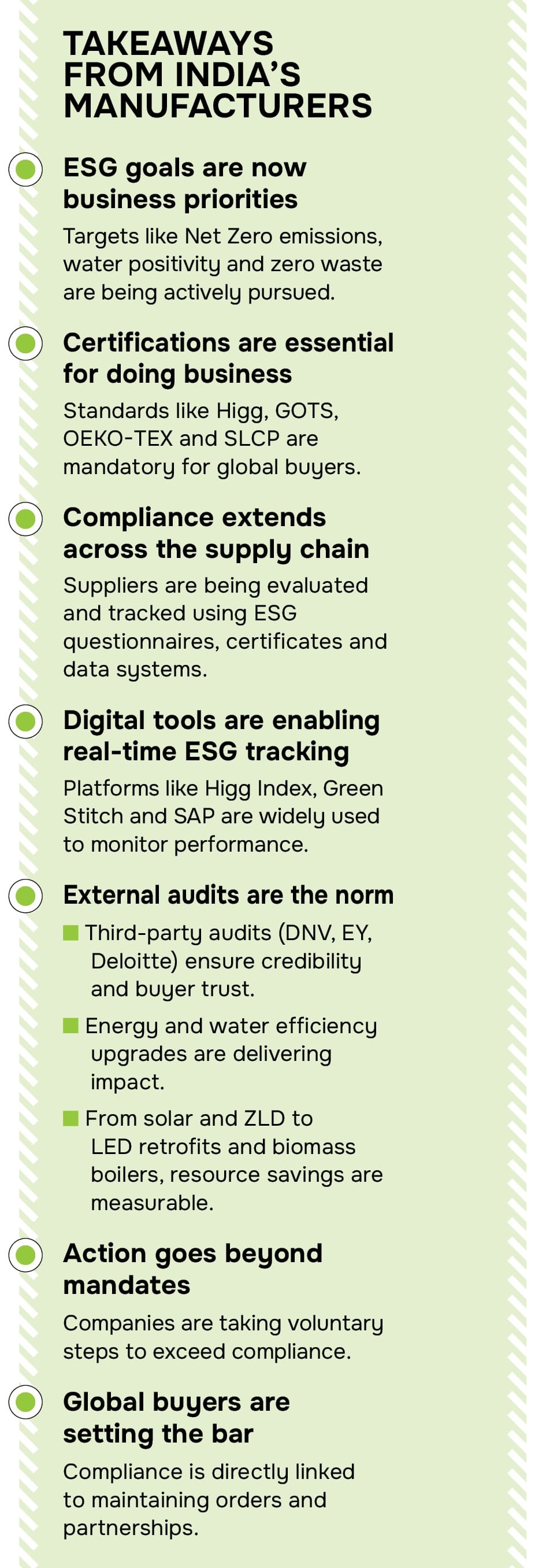
“We’re pursuing three major sustainability goals: Net Zero carbon operations across Scope 1 and 2 by 2030; Net Positive Water operations by 2030 and 100% recycling and reuse of post-production solid waste by 2025,” said Vinura Jayewardene, Senior Manager – Group Sustainability and ESG, Brandix, an apparel manufacturer with over 32 factories worldwide. Its client portfolio includes major global brands, some of which are Victoria’s Secret, PVH (including Calvin Klein and Tommy Hilfiger), Uniqlo, H&M etc.
In India, Brandix operates a 1,000- acre vertically integrated park near Visakhapatnam known as Brandix India Apparel City. The park comprises four core Brandix units and produces approximately 120 million garment pieces annually. It employs over 20,000 people, 80% of whom are women. To track sustainability progress, Brandix uses a suite of in-house digital platforms integrated into its ESG dashboard. “This system captures all data points pertaining to ESG indicators identified at the start of the financial year through the company’s materiality assessment,” added Vinura Jayewardene.
| 22,300
From August 28, 2025, BIS certification will be required for weaving and embroidery machines. India is also aligning itself with international standards, with over 22,300 domestic standards in force, 94% of which now match ISO and IEC benchmarks. |
All of this data is third-party verified by DNV (Det Norske Veritas), which has been auditing Brandix’s data annually since 2011.
The company’s sustainability framework is closely aligned with international standards, guided largely by buyer expectations. These include a wide range of certifications and protocols such as Higg FEM, Higg FSLM, GOTS, OCS, RCS, GRS, OEKO-TEX, Regenagri, BCI, BSCI, SMETA, WRAP and SLCP. In fact, some of these—particularly Higg FEM and SLCP—have now become mandatory for order placement from several global clients.
Ensuring compliance across the extended supply chain, especially in processes like dyeing, printing and chemical use, is managed through a two-fold strategy. First, the company distributes a detailed ESG questionnaire to key suppliers to evaluate their alignment with environmental and social expectations. Secondly, Brandix uses transfer certificates for applicable standards, such as OEKO-TEX, to validate chemical safety and discharge protocols.
The company also shares its sustainability performance publicly via its annual GRI-based Sustainability Report, which is available on its website.
Another major player, Texport Industries, with 12 plants across India and a monthly production capacity of 3.5 million units, is also pushing forward on sustainability goals. “Having committed to SBTi, our top priority is meeting those targets. We’re going for validation in a couple of months. We’re also phasing out coal by 2028. All three of our new units are equipped with ZLD systems and reuse over 90% of processed water,” said Raghavendra Shah, Senior VP.
To track GHG emissions, Texport uses the Green Stitch platform tailored for the apparel industry, which also supports ESG reporting. For waste tracking and upcycling, it relies on Reverse Resources, while the Higg platform helps monitor environmental performance across individual units.
The company supplies to clients like Kohl’s, PVH, Michael Kors, Levi’s and AEO.
Its compliance standards include Higg, ZDHC, GOTS, OEKO-TEX, SEDEX and WRAP—almost all of which are now required by the global buyers it serves. To ensure supply chain compliance, especially in wet processing, Texport relies on RSL testing, ZDHC documentation and Higg Index reporting. While it doesn’t publicly disclose data through platforms like CDP or GRI, it does share its Higg modules with buyers on request.
Joining the ranks is Pearl Global Industries Ltd. (PGIL), which reported Rs. 4,506 crore in revenue for FY ’25—a 31.1% Y-o-Y growth—and produced 93.2 million garments, with plans to scale up to 135 million by FY ’28. PGIL serves marquee names like Target, Ralph Lauren, PVH, Primark, Kohl’s, Old Navy and more across the US, EU, UK, Japan, Australia and Canada.

| “Our robust system, governed by stakeholder input and aligned with ISEAL’s Codes of Good Practice, makes FSC one of the most credible sustainability standards globally — often referred to as the ‘gold standard’ in responsible sourcing.” –Anuj Sharma, Deputy Country Director, FSC |

| “Our process goes beyond physical audits also. We validate batch-level traceability, input-output reconciliation, inwards transaction certificates and supplier scope certificates, ensuring every claim is traceable back to certified sources.” – Emilie Cherhal, Global Head of Certifications, Ecocert Group |
Pearl has outlined three top goals: reducing environmental impact, achieving full ESG compliance across its supply chain and empowering communities through CSR. To cut its carbon and water footprint, it’s expanding sustainable laundry infrastructure and investing in solar installations across India.
“Progress is audited internally by Ernst & Young in India, Bangladesh and Vietnam. Deloitte has also been appointed as statutory auditor for international operations. While external sustainability assurance is not yet formalised, internal governance teams use frameworks like BRSR, GRI and TCFD for ESG alignment,” explained Pallab Banerjee, MD and Group President, Pearl Global Industries Ltd.
Pearl complies with a comprehensive list of global standards demanded by buyers, including GOTS, GRS, OCS, OEKO-TEX, FSC, US Cotton Trust Protocol, European Flax Standard, SMETA and SLCP/FSLM. While SAP-based digital systems provide visibility across the supply chain.
| Hurdles
The sustainability cascade often stops at Tier-1. Requirements such as MRSL (Manufacturing Restricted Substances List) compliance, social standards or traceability protocols frequently fail to reach Tier-2–4 vendors like dyehouses, spinners or raw material suppliers. |
Likewise, Modelama Exports is also aligning aggressively with global sustainability goals. With a production capacity of 15 million garments annually and a workforce of over 13,000 employees, the company exports 100% of its output across categories like outerwear, tops, dresses, kidswear, shirts, scarves and jackets. “We want to reduce GHG emissions by at least 45% by 2030 and recycle or reuse 65% of our wastewater. We’re also increasing the use of sustainable raw materials, including recycled packaging and fabrics, while phasing out polythene,” said Arvind Rai, Director.

| “We want to reduce GHG emissions by at least 45% by 2030 and recycle or reuse 65% of our wastewater. We’re also increasing the use of sustainable raw materials, including recycled packaging and fabrics, while phasing out polythene.” – Arvind Rai Director, Modelama Exports |
To track progress, Modelama uses energy and water meters monitored through Higg Index tools, with all facilities verified on the platform. The company has also installed 2 MW of solar power across its factories and offices, along with 6.25 MW wind power capacity in Maharashtra, contributing to its renewable energy goals.
For chemical sustainability, the company follows defined parameters for Dispersions, Stabilizers and Pigments (DSP) to ensure safe and responsible usage. While such compliance isn’t always mandatory in foreign markets, Modelama is committed to meeting its sustainability goals proactively. The company also publishes its sustainability reports publicly through the Manufacturer Climate Action Program (MCAP).
The Rise of Rigorous Verification
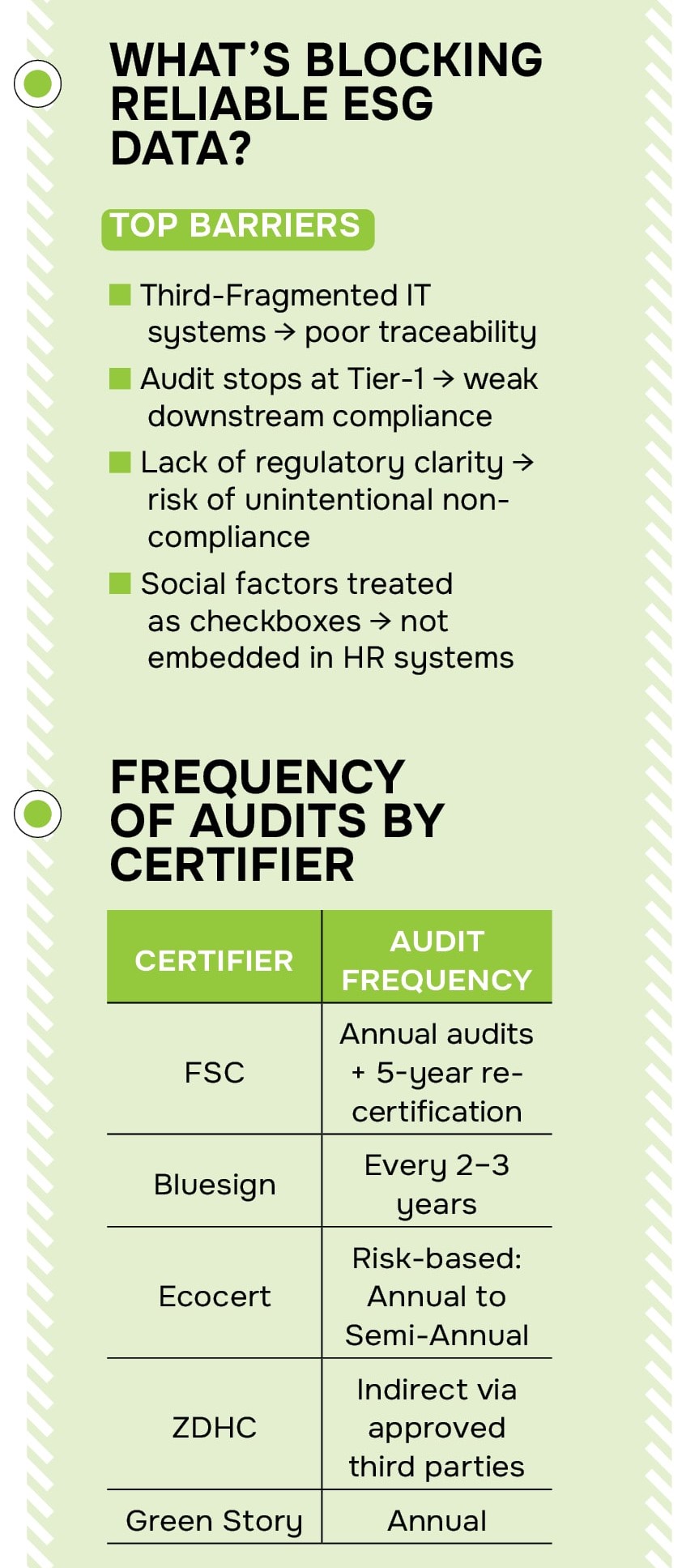
Experts point out that the biggest sustainability gaps in manufacturing are structural in nature, cutting across multiple tiers of the supply chain. One key barrier is the limited understanding of fast-evolving global regulations.
Data infrastructure is another critical hurdle. Many manufacturers still rely on manual or partially integrated systems. This fragmentation makes real-time traceability, accurate material mass balance reporting and consolidated impact disclosure incredibly difficult, especially across multi-tier, global supply chains.
Moreover, the sustainability cascade often stops at Tier-1. Requirements such as MRSL (Manufacturing Restricted Substances List) compliance, social standards or traceability protocols frequently fail to reach Tier-2–4 vendors like dyehouses, spinners or raw material suppliers. This creates blind spots that weaken the integrity of audit trails and brand-level disclosures.
The gaps don’t end there. Social compliance, from worker rights to grievance redressal and living wages, is still viewed by many as a checklist item rather than an embedded system within HR and operational processes. This misalignment not only risks audit failures but also erodes buyers’ trust.
It is in this context that the demand for credible, verifiable and transparent sustainability data has surged.

| “We’re pursuing three major sustainability goals: Net Zero carbon operations across Scope 1 and 2 by 2030, Net Positive Water operations by 2030 and 100% recycling and reuse of post-production solid waste by 2025.” Vinura Jayewardene, Senior Manager – Group Sustainability and ESG, Brandix |

| “Progress is audited internally by Ernst & Young in India, Bangladesh and Vietnam. While external sustainability assurance is not yet formalised, internal governance teams use frameworks like BRSR, GRI and TCFD for ESG alignment.” – Pallab Banerjee, MD and Group President, Pearl Global Industries Ltd. |
“Our process goes beyond physical audits also. We validate batch-level traceability, input-output reconciliation, inwards transaction certificates and supplier scope certificates, ensuring every claim is traceable back to certified sources. For high-risk cases, we apply risk-based audit targeting and may conduct unannounced or focused audits,” said Emilie Cherhal, Global Head of Certifications, Ecocert Group, a global player in organic product certification.
She added, “Such upstream traceability documentation check and material flow analysis ensures that data provided by manufacturers is consistent, complete and traceable back to source.” Similarly, Green Story has built a rigorous, multi-tiered verification system to ensure the credibility and accuracy of sustainability data shared by manufacturers.
“Our process includes automated verification through our proprietary smart data engine, which leverages AI and our extensive database to cross-check reported figures against industry benchmarks and identify outliers or inconsistencies. Human-led online reviews are provided by our trained LCA and sustainability analysts, who examine data submissions for quality, completeness and conformance to accepted LCA protocols,” highlighted Akhil Sivanandan, CEO, Green Story.

| “Our process includes automated verification through our proprietary smart data engine, which leverages AI and our extensive database to cross-check reported figures against industry benchmarks and identify outliers or inconsistencies. –Akhil Sivanandan CEO, Green Story |
Green Story conducts on-site audits either through its in-house sustainability experts or with accredited third-party auditors, depending on location and project scope. This thorough review process ensures data remains transparent and traceable—critical for Digital Product Passport (DPP) readiness and upcoming global compliance requirements.
“We leverage third-party solution providers for verified data. For example, we approve third-party wastewater testing laboratories to sample and test and upload the test report in our ZDHC Gateway (on behalf of the supplier) for data related to the implementation of our ZDHC Wastewater & Sludge Guidelines. ZDHC does not conduct audits on its own,” said Prasad Pant, Chief Technical and Education Officer, ZDHC Foundation.
Whereas Forest Stewardship Council (FSC), a global forest certification system for forests and forest products, doesn’t verify sustainability data directly. Instead, they work with independent, Assurance Services International (ASI) accredited third-party certification bodies that conduct detailed audits.
“Our robust system, governed by stakeholder input and aligned with ISEAL’s Codes of Good Practice, makes FSC one of the most credible sustainability standards globally — often referred to as the ‘gold standard’ in responsible sourcing. This ensures that brands and manufacturers have a reliable foundation for making legitimate sustainability claims and meeting evolving regulatory demands such as the EU Deforestation Regulation (EUDR),” said Anuj Sharma, Deputy Country Director, FSC.
The Audit Tech Stack
The tools that power verification today are becoming just as important as the audits themselves.
For instance, Ecocert has developed ACT (Audit and Certification Tool)— its proprietary platform that does more than just monitor checklists. ACT tracks product composition, transactions and other sustainability data collected during audits such as carbon footprint and water consumption. “We integrate with external traceability platforms as well and all digital data is cross verified through on-site audits and documentation,” said Emilie Cherhal. Similarly, Green Story follows an integrated approach with its smart platform designed to streamline data collection, validation and real-time reporting. One of its standout features is a smart data engine that uses AI-based tolerance checks and industry benchmarks to assess data quality at both the facility and product levels. The platform also performs automated document parsing, extracting and verifying information from certification documents such as GOTS and OEKO-TEX as well as invoices and bills of materials—minimising manual input and reducing error.
To strengthen process-level validation, Green Story draws from one of the largest textile manufacturing datasets available.
“We’re also integrating with traceability technologies like GS1 and blockchain to support Digital Product Passport (DPP) requirements. But above all, our priority is using the best available data. If verified primary data isn’t accessible, we use proxy data from our own extensive database”, clarified Akhil Sivanandan.
ZDHC Foundation uses multiple digital platforms to support its Roadmap to Zero Programme and maintain validated data. The ZDHC Gateway connects suppliers, chemical formulators, brands, and approved certifiers. The ZDHC Supplier Platform allows suppliers to complete the Supplier to Zero assessment and upload documentation for review against programme criteria for chemical management. Wastewater data is submitted electronically through an Electronic Data Reporting (EDR) system. FSC uses FSC TRACE, a blockchain-based platform that records certified transactions across the value chain. The system enables real-time traceability of certified materials from forest to final product. Each FSC-labelled product carries a unique license code that links back to the certified manufacturer and forest source.

| “Having committed to SBTi, our top priority is meeting those targets. We’re going for validation in a couple of months. We’re also phasing out coal by 2028. All three of our new units are equipped with ZLD systems and reuse over 90% of processed water.” – Raghavendra Shah Senior VP, Texport Industries |

| “We are actively exploring emerging technologies that can further strengthen traceability and transparency across the supply chain. Our focus is on data accuracy, interoperability and actionable insights.” – Barbara Oswald CCO, Bluesign |
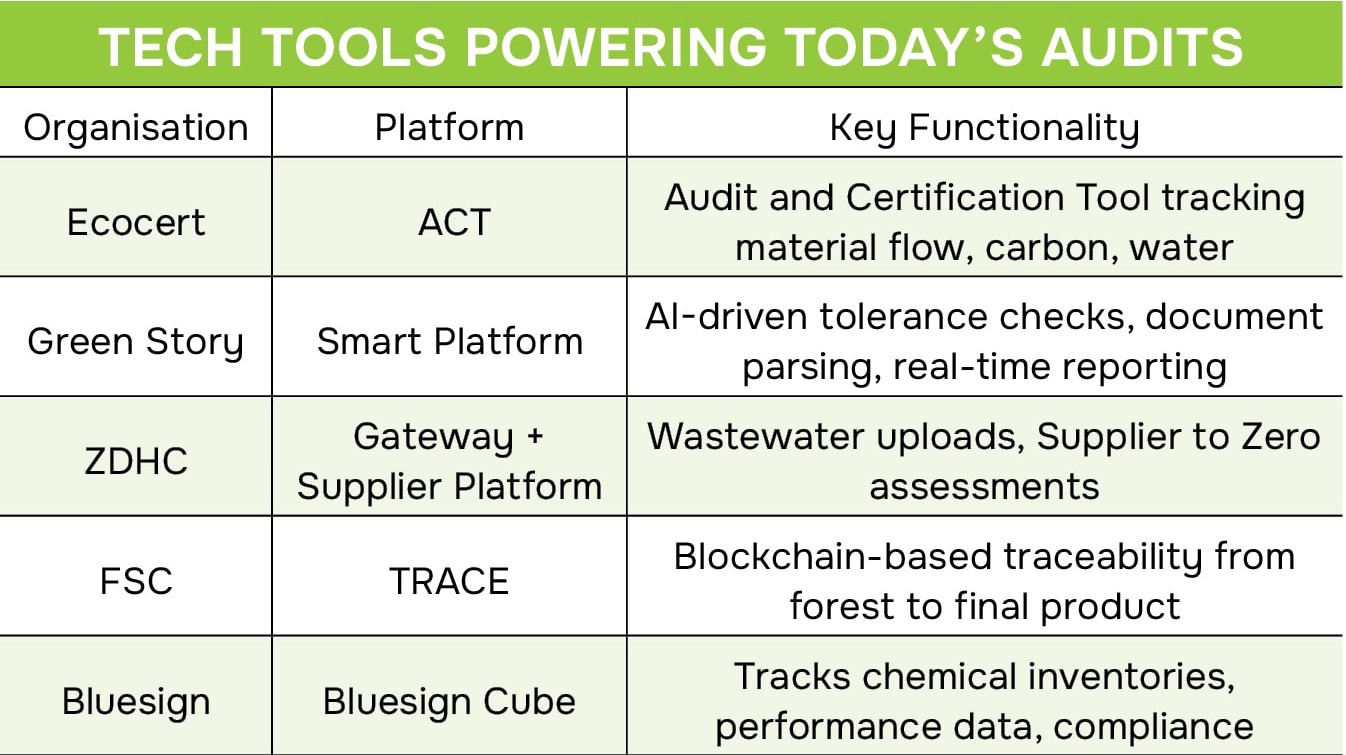
To further strengthen verification, FSC also uses Wood ID technology for species identification and satellite imagery to monitor forest cover and detect illegal activity.
Meanwhile, Bluesign manages traceability and data integrity through its bluesign Cube platform, which acts as a central hub for partners to manage chemical inventories, monitor performance, and access impact data.
“While we do not currently use blockchain, we are actively exploring emerging technologies that can further strengthen traceability and transparency across the supply chain. Our focus is on data accuracy, interoperability, and actionable insights,” said Barbara Oswald, CCO, Bluesign.
How Frequent Should Audits Be?
Certification bodies tailor audit schedules based on supplier risk, past performance and regulatory demand.
For instance, Ecocert calibrates audit intervals by scheme and risk level. High-risk or critical production sites are subject to annual or even semi-annual audits. Low-risk partners can expect a 12-month audit cycle, though unannounced visits remain a possibility. Each audit covers traceability of certified materials, environmental metrics like water and waste management, and critical social factors including working conditions and grievance mechanisms. Internal controls and previous non-compliance issues are also reviewed to assess continuous improvement.
| The most frequent issues today are related to social compliance such as labour rights, working conditions or poor stakeholder consultation, underscoring the need for third-party validation and ongoing oversight. |
Others typically conduct audits annually, but this may increase depending on the complexity of production or the need to comply with new regulations such as the EU’s DPP or the CBAM. Green Story audits span everything from water-saving tech adoption to the facility’s LCA data readiness. “ FSC follows a structured approach to certification, beginning with a main audit at the start of the process. Once certified, companies participate in annual surveillance audits to help ensure continued alignment with FSC’s environmental, social, and traceability standards. These audits review key areas such as material traceability, legal compliance, responsible sourcing, and labour practices. The certification is valid for five years, after which a full re-certification audit is required to renew the status. All audits are conducted by independent certification bodies accredited by Assurance Services International (ASI). Bluesign carries out initial on-site assessments and then re-audits every two to three years. Their evaluations cover emissions, chemical management, resource productivity, and occupational health and safety. Emergency preparedness and hazardous material handling also form part of the checklist. Unlike others, ZDHC does not conduct audits directly. Instead, it approves and qualifies third-party solution providers to perform on-site assessments, based on its own frameworks.

| “We approve third-party wastewater testing laboratories to sample and test and upload the test report in our ZDHC Gateway (on behalf of the supplier) for data related to the implementation of our ZDHC Wastewater & Sludge Guidelines. ZDHC does not conduct audits on its own.” –Prasad Pant, Chief Technical and Education Officer, ZDHC Foundation |
What Happens After the Audit Matters More
While frequency and scope are important, what follows an audit often determines its real value. The most frequent issues today are related to social compliance, such as labour rights, working conditions, or poor stakeholder consultation, underscoring the need for third-party validation and ongoing oversight. Non-conformities found during audits are classified as critical, major, or minor as defined by the respective standard. For all non compliances, suppliers must submit a Corrective Action Plan detailing root cause analysis and corrective measures.
These actions may involve enhancing fitraceability systems for certified materials, improving documentation practices, providing targeted staff training, or revisiting subcontractor oversight. In many cases, especially among manufacturers newer to global standards, discrepancies reflect system-level gaps rather than intent. Recognizing this, audit bodies increasingly adopt a coaching-first philosophy. Teams work hands-on with factories—often in local languages—to instill lifecycle thinking, help build internal data tracking systems, and set out phased roadmaps for continuous impact improvement.
“Rather than delivering a ‘pass or fail’ verdict, the focus is on developing capacity for robust product-level and corporate sustainability reporting,” said Akhil from Green Story.
“We do receive queries from our approved solution providers on situations that they encounter during the on -site assessments or wastewater or sludge sampling. These are received through our Customer Support as well as Regions teams. If these are related to our guidelines, we prepare explanatory articles in our ‘Knowledge Base’ tab on our website that serves as a self-help guide to our stakeholders,” mentioned Prasad Pant from ZDHC Foundation.
Having said that non-compliance isn’t taken lightly—status downgrades, certification withdrawal or even contract termination are possible for unresolved issues. But for partners willing to improve, expert support and targeted action plans help close gaps in a meaningful, lasting way. Experts say to bridge the funding gap, blended finance funds like GFF, capacity-building initiatives and buyer co-investment or at the least non-monetary support to manufacturers will be essential.
GREEN FINANCING: A CHALLENGE OF ACCESS, NOT JUST AVAILABILITY
Financing sustainability in the textile and apparel sector remains a persistent challenge, especially when it comes to availability, affordability and accessibility. “At group level, we evaluated a sustainability-linked financing option, however penalties for not achieving the stipulated targets, despite being purpose driven, did not make it a viable option against a conventional instrument,” said Vinura Jayewardene of Brandix.
Therefore many are self-financing their sustainability efforts. In FY ’25, Pearl Global invested approximately Rs. 135 crore in total CAPEX, of which an estimated Rs. 75 crore was specifically directed toward sustainability-focused initiatives. This investment represents roughly 1.7% of Pearl Global’s annual consolidated revenue of Rs. 4,506 crore for the year. Looking ahead, the company has outlined a Rs. 250 crore CAPEX plan for FY ’26, with nearly Rs. 95 crore of that explicitly earmarked for sustainability-led projects—Rs. 90 crore for further expansion of sustainable laundry operations and Rs. 5 crore for solar power installations across its Indian factories. However, some in the sector, like Sri Kannapiran Mills, a vertically integrated manufacturer in Coimbatore, have taken a different route. In 2023, the company secured US $ 2.5 million from the Good Fashion Fund (GFF), covering the entire CAPEX needed at the time.

“The investment was received in two of our cotton spinning mills and our flagship denim fabric weaving mill (KG Fabriks). GFF supported us in installation and replacement of key machines and equipment that directly reduces energy consumption and waste generation in yarn production. These included more efficient rotor spinning machines and winding machines, auto doffing systems, singeing machines and several airjet looms,” said Srihari Balakrishnan, MD, Sri Kannapiran Mills. The company has seen excellent results with a 97% reduction in yarn waste, over 50% energy savings in certain operations and annual financial savings of nearly US $ 250,000. “The terms were quite competitive on an overall basis compared to options in the market. Of course, interest benchmarks (SOFR) were higher in 2023 and 2024 but have since reduced to more reasonable levels,” added Srihari Balakrishnan. According to GFF’s Investment Lead, Jayanth Kashyap B, the fund has made four investments in India so far—Sri Kannapiran Mills, Pratibha Syntex, KKP Fine Linen and Sharadha Terry—impacting seven factories across Tier-1 to Tier-3 operations. Their most recent investments include KKP Fine Linen and Sharadha Terry.
“Despite being a small US $ 19 million fund, we receive a lot of outsized interest in the investment proposition – so definitely a lot more manufacturers have approached us with proposals. I see that the greatest need is from Tier-2 suppliers, operating vertically integrated or dedicated wet processing facilities that need to improve their renewable energy mix or transition away from fossil-fuel based assets,” stated Jayanth. Proposals received by GFF includes replacement of coil boilers with electric or biomass to ETP upgrades or ZLD systems, low-impact dyeing and finishing tech, energy-efficient spinning and weaving, solar rooftop and specialised needs within denim, home textile fabric processing that reduces waste and usage of hazardous chemicals to name a few. They also receive quite a few proposals focused on circularity i.e., recycling plants, sorting infrastructure, circular systems and even from Tier-4 solutions working on farm-level and ginner-level interventions.
“The exciting news is that we are already moving ahead with our second fund, ‘Good Fashion Fund 2.0’ which will have an updated framework and will provide risk capital in the form of mezzanine capital (a hybrid form of financing that combines features of both debt and equity) that is subordinated to local banks and not typically available or actively used in the textile industry,” stressed Jayanth.
Importantly, they will be onboarding mid-sized brands in Europe, UK and elsewhere and investing in their key suppliers in India, Bangladesh, Vietnam and Turkey.