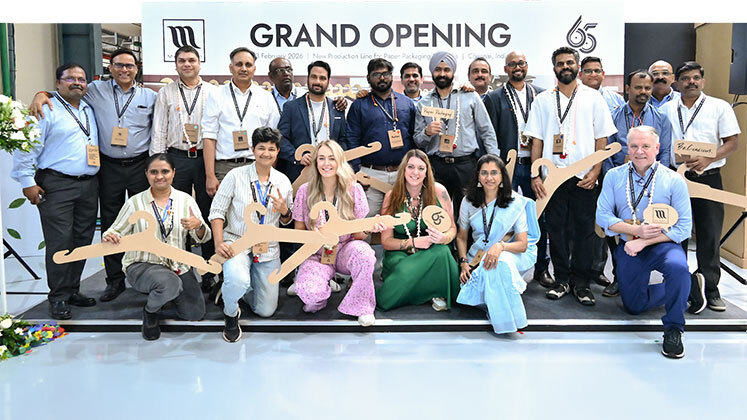
From the factory floor to the retail outlet, hangers play a crucial role in how clothing is presented, protected, and perceived. For over six decades, Mainetti, the world’s largest hanger company, has focused on this function, expanding from traditional hangers into circular, paper-based, and intelligently designed packaging solutions.
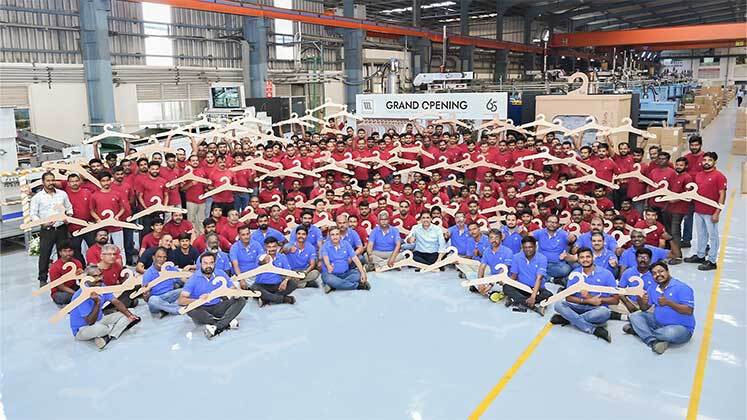
As demand for hangers and packaging solutions continues to grow, Mainetti has strengthened its global production network with a new paper packaging production facility at SIPCOT Industrial Park in Sriperumbudur, Chennai.
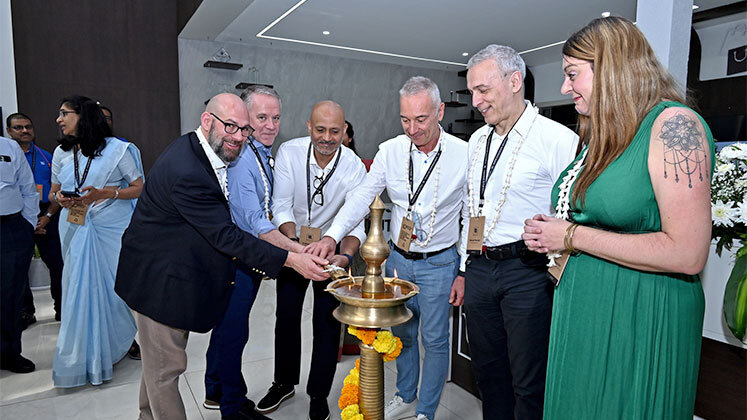
To mark the launch, Mainetti invited key customers and partners to visit the facility and see the new equipment in operation. Retailers and brands such as Primark, Decathlon, Tesco, Auchan, PVH, Leclerc, Jockey, and Asics were present, along with Indian garment manufacturers including Shivalik and Pearl Global Industries.
Alongside the new paper packaging facility, Mainetti also opened a Testing Centre of Excellence focused on paper packaging solutions.
At this centre, products are tested at every stage, from design and raw materials to sampling, bulk production, and storage. More than 35 quality checks are carried out to ensure each product meets performance standards and customer requirements.
Apparel Resources spoke with Marc Abeles, Global Marketing Director, Mainetti, to understand how the new Chennai facility will benefit customers and how he sees the future of the hanger and packaging industry in India. He was particularly bullish on India’s retail growth due to rising consumption, manufacturing expansion, and increasing focus on sustainable packaging. Edited excerpts:
Congratulations on the launch of your new paper packaging production unit in Chennai. What factors led Mainetti to make this investment, and how does it fit into your overall global production strategy?
Thank you! Our investment decisions are guided by how sourcing and manufacturing patterns are evolving globally. Today, we operate in 90 locations across six continents, with the support of over 6,000 employees. We work with many of the world’s leading retail and apparel brands. Over the last few years, I have seen how important South and Southeast Asia have become for global sourcing and manufacturing, which is why we have been strengthening our presence in this region.
This includes opening our facility in Bangladesh in February 2024 and our North Vietnam facility in September 2025. These investments were made to strengthen our sustainable flexible packaging capabilities and to scale our Polyloop recycling initiative. The new facility in Chennai is the next step in this journey.
I see this unit serving both the Indian market and our global customers. On the domestic side, it will support India’s fast-growing retail market, including e-commerce and quickcommerce, which offer strong local opportunities for us.
At the same time, the facility is also set up to support exports. Several of our major global customers already operate out of Chennai, so this location allows us to serve them more efficiently. While we continue to focus on expanding globally so customers around the world can benefit from our sustainable solutions, I also see India as a dynamic, high growth market. Strengthening our presence here and serving customers in the region is clearly a strategic priority for us.
Which specific paper packaging products will be manufactured at this site? What are the key features of these products, and how will the Chennai facility help your clients in terms of lead times, quality, usability, and other operational benefits?
As part of our investment in Chennai, I can share that we have developed our 2025–2026 global catalogue for Paper Packaging Solutions. This includes over 250 products across key categories such as tops, bottoms, sets, essentials, accessories, and lightweight footwear.
Each product is designed and tested by our engineers to meet high performance standards. We have made sure that hook sizes match standard store fixtures, so the products are easy to use in stores. This helps our customers with speed, reliability, cost efficiency, and flexibility in their operations.
The facility boasts the latest state-of-the-art equipment that will greatly enhance efficiency, increase output and allow Mainetti to expand its production of fully recyclable paper products to help meet its customers’ sustainability objectives.
With sustainability now a critical priority for brands and retailers, how are you making your products more environmentally responsible, including in terms of raw materials, certifications, and other sustainability measures?
We are embedding environmental responsibility into every part of our products. This starts with how we choose raw materials and continues through manufacturing, testing, and global delivery.
At the heart of our approach is circular design. Our Paper Packaging Solutions portfolio includes more than 250 designs made using FSCcertified paper, which supports responsible forest management and full supply chain traceability. We also use water-based adhesives and mineral oil-free inks, so our products are fully recyclable and have a lower environmental impact during production and at end of life. We also support customers with full visibility across our flexible packaging portfolio. Recyclable flexible packaging is a core part of what we offer, including polybags with up to 100% recycled content. These can be recycled through our Polyloop recycling program, which helps customers close the loop on both postconsumer and post-industrial waste.
To improve traceability, we provide Intelligent Solutions such as Digital Product Passports (DPP) and RFID technology. These tools give unitlevel visibility from the factory to the warehouse and through to the shop floor.
As packaging regulations continue to evolve, we have invested heavily in ESG data governance and compliance. To prepare for new European sustainability requirements, we partnered with Position Green to complete Corporate Sustainability Reporting Directive (CSRD) reporting and introduced a centralised ESG data capture platform. This helps us accurately measure and report greenhouse gas emissions and align with our customers’ reporting requirements.
In the current Indian market, what kind of demand are you seeing from retailers—are large, established brands still driving most of the business, or are smaller and D2C brands also becoming more significant?
From what I see, large and wellestablished brands continue to account for most of the spending in India. This is true across categories like apparel, FMCG, electronics, and beauty. Offline retail still dominates the market and makes up around 90% of overall retail sales.
At the same time, digital-first D2C brands have clearly grown beyond being niche players. They are becoming more relevant, especially in online channels and newer formats such as quick-commerce.
However, many D2C brands remain small and have not yet expanded strongly into offline retail. So while they are important growth drivers in urban and digitally connected markets, traditional brands continue to lead the wider retail landscape.
Do you believe in India’s long-term retail growth story? If so, what are the key factors that give you this confidence?
I see India as one of the strongest retail markets in the world today. This growth is being driven by both structural changes and consumer demand. By 2032, the Indian retail market is expected to reach around ₹18 lakh crore (US $2 trillion). Rising disposable incomes and increasing urbanisation are creating strong demand across apparel and lifestyle categories, which in turn is increasing the need for sustainable packaging and better in-store solutions.
Government initiatives have also played an important role. Programmes like Make in India have encouraged investment and innovation and helped strengthen the country’s manufacturing base. Since then, India has significantly improved its position in the World Bank’s Ease of Doing Business Index, moving from 142nd place in 2014 to 63rd in 2019. This progress has attracted strong foreign investment.
India is also building its reputation as a global manufacturing hub. This is supported by a strong talent pool, a growing consumer market, and improving infrastructure.
All of these factors hav-e helped India take a leading role in adopting sustainable packaging. Packaging is currently the fifth-largest sector in the Indian economy and is expected to reach ₹12,53,109 crore (US $138 billion) by 2029. There is a clear shift towards recyclability and circular models, supported by regulations and initiatives such as the National Mission on Sustainable Packaging Solutions, which focuses on developing sustainable materials, improving recycling methods, and strengthening testing facilities.
When it comes to labels, tags, and trims, fashion cycles are moving faster and retailers want stronger shelf impact. What changes and new demands are you seeing from brands today in this space?
I’m seeing brands look well beyond just shelf impact today. Labels, tags and trims are now being used to connect the physical product with the digital world. One of the biggest changes is the shift towards digital connectivity and intelligent labelling.
In particular, DPPs are becoming much more important and are changing the role of labels. These solutions link a garment’s physical label to a digital database, giving each item its own digital identity. This makes it possible to track products across the entire supply chain and helps brands meet new and emerging regulations.
I’m also seeing stronger demand for integrated Life Cycle Assessment tools. These allow brands to measure the environmental impact of a garment from production all the way through to global transportation.