KIPAS Textiles, Europe’s largest fully integrated textile manufacturer, has announced the launch of fibR-e, a new recycling platform designed to overcome long-standing barriers that have prevented polyester from becoming truly circular.
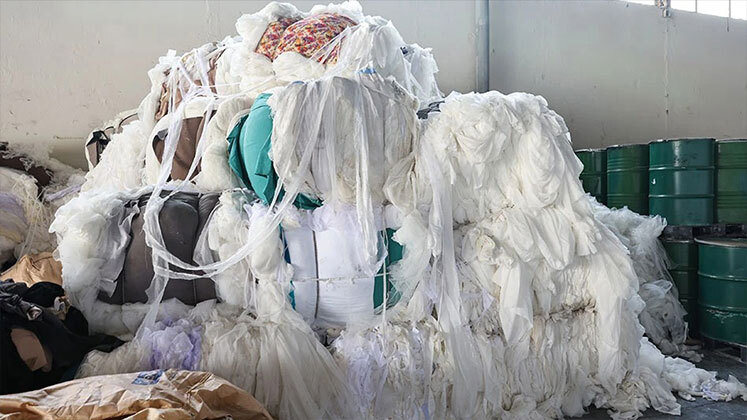
The scale of the challenge is significant. The global fashion industry produces millions of tonnes of polyester-based garments each year, yet less than one% is recycled back into new apparel. The vast majority ends up incinerated or in landfill, creating what industry observers describe as a major but under-acknowledged waste crisis. With regulatory pressure increasing across Europe and beyond, brands are being held accountable for the full lifecycle of their products, while consumers are raising expectations around sustainability.
fibR-e offers brands a practical route forward. Through Turkish chemical manufacturer Meltem Kimya, post-consumer garments containing 70% or more polyester — including polyester-elastane blends and other mixed-fibre compositions — are processed into high-quality, GRS-certified rTEX Chips. Items with attached trims and mixed-colour feedstocks can also be accommodated. These chips are then converted by KIPAS Textiles into certified filament yarns and staple fibres suitable for new collections.
The platform removes accessories during processing, reducing manual labour and eliminating key bottlenecks. It also decolourises blended fabrics to deliver cleaner outputs. Central to the system is Meltem Kimya’s patented molecular recycling technology, which breaks polyester down to its fundamental components and rebuilds it without generating microplastics, enabling repeated recycling with no loss of quality.
Early assessments indicate that producing polyester entirely from textile waste through fibR-e can reduce emissions by nearly 74% compared with virgin polyester. According to Halit Gümüser, Chief Executive of KIPAS Textiles, traditional recycling approaches have addressed only a fraction of polyester waste. He said the new platform allows genuine post-consumer waste, in all its complexity, to be returned to market as certified, high-quality yarns and fibres, representing a shift from linear to circular production at commercial scale.
fibR-e is the product of a multi-year partnership between KIPAS and specialist companies, with Meltem Kimya supplying the molecular recycling capability underpinning the platform. KIPAS will integrate fibR-e materials directly into its own yarn and fabric production, enabling bulk output at competitive prices. The resulting materials are traceable, performance-tested, and formulated to meet commercial standards while helping brands reduce reliance on virgin inputs and prepare for tightening regulatory requirements.
The launch of fibR-e represents a notable industry milestone, demonstrating that closing the loop on polyester waste can transition from aspiration to industrial reality.