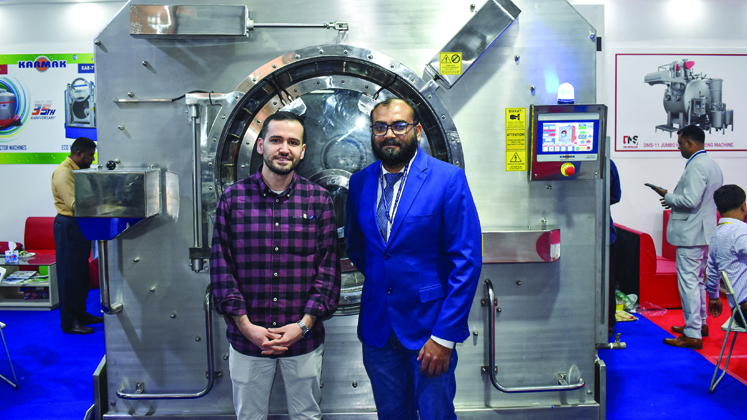
The highly competitive garment and textile manufacturing industry today needs to comply with stringent ecological parameters as sustainability is the pressing need of the hour. Garment washing and finishing is one such process that has timely adopted global standards and a country like Bangladesh – the second largest garment exporter in the world – understands the significance of the implementation of balanced technology in washing and finishing areas. A pioneer in garment laundry equipment, garment washing and garment dyeing machines, ozone washing machine, dryers and hydro machines, KARMAK is fast catching up with global sustainable trends to satisfy the expectations of Bangladesh’s RMG and textile industry and the same was evident in the recently concluded DTG ’23 in Dhaka.
Founded in 1987, the Turkey-based renowned company KARMAK holds over 36 years of experience in the business. Though, for a long period of time, KARMAK remained an established name in the Turkish textile industry, it forayed into the export business aggressively in last five years and today it has strengthened its foothold in more than 45 countries. Ever-evolving Bangladesh is one of the top destinations for the company’s cutting-edge technology along with other South Asian countries such as Pakistan, Vietnam and India.
Team Apparel Resources (AR) had a freewheeling discussion with Hasan Bozkurt, Director of KARMAK KARADENIZ MAKINA and Kazi Tawfiq-uz-Zaman, General Manager (Sales and Marketing) of TEX CORP (BD) LTD., regarding KARMAK’s growth strategy in Bangladesh, its focus on providing sustainable solutions to the industry and its edge over its competitors in the country.
-
Sustainable technology takes centre stage in KARMAK’s business
It is a known fact that the textile industry must look to provide one-stop ‘sustainable’ solution along the whole textile value chain from pre-treatment, through dyeing to finishing. The need of the hour is to impart the understanding of ‘environment impact minimisation’ to the textile and garment industry owners and this is exactly what KARMAK is aiming at in Bangladesh.
“We have always promoted eco-friendly processes through our products and we drastically reduce consumption in three core areas within washing and dyeing – water, chemical and electricity,” commented Hasan, adding, “We are following the developments happening in the textile industry of Bangladesh and identifying the companies that put sustainability on top of their business model. If you want to survive in this market, you have to rely on sustainable solutions.”
Seeing is believing – That’s the mantra of KARMAK as Hasan said. Just boasting about the reduction in water, chemical and electricity doesn’t serve the purpose, rather numbers tell their story! If the liquor ratio of a textile washing unit is 1:10, KARMAK claims to bring it down to 1:3 and some processes to 1:1 to 1:2 – that’s a significant reduction!
Adding to this, Kazi Tawfiq averred that KARMAK has three series of machines in its portfolio that serve the ‘purpose’ of all kinds of factories – small, mid and large. KARMAK showcased Sustainable Green Series; Sustainable Eco-Green Advanced Series and Sustainable Core Series Machines during DTG ’23 and received positive response from the visitors. The company now wants to continue the momentum it received during the exhibition and Kazi Tawfiq asserted that KARMAK’s edge over other washing and dyeing technology providers will help gain that momentum.
He stated, “We are ahead of our competitors in technology development and that’s the advantage we are getting in the country. A few of washing technology providers do have ‘Nano Bubble Technology’ that does not use water, instead, it uses clouds to wash the garments and thus reduces the liquor ratio. However, at KARMAK, we monitor health and safety, as well as in the process, focus on sustainable solutions. For instance, once the use of nano-bubble technology is done and the operator needs to open the hatch of the machine, he may catch up with the cloud that still remains inside the machine which is hazardous.”
“This cloud needs to be cleaned first before the signal of the hatch opening. Our machine has the technology that gives an alert to the operator and cleans up the remaining cloud automatically before opening the hatch. This makes them prepared for collecting the goods after the cloud washing cycle is done safely, then they can drain it or again use it in the next washing cycle. So, during the opening of the hatch in KARMAK machines, the operator’s breath will remain safe,” elaborated Kazi Tawfiq.
-
Future growth strategy involves providing affordable solutions to factories
Affordability and low CAPEX solution is something KARMAK is hoping for as it believes the high cost of machines in short- and long-run further fluctuates the entire cost management planning in a factory. To reduce the cost of machines, KARMAK has recently opened a new 6,000 square metre facility in Canakkalein Turkey that is equipped with a state-of-the-art R&D facility. This adds significant capacity to the existing production unit sprawling over 4,000 square metre in the Ikitelli Industrial Zone in Turkey.
“Both these facilities are assisting us to cater to our customers’ requirements in an effective and efficient manner. In Bangladesh, we have sold more than 100 machines in last three years and, going forward, if demand increases, our production units are able to suffice the requirements,” mentioned Hasan.
Upon being asked about the role of TEX CORP in KARMAK’s success in Bangladesh, Kazi Tawfiq concluded by saying, “Our motive is to enable KARMAK to increase its base in the country. KARMAK reduces overall manufacturing cost of garment factories through its sustainable and compact machines that require less maintenance. We are banking on these strengths and we’ll accelerate our efforts in the next five years to increase the company’s visibility to all manufacturing hubs in Bangladesh.”