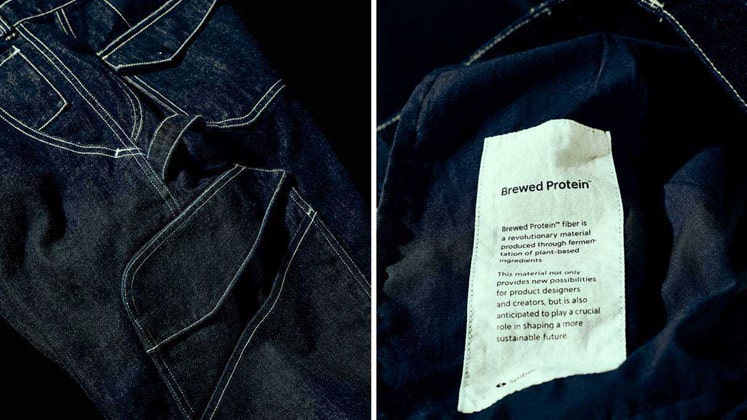
The biotech company’s fibre substitute for raw materials originating from petrochemicals or animals was fashioned into the US $ 950 pair of jeans and the US $ 1,000 denim jacket that the Japanese sports apparel brand Goldwin released.
Brewed Using a secret fermentation technique developed by Spiber, protein fibres are produced from sugars supplied from plants. Similar to how components are brewed into alcoholic beverages, the procedure involves microorganisms.
The circular fibres can be converted into nutrients at the end of their useful life and utilised as a feedstock for fermentation to create new Brewed Protein products and other materials. They can be used on knit and woven materials, fleece, and substitutes for fur and leather.
The 13 oz fabric used to make the men’s cargo jeans and jacket is 96 per cent cotton and 4 per cent Brewed Protein fibres. According to Goldwin, the method used to wash the dark indigo clothing consumes 30 per cent less water than standard washing. The advantages of brewed protein are detailed on an inner label.
The denim clothing is a part of Goldwin’s Spring/Summer 2023 collection, ‘Chance Encounters,’ which draws inspiration from the forested mountains of Japan and the ‘generative and regenerative philosophy of foraging.’
The collection is the end result of Goldwin and Spiber’s eight-year collaboration to scale Brewed Protein. The first denim line to feature Brewed Protein fibres is by Goldwin, and Spiber sees potential for expansion in this circularly-focused market.
“Moving forward, we intend to continue promoting the development, mass production, and adoption of our materials in order to expand product variation and deliver products featuring increasingly higher quantities of our revolutionary fibers,” Spiber said.
Goldwin now uses Brewed Protein for their shell jackets and bottoms. The North Face and Pangia released hoodies fashioned with the material last year.
Thailand-based Spiber’s first fermentation facility on a large scale started operating in 2022. The production of Brewed Protein fibre utilising American-made polymers is expected to start soon, according to the business’ 2020 sustainability impact report.
Both the polymer production facilities in Thailand and the USA are situated close to agricultural farmland for important feedstocks (corn in the US and sugarcane in Thailand), and both will expand in the upcoming years.