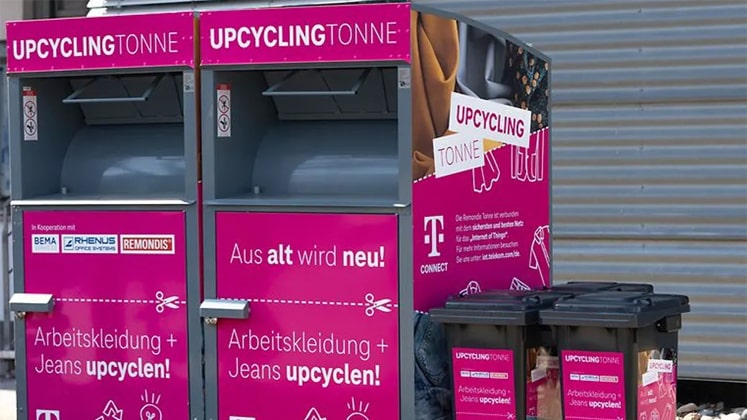
Deutsche Telekom has created an ecosystem that includes reuse, intelligent control of container fill levels, and recycling for the full textile recycling process. The production of textiles uses fewer resources and emits fewer greenhouse gases thanks to the use of intelligent textile recycling containers. And by working with partners Remondis and the Boer Group, old workwear may be converted into new fibres.
With the optimisation of transport routes, the intelligent collecting containers also lower fuel consumption and CO2 emissions.
The deadline for meeting the recycling standards for used textiles under the Green Deal for the European Union is 2025. These textiles need to be returned using a different system of collection.
Employees at Deutsche Telecom used to get rid of their used work clothing on their own. But first, all logos had to be eliminated. The cut-up clothes was therefore useless and had to be thrown away in the residual garbage in accordance with the waste directive. With the help of sophisticated textile recycling, Deutsche Telekom is now giving workwear a second chance.
Fill-level sensors are added to the textile collection containers of Deutsche Telecom. The NarrowBand IoT (NB-IoT) machine and sensor network of Deutsche Telekom is used by these sensors to measure and transmit the current fill level to the cloud. The data is processed and presented transparently in this internet portal.
Remondis will then be aware of when a container needs to be emptied because it is full. The clever technique optimises textile container collection cycles and prevents pointless fill-level checks. The Boer Group then uses a multi-step process to recycle the recovered textiles into fibres.
From December 2021, Deutsche Telecom has been collecting used jeans in smart textile bins in addition to work attire. Since then, over 2,380 kg of textiles have been recycled. This translates into a 15.71 million litre water savings and a reduction of 35.7 tonnes of CO2 emissions.
At the moment, workwear recycling bins may be found outside Deutsche Telecom facilities in Bonn, Cologne, Bochum, and Berlin. The office buildings in Bonn, Cologne, Leipzig, Saarbrücken, Frankfurt, and Chemnitz also have 25 smart textile trash cans. All Deutsche Telecom locations in Germany are expected to have recycling facilities at the end of the project.
“Our intelligent recycling processes support the circular economy by returning valuable textile resources again and again. This can also be transferred to other industries, such as airlines, hotels, healthcare, trade or in the public sector,” said Melanie Kubin-Hardewig, vice president group corporate responsibility at Deutsche Telekom.