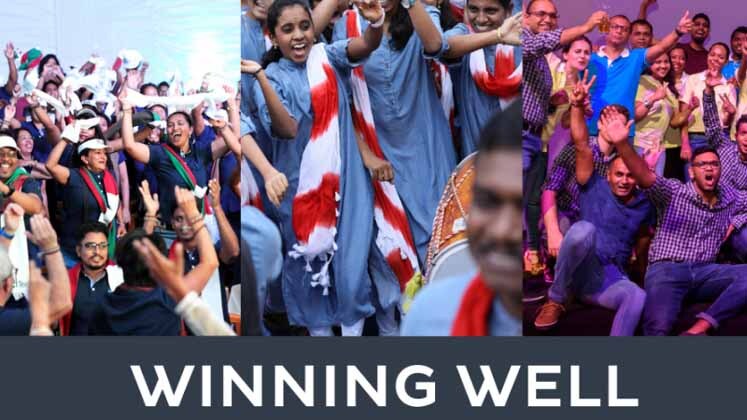
Winning Well, the first-ever sustainability report of CIEL Textile, is a well-drafted document showing how a textile and apparel giant should take the next leap in sustainability commitments. Like many other textile or apparel organisations globally, the company has aligned all its efforts with Sustainable Development Goals (SDGs) and The Paris Agreement. With manufacturing operations in four countries – India, Bangladesh, Madagascar and Mauritius – the company has many achievements across different levels and all geographies where it has operations, be it creating a 100 per cent recycled shirt or a 100 per cent ‘waste-to-wear’ sweater. This report covers the period from July 2017 to June 2020, and in future moving forward, the report is envisaged as a bi-yearly publication.

“I strongly believe that our future lies in our capacity to transform our industry through smart design, innovation, sustainable and traceable supply chains, and products at affordable prices. Our people have always been our strongest asset.”
We are sustainable not because we have to, but because we want to. These words of Eric Dorchies, CEO, CIEL Textile in the beginning of the report give a strong message that true sustainability should not be only buyer-driven or about saving cost in long term, but it should be an organisational commitment that should develop into the DNA of the organisation.

“Sustainability is part of our strategy today and not just a buzzword. Publishing our first report is hence a way of demonstrating this commitment to all our stakeholders and aligning our own resources and operations to achieving the goal set.”
Throwing light as to why the company felt the need for a report, Pami Kular, Group Head of Sustainability & Continuous Improvement at CIEL Textile says, “Sustainability is part of our strategy today and not just a buzzword. Publishing our first report is hence a way of demonstrating this commitment to all our stakeholders and aligning our own resources and operations to achieving the goal set. It further establishes a baseline hitherto which we can start measuring our progress towards in a consistent and credible manner and minimise the risk of green washing with nebulous goals and targets.”
And this spirit strongly reflects in the sustainability-related journey of CIEL since the Group established its sustainability policy six years ago in February 2015 and has thereafter made continuous and effective progress in this direction. “I strongly believe that our future lies in our capacity to transform our industry through smart design, innovation, sustainable and traceable supply chains and products at affordable prices. Our people have always been our strongest asset. I feel very positive about the future because I know our leadership teams are fully engaged in this journey, particularly through our ‘Act for our Community’ and ‘Act for our Environment’ employee engagement programmes,” says Eric.
The report was approached with honesty and the company used the Global Reporting Initiative (GRI) to both guide the reporting and support its drive for transparency. “In understanding the reporting standards and disclosures expected of a business alone, there is a huge learning in what and how to report. There is a sense of clarity in where we stand today and where we need to go, thus opening up a gap of challenges that need to be overcome to deliver significant impact,” shares Pami.
Easier said than done, the task faced many challenges, as getting people to understand the different aspects of sustainability to mean more than just ‘environment’ is a big hurdle in the sustainability path. However, a clear purpose and strategy for sustainability has been defined at CIEL Group level and CIEL Textile aligns itself with the dimensions that cover the three pillars of sustainability.
The Group was determined and three major strategies were defined:
- Champion-inclusive economic growth
Building transparency and trust with all our stakeholders is essential. This pillar will focus on the actions towards responsible offering, partnerships, supply chain and community engagement.
- Activate climate response
This pillar will focus on the actions towards energy, emissions, raw materials, waste, chemicals and mitigate our impact on the planet and its finite resources.
- Foster a vibrant workforce
The health and well-being of our 18,000 employees are the foundation of the Group and fundamental to our existence. This pillar focuses on the actions towards our work for the environment, health, safety, diversity, ethics, training, development and a life full of opportunities and growth.
Also Read: New Factories: Green Is The Top Priority; 3 Companies Confirmed To Have Green Factories
New dimensions added to sustainability circle post pandemic
The pandemic has demonstrated the fragility of the planet and the necessity to have a balanced view of human activity and its impact – our impact as both individuals, corporations and of course the authorities and Governments. “We all need to collaborate and partner on new business models and solutions. The lockdowns have inadvertently helped with a reality check for all in that we cannot continue our current trajectory regardless of impact,” says Pami.
Hence several sustainability projects were energised for completion and implementation at CIEL including
- Eco-Indexrating developed internally for sustainable product design to promote circularity, inclusive of raw materials and manufacturing processes
- Supply chain mapping for transparencyacross our supplier base
- Traceability of raw materialsfrom farm to retail
- Waste managementaimed to reduce our waste-to-landfill by 50%
As you start to work on the three pillars of sustainability, it becomes very clear that the three are interminably interconnected and interdependent in many ways. Therefore, the thinking required for developing new business models is transversal and not unique to a single pillar. For example, climate change initiatives are not for the sake of environment itself, the social impact of climate on communities cannot be ignored nor the loss of economic opportunity.
“We used the opportunity of lockdowns to develop and deliver Sustainability Forums from CEOs to the factory floor management, to both raise awareness of our commitments and obtain buy-in to the many projects driving our sustainability agenda. However, we first on-boarded our global financial teams and have set them a challenge to analyse and report on our business across the three dimensions versus the traditional economic bottomline. The challenge is to stop thinking in an insular manner and think about what we do holistically across the three pillars,” shares Pami.
The Group asserts that the interdependence and interconnectivity of the three pillars is a new way of thinking for businesses which until now have been focused on a single bottom line – profit. To transition from purely economic management thinking and style to one that encompasses social and environmental impacts requires a real change in mindset, behaviour and analysis. “Sustainability is a perpetual journey that defines a new way of thinking and we have just started. We would like to move faster; however, we also realise that systemic change takes time as we cannot progress alone on this journey. We have created a strong governance structure that allows us to constantly review and identify new opportunities where we need to do different and offer more sustainable solutions to our customers, end-consumers and all other stakeholders,” avers Pami.
In the introduction of the report itself it has been highlighted, “By publishing this report, we invite you to hold us accountable for our actions…” This is high time for many other giant players of the Indian apparel and textile industry to come out with such reports as they are doing commendable work with regard to sustainability but never come out with a sustainability report. The world should realise the strength and commitment of the Indian sustainability story.
TARGETS SET BY THE COMPANY
By 2023:
- 100 % employees trained on ethics and sustainability (Its senior leaders participate in the CIELHEC Leadership programme. Top talents benefit from a 9-month programme delivered by top academics at HEC Paris, a leading business school)
- Ethical and sustainable supply chain representing at least 80 % of business value
By 2025:
- Zero non-compliance on ethical matters
By 2030
- 50 % reduction in carbon intensity
- 50 % reduction in waste to landfill
(The company created a waste management sub-committee in 2020 with the aim of standardising the process and minimising waste to landfill)
- 35 % to achieve renewable energy (in 2019, it was 25 %)
- 35 % women at management level
- 10 % reduction in water intensity
(Despite the company’s efforts to improve its water efficiency, changes in product mix and new finishing processes have resulted in an increase in water intensity)
- Publicly disclosed list of value chain partners (The company procures wool, yarn, fabric, packaging, chemicals, trims and accessories through 1,150 suppliers, most of whom are located in Asia)
- Advocate for 50 % certified & recycled raw material usage
- 0 coal as fuel
- 0 lost-time injuries (There were total 635 injuries in 2019-20, out of them 92 % were minor)
“Our People, Our Gold”
The company strongly believe human beings are the same everywhere and desire the same opportunity for earning and living a dignified life. Despite there being local, national and cultural differences and challenges, this does not change the ultimate goal of being ethical and sustainable in our operations and way of doing business. We will be consistent in our focus for the big picture whilst maintaining sensitivity towards local issues which may in themselves need re-addressing.
CIEL strongly believes in the policy ‘Our People, our Gold’ and it reflects on the ground level also as it has 98 % permanent employees (100 % in India and Bangladesh). For the year ended June 2020, 48 % of employees were appraised despite Covid and female to male ratio was 54:46.
There are overall 55 % females and 45 % males in CIEL Textile; interestingly out of them, in Asia’s operations itself, there are 66 % females.
Similarly, the company is also concerned about the community, and reversing urbanisation is also one of the focuses of CIEL and it has set up fresh garmenting capacities in rural areas. The company mostly trains and employs women. By creating sustainable livelihoods in rural communities, the apparel giant contributes to reducing migration to cities. The company claims that operations in rural areas have significant positive impacts on local communities.
Impressive development in India and Bangladesh
As a decentralised business, CIEL takes a bottom-up, top-down approach to study and define achievable and realistic goals. Data cleansing and consistency is an issue with 18 sites in four countries, but we have made investments in adopting a sustainability platform to overcome that challenge. Furthermore, there are local challenges and solutions that are not available across all operating countries. Therefore, the Group learns best practice from each other and remains sensitive to local opportunities and challenges.
In India, Aquarelle India, Laguna Clothing are for woven garments, while Bangladesh has Floréal. The company promotes local sourcing and with regard to products and services purchased locally, India is on top in the entire Group with 65 % of the products and 95 % of the services. Bangladesh follows next with 30 % and 90 % respectively.
The ratio of the local minimum wage to entry level wage is 1:1 for male as well as female workers. The same is the case in Bangladesh.
Last year Aquarelle factory in Samudra (Karnataka) was awarded the LEED Platinum Certification.
At the same time when it comes to water consumption, water stress in India is extremely high but low in the case of Bangladesh.
No doubt, the global exposure and strong vision of CIEL Textile will not benefit its operation in India and Bangladesh but will also motivate other factories in these regions.
CIEL In 2020
Sold 36 million garments
Turnover: US $ 300 Million
Turnover: 18,000