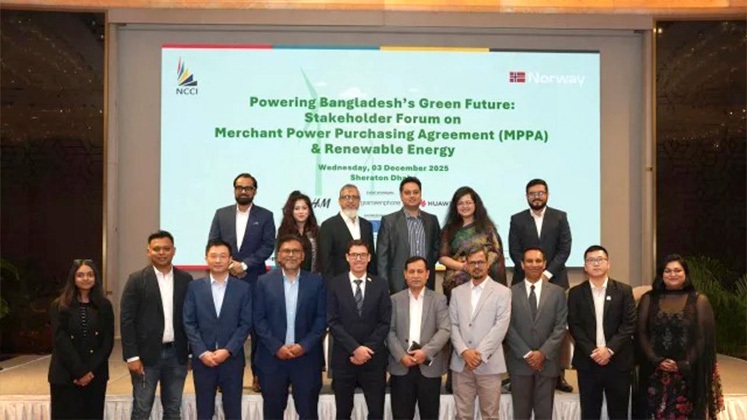
Bangladesh’s shift towards a market-driven renewable energy system gained momentum in Dhaka this week, as senior policymakers, business leaders and international experts gathered to discuss the forthcoming Merchant Power Purchase Agreement (MPPA) framework—an initiative expected to reshape how industries source green power.
The high-level forum, Powering Bangladesh’s Green Future: Stakeholder Forum on MPPA and Renewable Energy, was hosted by the Nordic Chamber of Commerce and Industry (NCCI) in partnership with the Royal Norwegian Embassy. The event focused on accelerating the country’s transition to a resilient, low-carbon energy system through policy reform, private investment and technological innovation.
Central to the discussions was the MPPA model, which will allow private investors to generate and sell renewable electricity directly to consumers, bypassing the traditional Power Purchase Agreement with the government. This marks a major departure from the Independent Power Producer (IPP) structure, under which the state-run Power Development Board acted as the sole buyer of electricity.
NCCI president Tanveer Mohammad said the introduction of the MPPA represented a pivotal moment in Bangladesh’s energy transition, opening the door to greater private-sector participation and competitive green power markets.
Norway’s Ambassador to Bangladesh, Håkon Arald Gulbrandsen, told attendees that the shift was essential as the country approached graduation from Least Developed Country status. He said the adoption of mechanisms such as the MPPA was “not merely an environmental choice” but a vital economic strategy aligned with Bangladesh’s long-term development ambitions.
Presentations from H&M, Grameenphone and Huawei explored corporate readiness, sustainability commitments and technological pathways for integrating renewable energy into industrial operations. A panel session examining MPPA mechanics, market preparedness and bankability drew participation from financiers and private-sector representatives, who emphasised the need for transparent regulation, strong financial structures and effective collaboration between government and industry.
The event, supported by the Royal Norwegian Embassy, Grameenphone, H&M and Huawei, concluded with a Vote of Thanks underscoring the shared commitment to building a competitive and environmentally responsible energy future for Bangladesh.