
Even though the Scandinavian market base is relatively younger than its peers, it has shown an impressive growth and consistency over the past few years. Fuelled by a strong economy steady population growth and rising disposable incomes, the market base which is divided into three major markets – Sweden, Denmark and Norway – has shown a positive growth for 14 consecutive years and is now enjoying its new found popularity as a potential retail destination even as other traditional European markets take a beating…
Since 2008, the world has experienced some serious financial crisis and the fashion trade has taken the hardest hit. Long established fashion houses to a number of independent retailers liquidated during the period. While a lot of markets witnessed a fall in sales, many markets emerged and matured during these crises with best results ever; amongst these is the consumer base in Scandinavia. Even during 2008-09, when the crisis was at its peak, the region benefited from growing disposable incomes due to lower taxes, lower loan costs and decreasing inflation. With a well performing and stable economy, along with a growing population of about 24 million willing to spend, the shoppers in Scandinavia soon became a target group for many brands and apparel retailers to seize the opportunity and open up their retail outlets. In 2010 and 2011, a number of retailers made a fresh entry including Spanish fashion retailer Desigual, which opened their first store of the region in Sweden, in Spring 2010, US fashion chain Hollister in Summer 2011, followed by a series of brand names including American Apparel, Urban Outfitters, Zara, Sephora, XXL, Esprit, Mango, KappAhl, Vero Moda, Decathlon and others.
[bleft]The Market
• Well performing stable economy
• Strong retail sales compared to most European countries
• Growth for 14 consecutive years
• Natural first entry base for expansion
• Steady population growth
• Solid rise in disposable income
• Strong purchasing power
• Appetite for new international brands [/bleft]
The consumer base of the region enjoys privileges such as free education and supported healthcare by the Government, also the employment figures of Denmark, Sweden, Norway and The Netherlands are higher compared to the European standards. More than 75 per cent of the men and around 75 per cent of women as well work in Scandinavia; not only are the overall figures high compared to the rest of Europe, the entire population in the region has higher disposable incomes too, which they spend for high standard of living.
Shoppers look at foreign brands for luxury high-end fashion for both adults and kids and even organic clothes, especially for kidswear, as a matter of fact some of the bigger chain stores in the region are now planning to sell organic clothes, which is a definite growth area, as there is not much available at the moment. Adding on to the retail segment is the growing online sales, which has witnessed a strong growth in the last few years with e-commerce accounting for 4 per cent of the total retail sales in Scandinavia which is further expected to grow to 13 per cent by the year 2013.
According to official statistics a household with two children in Scandinavia spends about US $ 2500 every year on clothes. While an average of around US $ 845 is spent by a woman of age 30-45 on clothes, a young woman in her twenties spends about US $ 1200 a year and men of the same age spend about US $ 400.
The development and growth for many retailers has been particularly strong in out of town shopping centres — destinations which are particularly keen to introduce new store concepts. While all the markets in Scandinavia have matured, the most developed markets base is that of Sweden, which has a small apparel industry of its own and excels at retailing and creating mid-priced clothing. As per the reports of the Swedish Trade Federation the retail sales of the region increased by 1 per cent in 2011 to 622 billion SEK and further 3 per cent in 2012. Until 2020 the retail sales is expected to grow by 30 per cent in Sweden alone.
Styles that sell
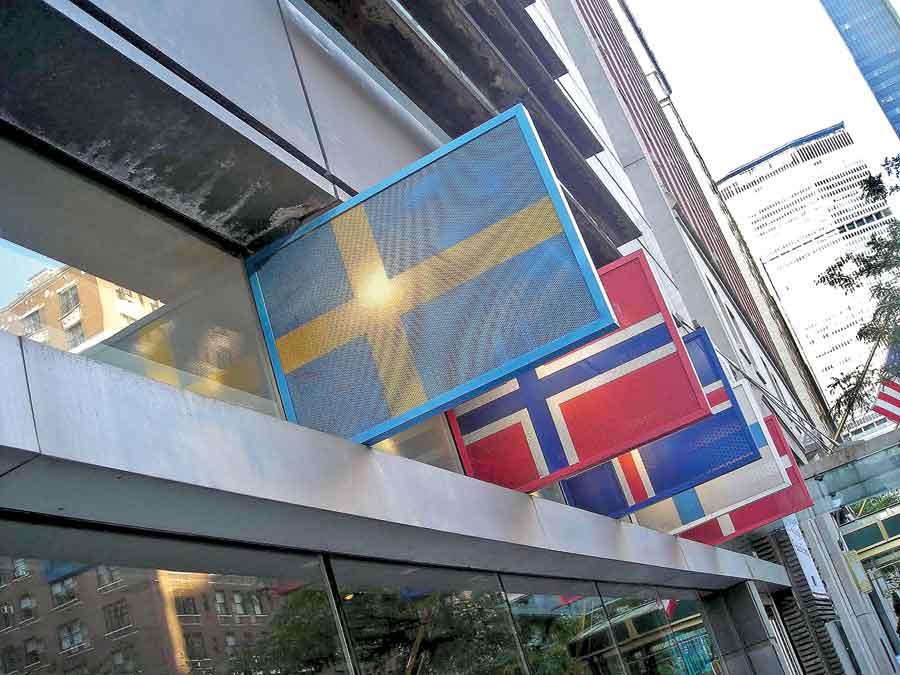
Even as Scandinavia is known to be the founder of minimalistic and functional designs, the design aesthetics for each region are different from one another; while consumers look for more edgy styles in Sweden, Norway is more street-style and the Danish fashion brands aim the mainstream fashion.
The biggest advantage for the exporters sending across their garments to Scandinavia is that the region doesn’t have a strong apparel industry of its own, apart from a few established brands like H&M, ACNE, Tenson and a few others, who outsource their production as well, there is no major manufacturing taking place in Scandinavia. The retail sector thus, is totally based on the imports, giving an opportunity to both retailers and manufacturers to cater to the growing market…