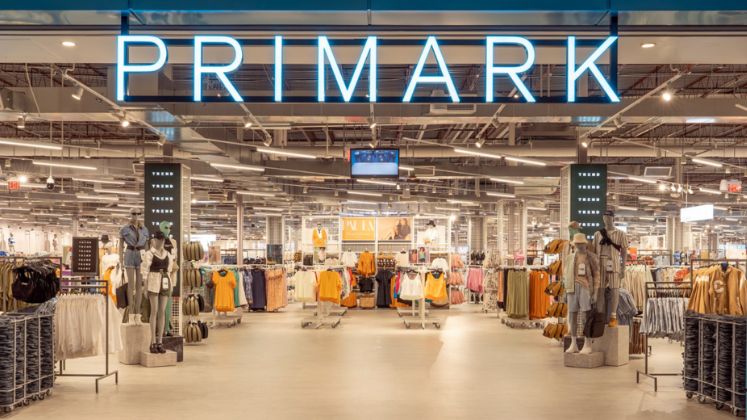
In its second-half trading update on Wednesday, Associated British Foods (ABF), the company that owns Primark, reported a mixed performance, with stronger growth in the US, better results in the UK, and a weaker performance throughout continental Europe. The news comes as the budget-friendly retailer of clothing, cosmetics, and home goods gets ready to launch its first franchise locations in the Middle East the following month.
It is anticipated that Primark’s overall sales growth for the second half will be approximately 1%, distributed equally between the third and fourth quarters. But after a 2.4% drop in Q3 and an anticipated 2% drop in Q4, like-for-like sales are predicted to be around 2% lower than they were in Q4 of last year. It is anticipated that Primark’s sales will increase by around 1% for the entire 2025 fiscal year, with its store rollout program accounting for about 4% of the rise.
“A good sequential improvement on H1 reflecting our strong product offer, particularly in womenswear, and increased digital engagement, supported by more favourable market conditions,” the business stated of its performance in the UK and Ireland. According to Kantar, it anticipates a 1% increase in H2 sales in these areas, with market share in the UK rising from 6.6% to 6.8%. Despite difficult comparisons with double-digit gains during the same period last year, Q4 delivered the same level of growth as Q3, which was bolstered by robust Easter trading.
Primark highlighted its womenswear product strength, effective execution, and increased investment in digital interaction, such as its Click & Collect service, which is currently offered in all 187 UK shops. Sales had also increased as a result of estate management, which included store extensions, relocations, and new store openings. Without these advantages, like-for-like sales in the UK and Ireland are predicted to remain stable in Q4 after declining by 0.7% in Q3.
The situation was mixed throughout continental Europe. Sales in Spain and Portugal are predicted to increase by about 2% in H2, remain mostly unchanged in Q3, and increase by 3% in Q4. Primark reported that new shop openings had a significant impact and that it had outperformed a weaker Spanish clothes market.
The business anticipates that consumer conditions will continue to be unpredictable in the future. Nonetheless, it predicted that, thanks to what it referred to as “Primark’s strong operating model,” its adjusted operating profit margin for the entire year would be somewhat comparable to that of the previous year. It further stated that because of the timing of one-time advantages, H2 margins would be lower than H1 margins; but, cost optimisation and efficiency efforts have made it possible to invest more in digital, brand, and product initiatives.
With 15 new openings in H2, including four in the US, three in Spain, two each in Portugal and France, one each in Italy and Romania, and two in the UK, store expansion remained a top priority. In the Netherlands, the company shrunk one store and shuttered another, while it also finished 22 renovations. The first franchise store will open in Kuwait next month, and two more are planned for Dubai in early 2026 as part of the brand’s ongoing preparations for its Middle East debut.