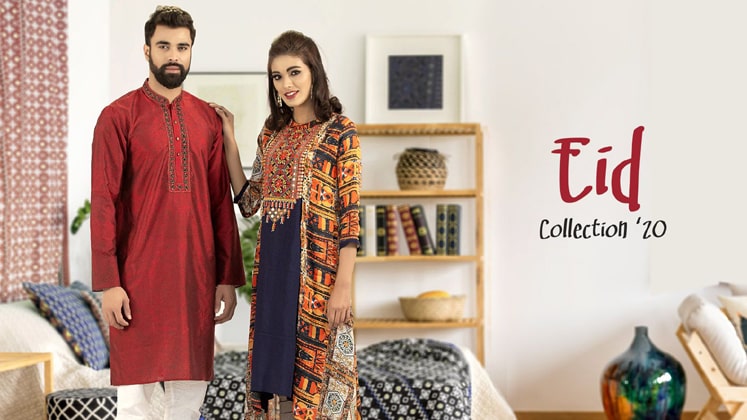
When almost the entire globe is in the grip of COVID-19 and social distancing has become the new norm, retailers in Bangladesh have witnessed a spike in online sales in view of the holy festival of Eid-ul-Fitr and related buying among the end-consumers; nevertheless, fashion retailers and brands have had to weather a subdued buying this festive season overall.
“Before the pandemic, only 5 per cent of our total sales came from e-commerce, but now it is about 50 per cent,” underlined Monnujan Nargis, CEO, Le Reve.
A leading fashion and lifestyle brand, Le Reve is part of REVE Tex Limited, one of the members of REVE family, which started its first retail store in 2009 and today boasts of around 17 stores at prime locations of Dhaka, Sylhet, Khulna and Narayangonj, offering value fashion for men, women and kids including complete wardrobe of uniquely-crafted ethnicwear, casuals, denims and accessories – all inspired from the most contemporary fashion trends across the globe.
Though not at par with the online, sale in the physical stores of Le Reve was not that bad either.
“The presence of customers is not that much like during Eids in previous years, when the shopping itself became a festival. But considering this grave situation, our sales are somewhat good,” Monnujan said, adding that the brand’s average invoice value was around Taka 3,500.
“We see only 10-15 customers daily in our outlets now, while we deal with 35 buyers online on an average,” said Farha Mahmud Trina, Owner, TR’s Closet, Banani, Dhaka, adding that customers were responding well on Facebook.
Also Read: Digital marketplace and Bangladesh garment industry
TR’s Closet is a clothing store inspired by passion in creative pursuits shared by two sisters, Farha Mahmud Trina and Sadia Mahmud Trisha. In 2016, together they embarked on a journey to create their own couture line and since then have opened two retail outlets, one of which is located in Banani and is renowned now as Trina’s Closet. Its sister concern outlet is located in Chittagong, branded as Trisha’s Closet.
Being the designers themselves, both the sisters have always kept their clothing line relevant to the global fashion trends. However, keeping in mind the traditional customs, they tend to always give a twist of fusion in their offerings.
After the prolonged lockdown, even if the Government has allowed stores to open, the overall depressing sale this festive season has led many to resort to promotional activities, discounts, etc., to rev up the overall sales including Twelve, a popular name in Bangladesh’s fashion fraternity which has introduced EMI facility – the first time in Bangladesh – for credit card holders of City Bank American Express, Dhaka Bank, EBL and Prime Bank, who can buy products worth Taka 5,000 or above by availing the three-month EMI facility.
“We have to sell our products anyhow. If the items remain unsold, that means we will be out of cash soon,” explained Samia Ahmed, Head –Brand and Marketing, Twelve, which also came up with offers such as buy-one-get-one-free, special gift voucher for outlet purchase and even a 30 per cent discount on new arrivals at its various outlets. “These offers are now ticking up our sales,” Samia added while underlining that its e-commerce sales have gained up to 80 per cent growth lately.
Established in 2012, Twelve is a clothing, fashion and lifestyle brand created by Team Group.
Apart from Twelve, many fashion houses, brands and retailers such as Le Reve, Bishworang, Kay Kraft, Gentle Park, Bata and Apex were offering discounts this year to increase sales, alongside different offers. If Apex offered 50 per cent off for some products and 12 per cent cashback for Mutual Trust Bank credit card holders, Bata came up with 10 per cent cashback offer in case of payment through mobile financial service Bkash while Kay Kraft offered 30 per cent discount if anyone ordered online. Besides, popular e-commerce companies including Bagdoom, Ajkerdeal, Othoba, E-valy and PriyoShop also offered discounts, cashback, gifts and gift vouchers.
“We had two options: to resume operations or to just sit idle. We decided on the former,” maintained Mohammad Ashraful Alam, Chief Executive Officer, Aarong. A leading lifestyle brand, even though Aarong’s online sales have soared tenfold amidst the pandemic, it is still the bricks-and-mortar stores that bring most of its revenue.
He further maintained that the contribution of e-commerce is only 1 per cent of Aarong’s total sales, adding that the brand’s average daily Eid sales this year were just 10 per cent as compared to that of the previous year.
Despite criticism from some quarters for opening the outlets even though with staggered timings, 6 hours of opening time is divided into six time slots and customers are required to book a date and time on its website before calling in. Besides, to ensure social distancing, Aarong allows only a limited number of customers to enter its stores based on capacity. Mohammad Ashraful Alam said that there are around 65,000 craftsmen and artisans, who are dependent on the brand and they would be left with no new commission if Aarong cannot sell.
“Those artisans eventually would be jobless,” commented Aarong’s CEO, adding that in such a scenario, the workers could switch professions and that would lead to the extinction of many traditional handicraft products considered to be part of Bangladesh’s heritage.
It may be mentioned here that it’s not only the brands and retailers in Bangladesh who have seen their online sales going up amidst the coronavirus outbreak, even the garment manufacturers have proposed to come up with a virtual platform to dispose of the stocks that have piled up in various factories in the country subsequent to the large-scale order cancellations by the global buyers.
Recently, business leaders in the readymade garment sector under the aegis of the apex garment makers’ body, the Bangladesh Garment Manufacturers and Exporters Association (BGMEA), have proposed developing a virtual market platform in an effort to dispose of apparel items worth billions of dollars. The business leaders also sought Government’s policy support in devising trade and economic strategies which fit in this context to help sustain the ongoing critical situation.
“Buyers have cancelled orders in large scale, worth billions of dollars, which are now lying with the factories as stocks and need to be done away with in the most feasible way. Besides, the coronavirus pandemic will now shift the world market from physical stores to online significantly, therefore we feel the necessity of our own virtual marketplace platform,” Dr. Rubana Huq, BGMEA President, thus explained the garment makers’ wish to go digital.
However, despite the promise of online sales and the digital marketplace, Bangladesh seems to have some distance yet to cover towards ensuring customer satisfaction. As per reports, many customers complained that they did not receive their products on time after ordering from online outlets while some even complained that they could not order online as e-commerce platforms were not covering their respective areas.
Keeping the same in consideration, the e-Commerce Association of Bangladesh (E-CAB) urged online traders not to take extra orders and ensure delivery on time as transportation issues were persistent due to the countrywide shutdown.
The General Secretary of E-CAB, however, underlined that despite the reports of surge in online sales in the country owing to COVID-19 and the extensive lockdown imposed by the Government to check spread of this deadly pandemic, its organisations have had to incur losses to the tune of Taka 666 so far, not to mention the depressing sales’ proceeds even during Pohela Boishakh and Eid-ul-Fitr.
Also, many brands and retailers have had to incur significant business losses despite opening outlets while also focusing on promoting the online sales. “Our online orders are also flat because lockdown created an obstacle to reach the customers,” stated Soumik Das, CEO, Rang Bangladesh, while Azharul Haque Azad, Managing Director, Sadakalo (clothing brand), underlined that opening of the outlets had failed to bring in any desired impact on sales.
“We are facing a devastating situation in our business. We thought online orders would be good, but it’s not,” rued Azharul.
Both Soumik and Azharul are now worried about the future, more so considering the exorbitant rent on space that they have to pay followed by almost negligible business in the last few months, which they feel could very well mean the end of the road for many domestic brands and retailers.
Also Read: The COVID-19 concerns for buying entities!