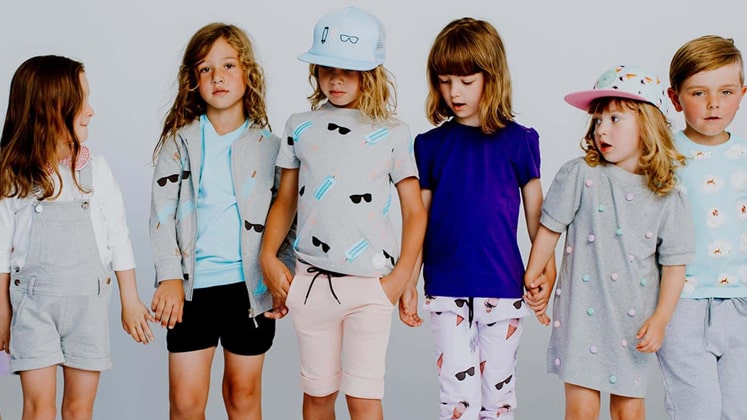
A segment that has recently been brought to the fore of fast fashion owing to the whopping numbers in profits and margins it garnered in the previous years as compared to its counterpart categories, the kidswear segment is a hot category every brand or retailer wants to either venture into or expand and diversify. In fact, as per Mordor Intelligence report of FY 2019, the global kidswear market was poised to grow at a CAGR of 8.76 per cent during the forecast period 2020-2025. That is, until a global pandemic brought the global markets to a stand and subjected children along with elderly to stay within the four walls more often than other age groups due to the mere tendency of being more prone to the contagious virus.
However, the market did not show as steep a decline as was predicted due to the power combination of two main reasons – the start of online schooling and classes that entailed students to dress up for next Zoom call, a trend that has bound to become the new normal as UNESCO reported over 60 per cent of the global student population are out of lessons as home-schooling and online learning are the new norm. Adding to this requirement of new clothing birthed out of want is the reason for extreme need as this consumer group is bound to grow in size every season, increasing the frequency of the buying cycle for the parents.
The back-to-school fashion cycle is also bound to get hit majorly, although NRF’s recent study indicated the expected spending for school and college combined to reach US $ 101.6 billion emblematic of the hot ongoing debate of whether coronavirus will be back with a surge in the coming months, leading to a certain amount of hope in both parents and kidswear stakeholders in the industry. Parents of the school-going children, however, are projected to spend less than they did in 2019 on clothing, which is down slightly to an average of US $ 234.48 from US $ 239.82 last year, which is why this prediction is shadowed by the fact that parents nowadays are more willing to spend on technology to equip their child for all modes of education and learning.
Similar hopes were seen in the Indian kidswear apparel industry, which was valued at US $ 14.9 billion in 2019, being a potential hub for the segment emblematic of a large population with increasing number of households with dispensable incomes. As lockdown lifted earlier this year and transitioned to the ‘Unlock’ stage, apparel retailers became more hopeful about the potential this segment holds, which was also witnessed as kidswear collections registered an overwhelming rise in the demand approximating to about 50 per cent just in the past couple of months. Vishak Kumar, CEO, Madura Fashion and Lifestyle, shared that the company has seen the demand of kidswear collections go up by three times as compared to the pre-lockdown period. Meanwhile, several small retailers and brands for kids are turning over their stocked inventory into products more suitable for the situation.
Also Read: Yogawear segment gets its own ‘movement space’ during stay-at-home days
Steven Jhangiani, Founder/Designer, Kurtees India, a retailer that boasts of a diverse assortment of jersey kurtas and churidars for young boys and men, discusses the changes in the consumer buying choices and behaviour post COVID-19, “Buying has been very muted over the last few months. And it’s completely understandable as we move into a very uncertain economic phase, people are looking at ways in which they can reduce non-essential spending. The whole reset that world has undergone is making consumers very conscious of the planet and the impact we have on it. As we’ve seen in the past few years with the popularity of organic foods, customers are looking for other areas where they can contribute. Fashion is one of them.”

As per several domestic manufacturers and retailers, newness in the trends and assortment offered will be a lot lower for the coming seasons, and the assortment will go more towards comfort in wearability for children staying at home along with precautionary technical fabrics and features, all the while having season-based aesthetics such as bright motifs and colours suiting the SP ’21 season.

The classics
A few classics are still shining through the lot including evergreen AOP styles and transitional yet season-based changing motifs. Rahul Srivastava, Director, RNG Apparels, says that there is significant drop in order quantities due to the lack of travel and occasions for the end consumers, “Quantity has reduced, as states are under lockdown. However, top trends include AOP, especially championing Disney characters such as Mickey Mouse and Marvel superheroes. Certain trims such as contrasting tapes along the edges of the shoulder or sleeves are also being demanded by the buyers. Another popular trim is rib, which is being used in the hems of joggers and dungarees that were earlier only limited to corduroy fabric. Mix media is in.”
B. Mishra, Director, Ashi Exports, a manufacturer excelling in kids’ bottomwear, avers, “AOP is evergreen as it adds aesthetical value to the kids garment and children are usually drawn towards bright motifs. For the coming spring season, we are seeing a rise in Hawaiian prints, or a print mash up of bright motifs paired with classics such as dinosaurs with palm leaves are doing well. Similarly, on the denims end, Samir Garg, Proprietor, Shree Krishna Creations, who boasts of offering denims for men’s, women’s and kidswear with specialisation in overdyed and coloured denims, says the demand for the classic washes and effects for the category are on the rise, “Whiskering spray effect in medium level of contrast is going well for kids’ bottoms, and in fabrics, 3 by 1 twill denim is still going strong. 100 per cent cotton lycra is a must for the two way stretch and relaxed effect.”
Also Read: Riding the cold wave: Outerwear industry’s day in the sun
The COVID edit
The stakeholders in kidswear category might have been hit with a smaller number of orders this time; however, most are saying that the orders are still continuing to come in. As Europe market was hit the worst, and US is still in recovering stage, the Middle East has come out as the strongest region when it comes to demand. R B. Mishra expresses, “Europe has really dropped in demand, and USA and Canada are still cold, but in Middle East the demand has not changed, it is still stable.” The same was corroborated by Samir as well, who called Middle East as very much recovered, even though the domestic Indian market was adversely hit.
Face masks is still the biggest category during these times, ranked as one of the best-selling products of Q2 by Edited quarterly report for 2020 as well, signifying masks and shields reimagined with playful colours and prints to convince the kids to wear a mask, a feat rendered difficult otherwise, which is why retailers are also coming up with new silhouettes such as scarves and snoods and even bandanas extending from the neck to the nose, or simply extended cowl necks with cord ties to cover the face while wearing a garment. Rahul avers, “Nowadays, you can see masks that have so many prints – be it your classic Donald or Mickey or Captain America or even Indian-based character Chhota Bheem, going on to luxury logoed prints from Burberry and Louis Vuitton and value addition such as soft sequins on the outer lines to attract the little girls to wear the mask.”

Technical fabrics and features are also a highlight for garments, with anti-bacterial fabric blends and hygiene enhancing technology at the top of the mix. Marks & Spencer is offering school shirts with anti-bacterial finishes, while Diesel recently revealed that the brand is partnering with Swedish chemical company Polygiene to imbibe a finishing treatment that prevents the fabric from attack of 99 per cent of viruses, encompassing the COVID-19 viruses as well.
Indian retailers are also coming up with their own ways to prevent inventory pile up for better causes, as Kurtees is upcycling old unsold stock into face masks for charity. Steven says, “India, with its vast number of cases and even larger number of needy people, is in a very tough spot. We turned out clothes into 1,100 face masks which were then donated. We then opened it out to our customers to visit our site and purchase face masks at cost, which we then donated on their behalf. Doing this, we were able to donate another 2,300 masks. It gives us immense pleasure knowing that we had a direct hand in helping 3,000+ needy people breathe better and more safely.”

The quarantine comfort zone
The garments have taken a more comfortable avatar to suit the children’s needs when at home, making the knitswear category a hot-seller. Rahul elucidates, “Trends have taken a backseat to give the wheels to comfortwear, and loungewear is in great demand. Knit button down shirts or basic T-shirts with joggers are doing great.” Knit denim, as a material, is in high demand, and ergonomic additions with garments sporting cuffed ankles made of soft ribs, elasticated waists, breathable and soft tactility linings along with light GSM fabrics such as fleece and Pima or organic cotton.
Stephen aligns with the comfort trend, “We believe that people, in the absence of participation in sports, will want to reflect that simpler time in their wardrobe. And similar for adults, kids on lockdown will also be looking for garments that are comfortable and durable. People aren’t spending easily, and if they do, utility is what they want. For example, our garments, which are traditionally Indian, can also be worn with jeans or joggers, and have a use case far more extensive than normal traditional wear. Our clothes are all organic T-shirt material, so there is a familiarity in terms of look and feel.”
In addition to these, accessories such as cloth hair bandanas and bib detailing along with non-garment categories such as blue light anti-glare glasses for kids are trending majorly for the coming season, and despite the constantly changing graphs of buying behaviour and sales, manufacturers and retailers are hopeful about the online sales surge and discounted bricks-and-mortar ranges as significant steps towards normalising the curve.
Also Read: From road to ramp: Start-ups leading the streetwear movement in India