In a highly competitive market condition, Morgan is creating new methods and equipment to automate designing and cutting processes involved in apparel manufacturing. This leads to the implementation of state-of-the-art technology, which may or may not be the final solution. Technology without proper knowledge of how it has to be used is not valuable and optimization of any investment will not be viable.
Italy-based Morgan Tecnica, considered among the leading cutting room experts, produces several types of roll loading and handling systems, automatic spreaders, spreading tables, labellers, automatic cutters with different lay thickness, from 2.5 cm to 9 cm and plotters and even software for CAD, Cut Order Planning, PDM and Virtual Fitting. After finding acceptance for their technologies, the company is now taking a leader role in educating the industry on how to make best use of cutting room solutions for complete satisfaction and optimal returns on investment at the especially designed training centre in Bangalore.
The company has realized the vital role of training in automation projects which has a crucial impact in building high morale in employees and results in optimal efficiency and quick returns on investments. The Morgan Centre of Vocational Excellence fulfils this demand of Man-Machine Method to ensure successful implementation of its automation in apparel cutting operation.
The teams are trained by industry experienced cutting room professionals, where they are taught the best industry practices in cutting rooms. The students are given practical training on machinery as these courses are 100 per cent job-oriented.
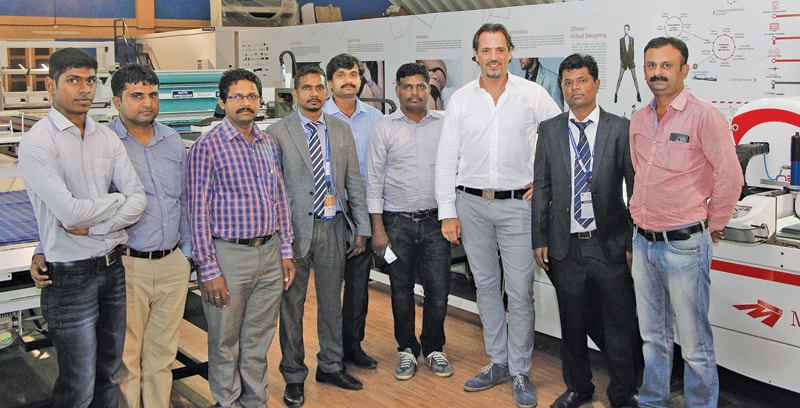
Morgan currently provides courses for Virtual Fashion Designing (3D), Apparel Pattern Designing (Manual and CAD), Cut Order Planning (Manual and CAD), Made to Measure Process Automation, Maintenance of Automated Cutting Equipment and Automated Cutting Room Process. “We have a 10-day training programme for our customers, a one-month training period for people with experience in garmenting, and a 3-month training module for people from other backgrounds who are interested to take up jobs in cutting rooms,” states, Anandakumar, Director (Asia Operation), Morgan Tecnica. At the training centre experts demonstrate how the machines are used, how to handle technical difficulties and maintain the machinery. This is a vital teaching for operators, who will eventually handle the machine once it’s on the shop floor. The training saves a lot of trouble for the company that can be caused in case the machine, which is a costly investment, is misshandled.
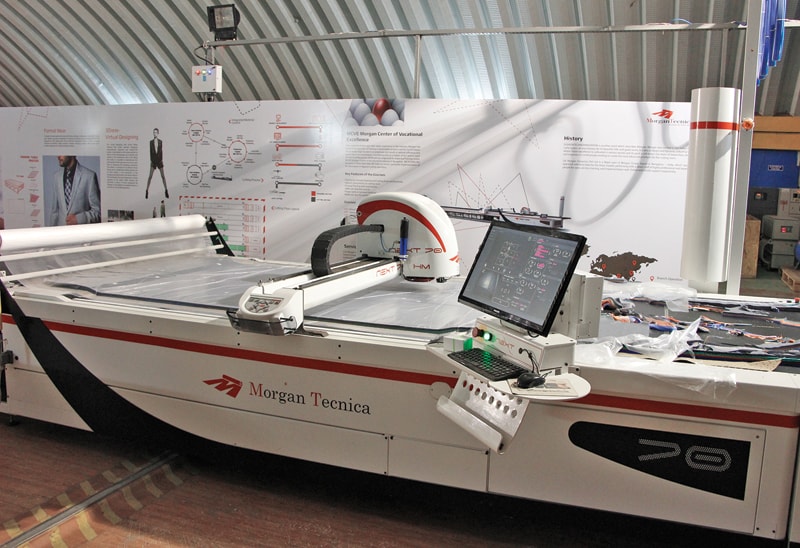
The training centre has live technology to cover a whole automated cutting room for an apparel industry, including 3D software, Cut Plan, CAD, plotter, automatic spreaders, cutters, pintables, visual nest and the software that assist the workings of a cutting room. The latest technologies are used and the teaching method is deep, systematic and well-modulated.
Even a simple process like handling of the fabric roll loaders, which have a solid metallic structure and are fixed to the edge of the spreading table is demonstrated and explained in detail for clarity. From a control panel, the operator drives the system for motorized lift of the roll, laid over a proper cradle support, from the ground directly onto the machine. A specific device for automatic cradle reversing helps the roll loading over the machine turret. Automatic systems are important for the continuous and precise provision of cloth rolls directly onto the spreading machines. They guarantee efficiency, synchronization and maximum productivity to the entire cutting line.
The spreading machines at the training centre are equipped with advanced electronics and software developed to allow the best possible control. Compact and versatile, the machines can be used in spreading of any type of material in open or tubular rolls. The PC touch on board offers the possibility to control and manage the productivity even by remote.
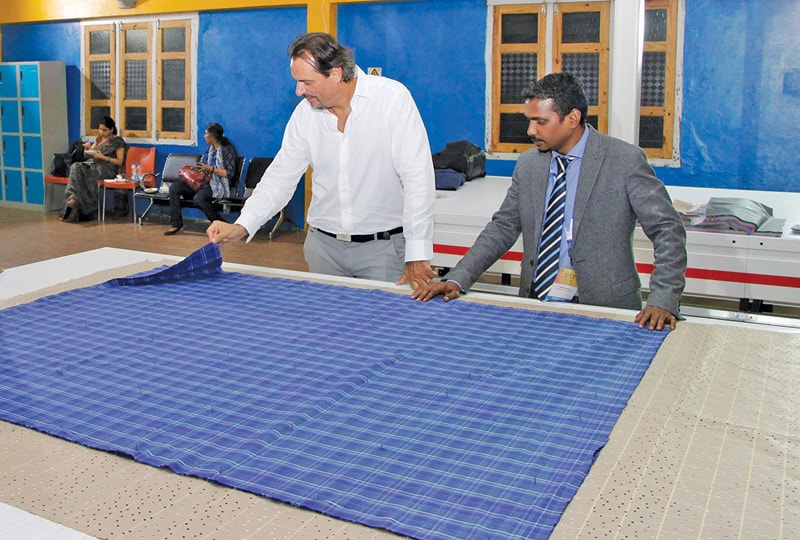
Furthermore, the centre also has pintables which have specially-made, ball-point headed needles, which do not puncture the yarn of the fabric while spreading fabric in which matching of checks or stripes is required. It has a motorized system, where a button controls the height of the needles protruding from the table top. The needle has a thread in it, which once the spread is laid, stays in at the point where matching is required and can be knotted to ensure that there is no disturbance between top to bottom plies, when the lays are transported to the auto cutter.
Once the marker for any style is designed in a factory as per matching rules, the areas that require matching are identified and corresponding needles are inserted in the table surface, which has holes in place.
Pintables are used for two major purposes – first to match the checks or stripes in fabric while spreading and second to reduce manpower in cutting rooms up to 30 per cent, as it reduces block cutting, one does not have to re-lay, the process of band knife cutting is eliminated; all of which are manually performed in factories.
Companies that do not use pintables create pattern blocks and then cut on the band knife, which causes fabric wastage and repetition of operations that can be done in one go. It requires the operator to re-lay the plies while matching the checks and even then there is no guarantee of the quality of cutting.
Next on the training module, the Morgan Cut Order Planning (COP) software is described which aids in organizing and checking the workflow in the cutting room, along with optimizing time and consumptions for each individual work order, in a fast and reliable way, by the automatic selection of markers to do, with relative size ratio. The software can be integrated with the existing ERP and Fabric Storage System, besides Morgan CAD, Spreaders and Cutters for the automatic machine programming by remote.
Catering even to companies that are growing in the area of mass customization, Morgan has implemented the new MTM COP, a specific system to manage the MTM Orders. MTM COP allows processing of MTM Orders in a fully automatic way, even without an operator, starting from the order collection (by retail shop or web), going through the automatic calculation and application on the patterns of the required alterations on the reference size, also automatically detected, to end with the automatic launch of the markers list, with all relative fabric restrictions set, for the automatic Morgan nesting.
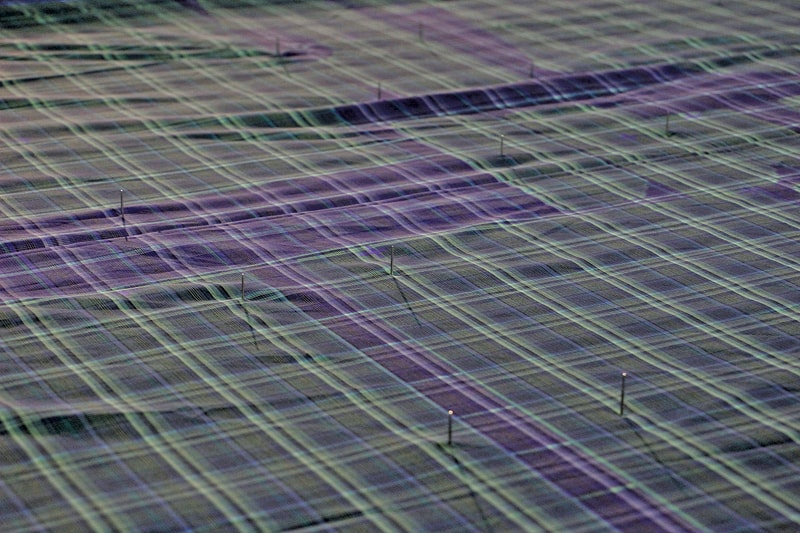
An innovative, practical and effective system by Morgan displayed at the centre – ‘Virtual Nest’ allows the markers to be directly projected over the fabric and to move the pieces in real time if required. In fact, Visual Nest projects both the theoretical repetition lines and the entire marker, complete will all the pattern contours and the matching points highlighted, so that the operator can play with the mouse directly over the fabric, on the spreading table, to move or rotate each individual pattern until it is perfectly aligned with the fabric below and save the new cut file accordingly.
The Nest was originally designed with the sole purpose to help the manual spreading of stripes and plaid fabric on the pintable, by projecting the fabric repetition grid, as a guide line for the operators, while aligning and pinning the fabric. However, Visual Nest has become very useful also in several other applications, both in the manual spreading of printed fabric as well as in the automatic spreading of plain fabrics, to check in real time the position of any eventual flaws in the marker, to handle the fabric splice and overlapping, to check the minimum fabric width and length throughout the lay.
Morgan’s automatic cutters displayed at the training centre are fast, flexible and extremely precise and productive. The machines are available in several different configurations, controlled by an advanced and intuitive software, able to enhance their performances. Cutters capable of cutting all ranges of plies, making them viable for both mass production and customization are manufactured by Morgan.
Apart from the existing technology, the company is working on a fabric booking software, to make their solutions complete end-to-end. There are also talks of a new 3D software for product development.
Such training centres are the need of the time to develop professionals for the future, since the industry is growing at such a fast pace in automation technologies. In an honest effort to create cutting room professionals, Morgan is going ahead and creating training modules for the industry, which will aid even those working on machines from different brands and will be a step forward for standardizing processes.