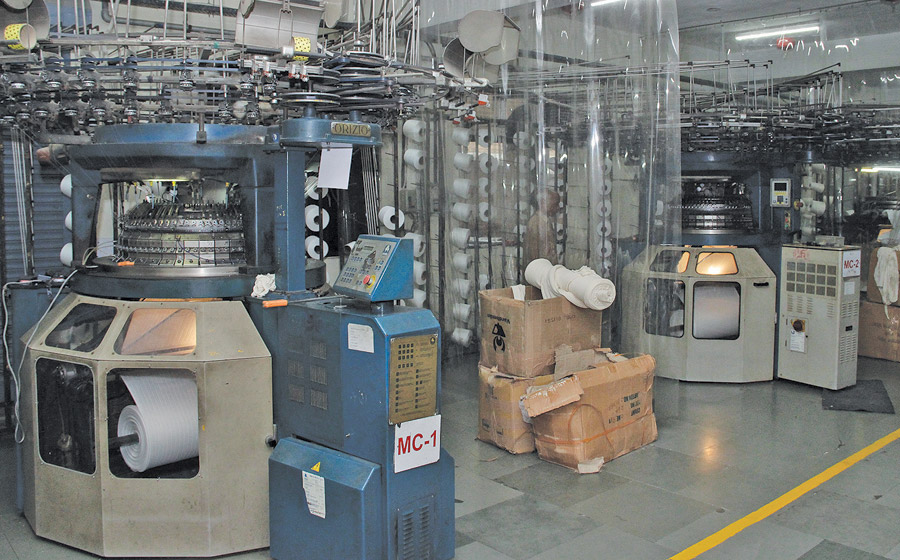
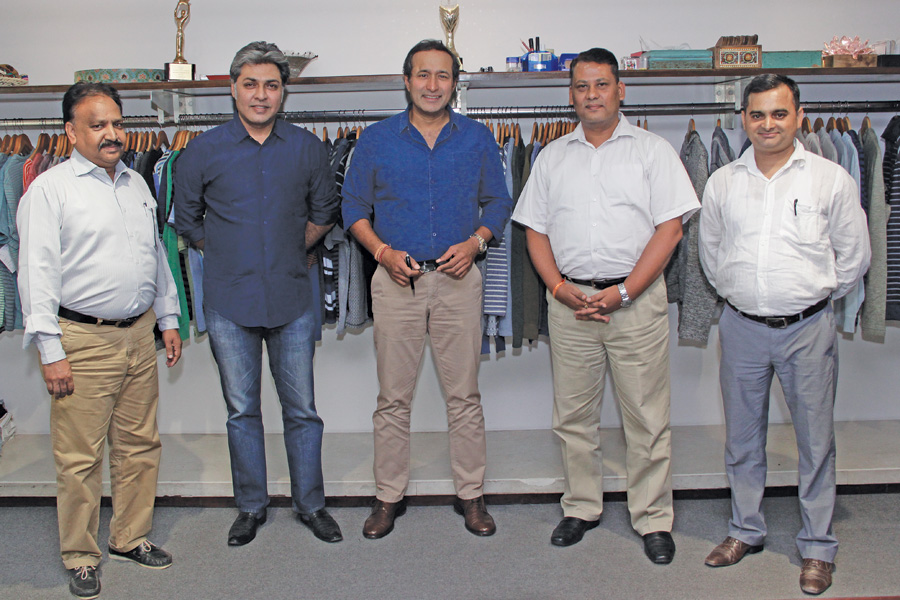
In the late 1980s, Sanjay Agarwal, now the MD of Shree Bharat International Limited (SBIL), had to make a choice on how he wanted to make a living, and he had the option to join the family business of knitting machines dealership. Call it lineage, Sanjay chose apparel manufacturing and there has been no looking back since then. SBIL today has over 2,000 machines in nine factories spread across Noida; the latest one was inaugurated in October 2015. Manufacturing knitwear (for both men and women) for retailers like Lucky, Basspro, Tommy Hilfiger and Zara, SBIL clocked a turnover of US $ 30.3 million last year. In an exclusive interaction with Team StitchWorld, SBIL’s top management elaborated on the company’s operations.
Variety is starkly evident in SBIL’s portfolio of products – from simple to complex silhouettes, and beaded to embroidered designs, some with delicate fabrics and some with very high GSM in order quantities from 600 to 20,000. The bedlam continues with the varied supply chain models – some buyers have a lead time of 190 days, some have 90 days and while some just have 60 days. This multiplicity of the product, complications and quantities also explains the numerous units under SBIL. “We have different units to address different variables,” shares George SK, GM – Quality at the company. Each unit has its federalized set of PPC control, Factory Manager, Production Manager and QA Manager for quick decision making. As far as the allocation of orders is concerned, the compatibility of orders is assessed on the basis of the capacity of each factory, the forte of that factory and its management, the optimum use of machinery and where the fastest turnarounds will be possible.
Infrastructure
The company has a vertically integrated setup with 12 circular knitting machines that can produce a total of 2,000 tonnes of knitted fabric per day as against the Group’s total requirement of 4,000 tonnes per day; the balance is outsourced. “The main concern when it comes to running our own knitting setup is the availability of yarns in and around Delhi-NCR which sends our timelines haywire,” explains George. The company also has three 18-head Tajima embroidery machines. The printing is outsourced from a captive unit whose capacities have been reserved entirely for SBIL. “Our QC team is deployed at all the contractor firms to control the quality,” informs George. The company also has a centralized sampling team where each tailor is reserved for a particular set of buyers. “This proves helpful because when the operator is working for the same buyer day-in and day-out, she/he becomes well-versed with the quality and fit requirements of that particular buyer,” avers George.
Manufacturing and Quality Control

Working with knits, George has minimized last minute derailments by following what he refers to as a triangular method of control. During the sampling stage, every style is assessed to establish the parameters that are Critical to Quality (CTQ) to establish process controls and control Cost of Poor Quality. George elaborates, “In a shirt, if the tech pack’s requirement is 9-12 SPI, it is a major CTQ checkpoint. The Quality Checkers on the lines are communicated the same. Similarly there could be other CTQs such as checking pockets for crookedness or requirement of 2.5 cm side slit. These are some of the points you put on the process for your QC Team.”

Being vertically integrated has allowed SBIL to exert control over its processes, inputs and outputs. The yarn is inspected for GSM. For the fabric being bought from other mills, SBIL’s QA teams are deployed at these mills to ensure that only quality material reaches SBIL premises. The output fabric is then graded on four-point system. Apart from this, the fabric is checked for GSM, colour matching, diameter, stains, holes, and lot continuity. In case of deviations from the tolerance limit, the QA Manager prepares a proposal for consideration by the CMD. Once the report is assessed by the CMD, he gives his decision on splicing. “It is extremely important to exercise caution before the fabric has been cut, because once it has been cut without splicing considerations, it is of no use,” reasons George. The criteria for what should be spliced is extremely simple – any anomaly which is visible to the naked eye and cannot be rectified at the spotting stage which includes slubs, holes, grease marks, etc.
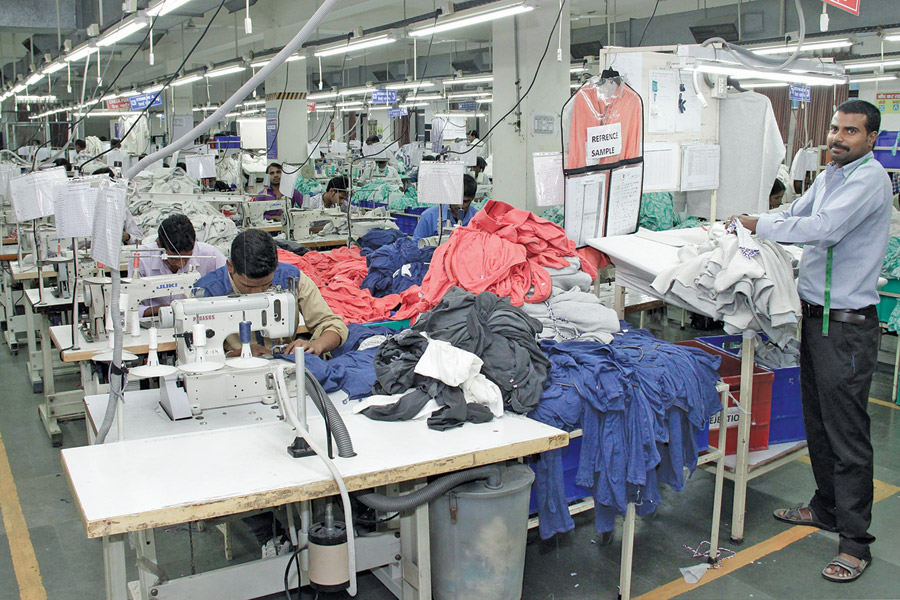
(placed after critical operation), another at the end of the line
In order to control fabric behaviour, each roll of fabric is first cut into plies of length equivalent to lay length (including shrinkage), washed and tumble dried. There is no need to overlock the fabric plies before being sent to washing as the knit fabric does not unravel; it only rolls back and can be rectified by patting it while re-laying. The washed plies are re-laid manually and allowed to relax for 1-2 hours. Only after 100 per cent lays are inspected, the cutting is done by a straight knife, and for small components the band knife is used. The bundling and numbering process also is looked after by the QA team to take care of the traceability of the components. From here, the cut parts are moved to the audit table for a quality audit as per Factory AQL of 2.5 or as per the buyer’s requirements. The auditor then checks the cut bundles for top plies, bottom plies and middle plies for congruence with hard patterns. In case any components is rejected, it is cut from the remnant fabric (end pallas) of the roll from which it was initially cut to maintain colour continuity.
Following this, the cut parts are moved to the sewing floor where sewing machines run on assembly lines and 100 per cent produce is checked. Each sewing line has two quality checkers, one in-line (placed after critical operation), and another at the end of the line Thereafter, the output is sent to finishing floor where again 100 per cent output is checked as per CTQ parameters.
Workforce Management
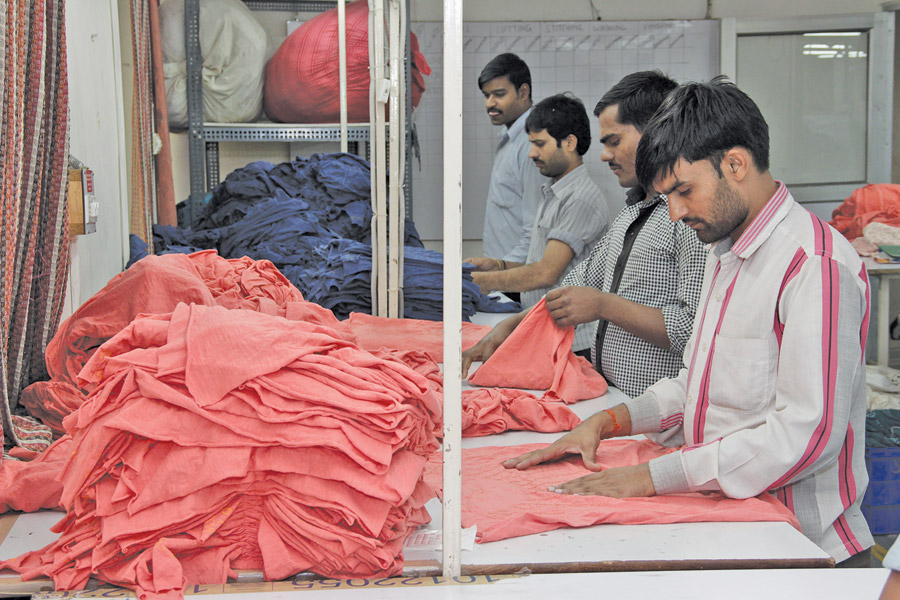
finishing floor
“At SBIL, we are lucky. We have a workforce of 3,000, and the people holding the top positions have spent 5 years and above at the factory. Operator turnover is at 8-10 per cent as we pay above the minimum wages,” informs Jaisheel Chaturvedi, GM – HR & Admin. SBIL also acknowledges top performers from each unit annually. Apart from a robust incentive scheme, the operators are trained in technical areas as well as in soft skills which includes behavioural, team building, motivation, and time management. The only concern for the company today is developing a strong systemic approach to train new recruits. Presently, the new recruits are trained on-the-job by the supervisors and are assessed for their capabilities by giving them a job to perform.
“We have been growing over the past few years at a rate of 20 per cent and would like to continue that,” concludes Sanjay.