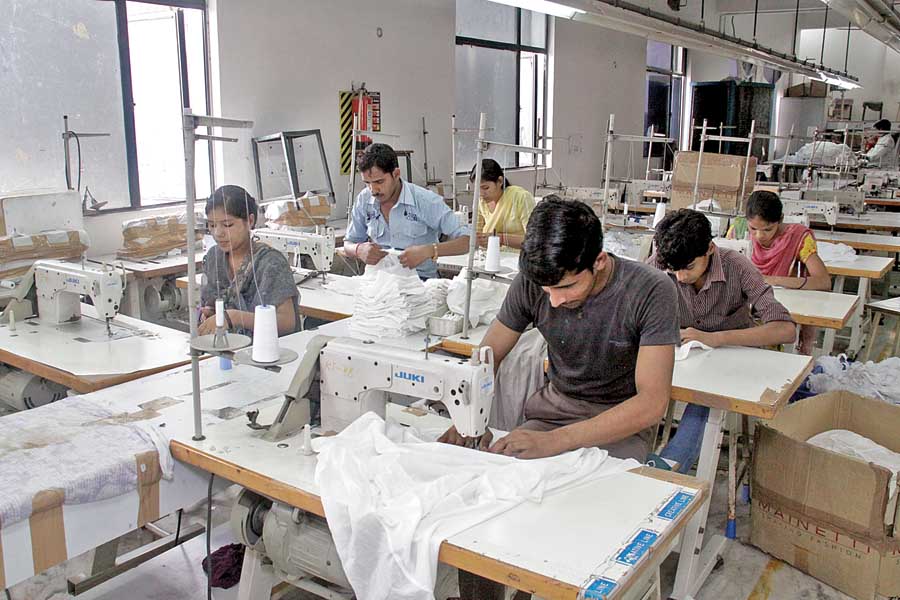
Assembly line as a manufacturing process which originated from the industrial revolution and refined by car manufacturers, was accepted by Indian apparel manufacturers in the late 1990’s on the insistence of international retailers, and has been followed since for mass manufacturing. Before the assembly line system, it was the tailors who would stitch complete apparel alone (what we call make through) or with the help of their apprentices, a modified version of what we now call ‘teamwork system’. In these new times when the quantities and lead times have shrunk, while the styles have increased, apparel manufacturers in NCR regions of India have gone back to the same Make Through system. And why not, tailors are still available in India so one does not have to supervise them painstakingly. In a two-part article series, Team StitchWorld interacts with many companies specializing in the different versions of Make Through system, highlighting the pros and cons along with the reasons of rejecting the globally prevalent assembly lines. The second article to follow would discuss the various versions of the system and how the aspects of quality control, wage payment and man-machine utilization are dealt with. Apart from technical issues, this article will also address the complex working practices of migratory workers in the age of compliance.
The Make Through system has been followed since the mid 1970’s by companies like Gurgaon-based Mehra Bandhu Creations, for sewing ladies dresses, tops and other such similar products, irrespective of the fabric types. The manufacturing system has been termed as Make Through due to its high level of flexibility and absence of ‘sequential workflow’, like in an assembly line. It is a grouping of sewing machines of different types from lockstitch to overlock to chainstitch, on which multi-skilled sewing operators work, handling more than one style at a time and sewing a garment on ‘shared tailoring’ basis. Another distinct feature of the system is that the sewing operators work on piece rate and not salaries or daily wages.
Now the system is used in many forms by the apparel manufacturers of the region and everyone has a reason for working on their own individual system, whether it is pure Make Through system, Make Through system along with assembly lines or having moved beyond improvising the Make Through system.
Make Through suits us fine…
Small order quantities and piece rate systems are the most dominant reasons for manufacturing on Make Through sewing groups. “We are manufacturing high fashion products, which have very small quantities and the quality is of greater concern. Hence the system suits us fine because it is easier to monitor 9 sewing groups of 4 machines each, than handle 1 assembly line of 36 operators,” shared Rajiv Guglani, Owner, Rajiv Exports.
Adding further, Uday Sehgal, Director, Mariko explained, “In such small quantities lack of continuity from a buyer along with scarcity of skilled labour has always been a roadblock for us, even if we wanted to go into assembly line production, we could not.” When looked upon from a different perspective, Make Through systems have actually helped companies control overheads as a lot of sewing operations are clubbed together, increasing the man-machine utilization and also giving a greater production per operator per day.
Furthermore, the piece rate system of wage payment is preferred by the operator in the Delhi-NCR and Jaipur region, because when working in an assembly line they would have to do just one sewing operation, even while possessing a wider skill set and in the process expect better salaries compared to single-skilled operators. “The system also suits the manufacturers as the output of a salaried employee is always lower than that of piece rate,” asserts Ashish Garg, Director, AG Fashions, who unlike other companies, manufactured an order quantity of even 20,000 pieces on Make Through system and shipped on time a quality product. Moreover the company also claims of venturing into assembly line production but failing as the operators were then on salary or daily wages, and they became complacent due to which the production output suffered a lot.
Make Through systems have actually helped companies control overheads, as a lot of sewing operations are clubbed together, increasing the man-machine utilization and also giving a greater production per operator per day.
Although many are concerned about the quality issues in the Make Through system which arises due to different versions of quality as each group manufactures on its own in the absence of a product and quality standardization system. However, companies experienced much less rework and alteration compared to an assembly line. Sharing his perspective on quality management in piece rate systems, Rajiv Guglani argues, “Since our focus is more on quality, we hire skilled workers only and even end up paying 10-15% more, which not only helps us retain our trained workforce but also helps us save on the time and money wasted in rework and alteration.”
Companies using Make Through system haven’t undertaken any kind of training program for its workers and even the highly trained production staffs is conspicuous by its absence. Not only this, the companies are also reluctant to pay attention and allocate resources to improve on both the aspects without which one can never setup an assembly line successfully. In the Make Through system the essential aspects of grouping sewing machines, distribution of styles and total capacity utilization are not managed by the top management but rather left at the disposal of the sewing operators and line masters. The unit master keeps track of all the operators, who has done which operation and style, and maintains a complete style-wise, colour-wise and size-wise chart, indicating which operator has been allotted what. Via the same chart he executes capacity utilization, wage calculation and order tracking. “Managing both the systems is very distinct as the people working on piece rate system are easier to manage since they manage themselves and their group, you can say it is a part of their high skill set, which is very unlike expectation from an assembly line system,” added Uday Sehgal.
The Make Through system might prove feasible and profitable for handling small quantities but the overall production and consistency of quality offered by the assembly system is far greater than that of a Make Through system
We need both, Assembly Line as well as Make Through
The limitation of manufacturing on assembly lines are better understood when companies who are successfully working on assembly lines are still maintaining a set of Make Through sewing lines in their apparel manufacturing facilities. Since the same company would be doing an order of 50,000 pieces per style, while also executing an order of 500 pieces, having both systems work in their favour. Jitin Pal Singh, Director, Nancy Kraft one of the oldest ladies top and dress manufacturers of the country, with a setup of 800 sewing machines explains, “It is not only the quantities which define the nature of the manufacturing process, it is the overall feasibility that is taken into consideration. For example we see the amount of value addition that is required in a garment, which further defines its movement in and out of the sewing lines and within the factory. If value addition is more, then the product would be manufactured by a Make Through sewing group due to its greater flexibility than assembly line.”
Going for assembly line system after a specific turnover mark is a total myth… It is only the business model, order quantities and certainty of business which defines this transition.
The people who have been working on assembly lines know that the system does not work well economically for such quantities; secondly the quality and productivity will not be up to the mark as by the time the learning curve stabilizes the order quantity would have been exhausted.
“One of the biggest advantages of Make Through when compared to an assembly line is the absence of any sort of style changeover time, as 2-3 styles are sewn at a time by a group. Moreover, the operators are highly skilled for easy switching from one style to another style,” added Sharan Gupta, Director of JUJAN Markfin and an industrial engineer by qualification. The company has a setup of 400 sewing machines and 15 embroidery machines from Tajima, Barudan and Tang.
The companies agreed that the Make Through system might prove feasible and profitable for handling small quantities due to efficient man-machine utilization and greater production per operator, when compared to assembly lines but the overall production and consistency of quality offered by the assembly system is far greater than that of a Make Through system. “Since different groups make a number of styles at a time, one can experience different versions of quality of a same product or style. Nancy Kraft monitors and matches the initial 2-3 pieces from all the groups, for not only reviewing the quality of critical operations but also for checking the gaps in understanding of different operators,” shared Jitin Pal Singh.
Make Through is not our cup of tea

All said, Make Through manufacturing system has still found limited acceptance at a global level and companies if given an opportunity have moved beyond the system to assembly lines only. “Yes we do work on Make Through system but not in our factories, it is completely outsourced to contractual units due to the high operating overheads incurred, we find that when manufacturing such small quantities in-house, the target CM will exceed by 10% to 15%,” informs Devang Seth, General Manager, Intime Knits, who only manufactures orders of more than 5,000 pieces in the assembly lines of its factories.


Similar is the case with Noida-based 360 Clothing, who specialize in manufacturing garment dyed ladies tops, skirts and dresses. “On our 120 sewing machines we produce bulk orders of more than 1,000 pieces and the order quantities lesser than that are outsourced from job workers, as we work with a set of 30 buyers at a time, and end up with small quantities in numerous styles,” shared Brigadier (Retd.) K. Mago, Owner, 360 Clothing. But that is not all; in the lean period when there is shortage of labour, the company divides its assembly lines in groups similar to that of a Make Through sewing system, sewing small order quantities. The company in the future wants to consolidate its buyers and execute only volume business.
It would be wrong to assume that Make Through is a region-specific phenomenon followed by apparel manufacturers as there are many companies, who are not only manufacturing similar ladies tops on assembly lines only, as people believe it is the intent to do so which matters, not the product. Not only have these companies had the advantage of higher production and standardized quality but they are proud of the systems that they have set in their facilities, which are abided by all. People manufacturing only on assembly lines believe that assembly lines if coupled with a robust training department, are a success anywhere.