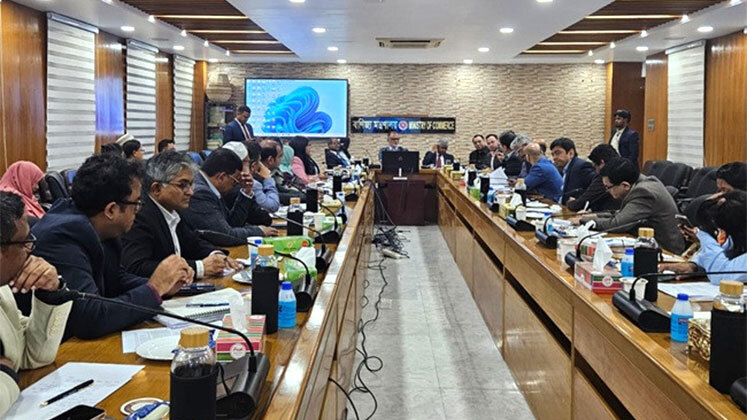
A high-level consultative meeting has been held at the Ministry of Commerce to review the challenges confronting Bangladesh’s readymade garment and textile sectors, with particular focus on the spinning industry.
The meeting was chaired by Commerce Adviser Sk. Bashir Uddin, who acknowledged the concerns raised by industry stakeholders and highlighted the strategic importance of the spinning sector to the country’s export competitiveness and industrial value chain. He conveyed that the issues presented by the industry were valid and required careful policy consideration.
On behalf of the government, the Commerce Adviser reiterated a commitment to resolving the challenges through lawful, equitable and time-bound policy measures, in accordance with existing fiscal and regulatory frameworks.
Senior government officials attended the meeting, including the Chairman of the National Board of Revenue (NBR), the Secretary of the Ministry of Commerce, and representatives from the Bangladesh Trade and Tariff Commission, the Finance Division and the NBR. Leaders from key industry bodies—the Bangladesh Textile Mills Association (BTMA), the Bangladesh Garment Manufacturers and Exporters Association (BGMEA), and the Bangladesh Knitwear Manufacturers and Exporters Association (BKMEA)—were also present.
Industry representatives presented their proposals separately, detailing the legal, economic and operational rationale underpinning their demands.
The Commerce Adviser further informed participants that an inter-ministerial coordination meeting involving all relevant stakeholders would be held on 3rd February 2026, at the Finance Division of the Ministry of Finance. The meeting is intended to arrive at an appropriate and timely policy response to address the ongoing crisis in the spinning sector.
In light of the government’s assurances and the constructive progress made during discussions, and taking into account the broader national context, including the forthcoming national election and referendum, the BTMA has decided to temporarily suspend its earlier decision to shut down all textile mills from 1st February 2026.
The association stated that it remained confident the government would address the spinning sector’s issues in a timely, transparent and lawful manner, supporting export competitiveness, safeguarding employment and ensuring macroeconomic stability. It added that it would closely monitor further developments before announcing its future course of action.