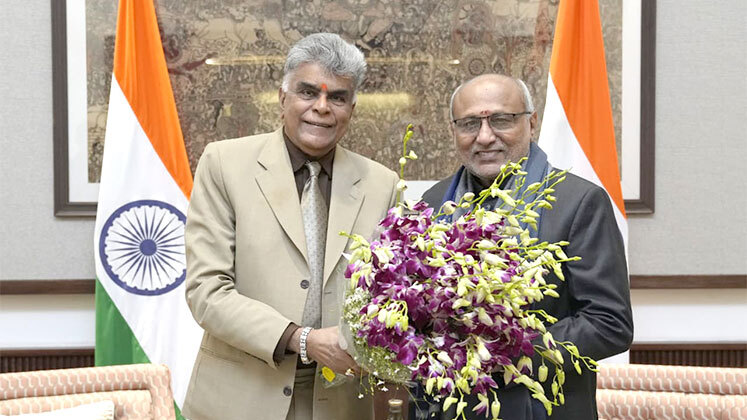
The chairman of the Apparel Export Promotion Council (AEPC), Dr A Sakthivel, met Vice President C P Radhakrishnan to discuss key challenges facing the sector, including US tariff measures, interest subvention support and the need for market diversification. The meeting focused on the growing impact of higher duties on Indian textile and apparel exports to the United States. The Vice President assured that the concerns raised would be referred to the relevant ministries for early consideration and appropriate action.
AEPC highlighted the impact of recent US actions imposing a 25% tariff along with an additional 25% oil-related penalty on certain imports, warning that these measures were causing severe disruption to India’s textile and garment exports. The United States is India’s largest single export market for apparel, and the council said prolonged uncertainty could lead to order stoppages, permanent loss of market share and large-scale job losses.
The exporters’ body said that for several large Indian textile and garment exporters, the US accounts for nearly 70% of total exports. It noted that the sector operates with structural constraints, including around four months of work-in-progress, a six-month product development and order cycle, and wage costs of about 30%, most of which are fixed. Given the industry’s thin margins, AEPC said there is limited capacity to absorb sustained tariff shocks.
To retain US customers and maintain production continuity, exporters have already absorbed price reductions equivalent to the oil-related penalty, AEPC said. This strategy has wiped out profits and depleted reserves and was adopted in anticipation of an early resolution of India–US tariff and treaty negotiations. The council said the approach is viable only as a short-term bridge and is not financially sustainable.
AEPC also warned of escalating risks, with US buyers withholding or cancelling new orders due to concerns over mid-cycle tariff escalation. It said that even with existing discounts, further tariff absorption is commercially impossible, while passing on higher costs to buyers is not viable in the current market environment.
The council stated that market diversification cannot provide short-term relief, as textile sourcing is embedded in long-term buyer supply chains. Developing alternative markets typically requires two to three years for buyer onboarding, compliance audits and volume scaling. A sudden loss of the US market, AEPC warned, would lead to permanent customer displacement and allow competing nations with preferential access to replace Indian suppliers.
In the immediate term, the sector faces production cuts, factory closures and large-scale employment losses. In the medium term, there would be a decline in export earnings and tax revenues, alongside structural weakening of the textile value chain. Over the long term, the industry risks irreversible loss of market share in the US.
AEPC has called for the fast-tracking of an India–US tariff treaty or, alternatively, the introduction of interim tariff relief or a suspension mechanism until a formal agreement is concluded. The council said even temporary relief would help restore buyer confidence, protect ongoing work-in-progress and export commitments, and prevent irreversible damage to the sector.
The exporters’ body stressed that the industry has already absorbed significant losses in the national interest to protect exports and employment, adding that there is no further shock-absorption capacity. It warned that delays of even three to six months could cause permanent damage to India’s strategic apparel and textile export sector.