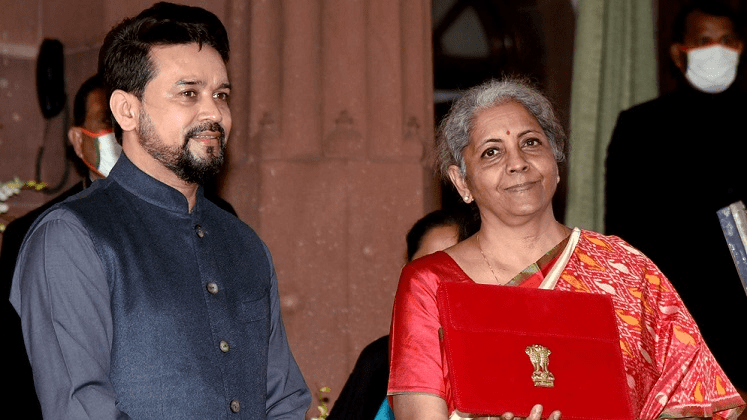
Nirmala Sitharaman, Minister of Finance today presented Budget for the year 2021-2022. Right from the announcement of 7 textile parks to be established over 3 years, other important decisions regarding customs duties and support for starts-ups were also announced. Here is a deep dive into what textile and apparel industry has been allocated in the current Budget.
Budget Announcement for Textile and Apparel Industry
1. 7 textile parks will be established over 3 years
To enable the textile industry to become globally competitive, attract large investments and boost employment generation, a scheme of Mega Investment Textiles Parks (MITRA) will be launched in addition to the PLI scheme.
This will create world-class infrastructure with plug and play facilities to help build global champions in exports.
2. Reduction in Basic Customs Duty
As the Government strongly feels that there is a need to rationalise duties on raw material inputs to man-made textiles, the Finance Minister announced to bring nylon chain at par with polyester and other man-made fibres.
The Government uniformly reduced the Basic Customs Duty (BCD) rates on caprolactam, nylon chips and nylon fibre and yarn to 5 per cent. So far, the rate of duty was 7.5 per cent.
3. Increase in customs duty
The Budget announced raising customs duty on cotton from nil to 5 per cent, besides attracting agriculture infrastructure and development cess at the rate of 5 per cent.
Similarly, the customs duty on cotton waste, which was earlier nil, is now 10 per cent. The same on raw silk (not thrown) and silk yarn/yarn spun from silk waste has been increased from 10 per cent to 15 per cent. The step will benefit the farmers.
The Government is also rationalising exemption on import of duty-free items as an incentive to exporters of garments, leather and handicraft items. Almost all these items are made domestically by Indian MSMEs. The Government is also withdrawing exemption on imports of certain kind of leathers as they are domestically produced in good quantity and quality, mostly by MSMEs.
4. Changed definition of companies
The Budget proposes to revise the definition for small companies under the Companies Act, 2013 by increasing their thresholds for paid-up capital from ‘not exceeding Rs. 50 lakh’ to ‘not exceeding Rs. 2 crore’ and turnover from ‘not exceeding Rs. 2 crore’ to ‘not exceeding Rs. 20 crore’. This will benefit many companies in easing their compliance requirements.
5. Trims going to be costly!
Certain duty-free imports of items like motif, glue, veneer, polish, hooks, rivets, button, Velcro, chaton, badges, beads, sewing thread etc., on the basis of export made in the previous financial year, were allowed to handicraft, garments and leather exporters. Now rates will be applicable on these items.
These concessions shall duly end on 31 March 2021.
Methyl diphenyl isocyanate (MDI) for the manufacture of spandex yarn will also face duty of 7.5 per cent. So far it had nil duty.
6. Infrastructure in textile and apparel hubs
Funding will be provided to Chennai Metro railway phase-II of 118.9 km at a cost of Rs. 63,246 crore and Bengaluru Metro railway project phase 2A and 2B of 58.19 km at a cost of Rs. 14,788 crore.
The 3,500 km of National Highway work in the state of Tamil Nadu at an investment of Rs. 1.03 lakh crore is also planned. These include Madurai-Kollam corridor and Chittoor-Thatchur corridor. Construction will start next year.
Chennai-Salem corridor of 277 km Expressway will be awarded and construction would start in 2021-22.
7. Support for start-ups
Start-ups and innovators will be directly benefited as the Budget proposed to incentivise the incorporation of One Person Companies (OPCs) by allowing OPCs to grow without any restrictions on paid up capital and turnover, allowing their conversion into any other type of company at any time, reducing the residency limit for an Indian citizen to set up an OPC from 182 days to 120 days and also allowing Non Resident Indians (NRIs) to incorporate OPCs in India.
The eligibility for claiming tax holiday for start-ups is being extended by one more year – till 31 March 2022. Further, in order to incentivise funding of the start-ups, extension of the capital gains exemption for investment in start-ups has also been made for one more year till 31 March 2022.
8. Labour-specific
The Government has allowed a new tax exemption for the notified Affordable Rental Housing Projects as it will support the migrant workers. It has also proposed to allow women workers in all categories to work in night shifts with adequate protection and has reduced compliance burden on employers with single registration and licensing, and online returns.
9. Other important aspects
It has been proposed that all specified amendments by importer/exporter should be allowed on self-amendment basis. Hitherto all amendments were to be approved by the officer.
As improving tax compliance, a new provision is being proposed for any good entering for export, making wrongful claim of remission or refund shall be liable to confiscation.
A new provision is being inserted in the Customs Act to prescribe penalty in specific cases where any person claims refund of tax or duty discharge, using fraudulent invoices, on exports of goods.
The companies, having turnover of Rs. 10 crore and 95 per cent of their transactions digitally, are now exempted from audit. Earlier the limit was Rs. 5 crore only.
10. Important allocations
Rs. 700 crore for Amended Technology Upgradation Scheme (ATUFs)! The same was Rs. 545 crore in the last Budget.
Rs. 100 crore for Integrated Scheme for Skill Development, a need of the hour for the textiles industry.
Rs. 30 crore for Export Promotion Studies! The same was Rs. 5 crore in the last Budget
Rs.80 crore for Scheme on Integrated Textile Parks (SITP)
Industry reactions
“It is a pragmatic Budget presented to address all sectors’ issues at a time when our economy is getting revived back to normalcy. I appreciate allocation of Rs. 50,000 crore over five years for National Research Foundation to strengthen the ecosystem of the country and hopefully Tirupur would also get benefited out of this allocation,” Raja. M. Shanmugham, President, Tirupur Exporters’ Association
“We welcome the thrust given to textile sector in Budget with announcement of 7 Mega Integrated Textile Region and Apparel Parks. With the concept of these mega parks with a plug and play model, Indian textile and apparel sector – particularly SMEs – can work on large-scale and build competitiveness in manufacturing. Further these parks can be aligned with ESG (Environmental, Social and Governance) goals to attract international buyers as well as investors. The mention of 3-year time period is a welcome one to capitalise the opportunities emerging from brands’ China plus one strategy. Reducing the BCD rates on nylon also will help the MMF sector in a big way,” Prabhu Dhamodharan, Convenor, Indian Texpreneurs Federation (ITF), Coimbatore
“The Budget takes care of all the sectors including the apparel sector and will ensure robust economic recovery going forward. This is one of the finest Budgets considering the current situation due to the Coronavirus pandemic. All key sectors like health, agriculture, infrastructure, finance and skilling have been covered well. The focus on infrastructure highways, railways and ports is a welcome decision as it will go a long way in improving the logistics and reduce the cost of doing business. Further, the rationalisation of GST and customs will also help in easy access to raw materials and export of value-added products. A scheme to promote flagging of merchant ships in India will be launched by providing subsidy support to Indian shipping companies in global tenders floated by Ministries and CPSEs. This will help in reducing our shipping costs,” Dr A Sakthivel, Chairman, Apparel Export Promotion Council (AEPC)
“10 per cent import duty on cotton is a severe blow for the cotton textile value chain; we appeal to the PM for immediate withdrawal of the same to sustain the global competitiveness of Indian textiles and apparel industry and prevent huge job losses. This levy will not benefit the cotton farmers as the normal import of 12 to 14 lakh bales per year accounts only around 3 per cent of Indian cotton production and consumption and such cotton is not produced in India,” Ashwin Chandran, Chairman, The Southern India Mills’ Association (SIMA)
“Budget is growth-oriented but the imposition of BCD on Cotton – is a matter of deep concern. The imposition of 10 per cent BCD on Raw Cotton is surprising, this will make imports of extra-long staple cotton costly especially Giza Cotton from Egypt and Supima Cotton from the US. Regarding direct taxes, the Budget has reduced the time-limit for reopening of assessment to 3 years from the present 6 years. This is a welcome step and it will remove the uncertainty for the assesses,” Manoj Patodia, Chairman, The Cotton Textiles Export Promotion Council (TEXPROCIL)
Also Read: Budget: What industry demands and what it can get…