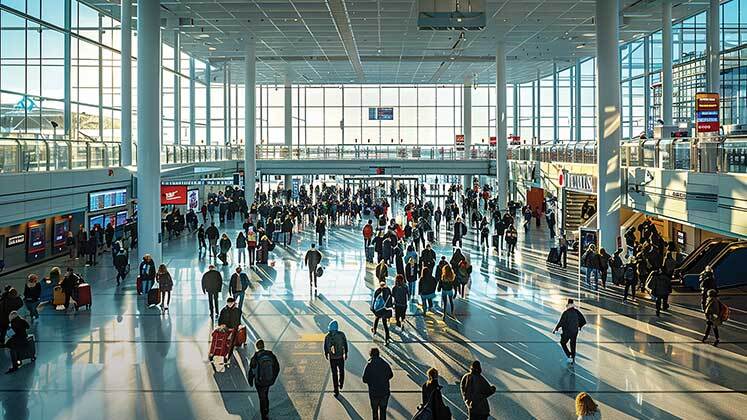
Airports in India aren’t just places to board flights anymore. They are turning into the country’s newest fashion runways. What once meant picking up souvenirs or a bottle from dutyfree now often includes browsing racks of clothes, trying on shoes or grabbing last-minute accessories. With more people flying, longer wait times and shiny new terminals coming up, airports are fast becoming prime spots for discovery, shopping and indulgence.
Annual passenger numbers have already crossed 350 million, placing India as the world’s third-largest aviation market, behind only the US and China. And it is not just about travel. The sector fuels the economy too, contributing nearly US $54 billion indirectly and around US $6 billion directly to India’s GDP, while creating more than 8 million jobs across the country.
The growth has been staggering. In just a decade, the number of operational airports has doubled from 74 to 159, with plans to reach as many as 400 by 2047. In the next five years alone, the commercial aircraft fleet is set to grow from 813 to 1,300 and passenger handling capacity will expand to 800 million. More than 50 new airports are in the works, many in Tier-2 and Tier-3 cities, which means airport shopping will no longer remain a metro-only affair.
Some of the big airport projects include the recently opened Navi Mumbai International Airport, along with upcoming developments such as Jewar Airport in Noida, Bhogapuram in Andhra Pradesh, Purandar in Pune, Mopa in Goa, and Kalyani in Kolkata. Together, they are part of a US $11.88 billion investment drive aimed at reshaping India’s airport network by 2025.
For travellers, this expansion is transforming the way they shop. Today’s airports host a mix of fashion and lifestyle brands that cater to every budget and taste. Think Marks & Spencer, United Colors of Benetton, Fabindia, W, Shopper’s Stop, Levi’s, Superdry, Go Colors, Biba, Crocs, Skechers, Hush Puppies, Lacoste and more. Alongside them are global luxury labels like Hugo Boss, Armani Exchange, Michael Kors, Victoria’s Secret, Steve Madden, Tommy Hilfiger and Jimmy Choo, turning terminals into mini high streets.
And this is just the beginning. According to Knight Frank India, the airport retail market could leap from US $1.4 billion in 2019 to nearly US $9.3 billion by 2030, a six-fold jump that signals just how central airports are becoming the country’s shopping story.
Airports are also increasingly relying on non-aeronautical revenue streams, with retail and duty-free sales playing a crucial role. For instance, Delhi Airport generates about 57% of its revenue from non-aeronautical activities.

“In major cities like Delhi, Mumbai and Bengaluru, the future looks promising for fashion retail. Young and aspirational Indian consumers are especially looking for better shopping experiences while travelling,” said Anuj Kejriwal, CEO and MD, Anarock Retail, a leading Indian real estate services company.

“Our airport stores are strategically located in major international and domestic hubs to capture high foot traffic. We focus on locations with strong passenger volumes and premium retail environments. The average size of our airport stores are 300-350 sq. ft., depending on the terminal layout and passenger demographics,” said Kamal Khushlani, Founder, Mufti.
The homegrown denim brand, marketed and distributed by its parent company, Credo Brands Marketing Ltd., is present in Mumbai T2 Domestic, Mumbai T2 International, Mangalore, Nagpur, Pune and Vizag airports.

“We have a presence at three airports— Mumbai, Pune and Srinagar. The average size of our airport store is 140 sq. ft.,” said Akhil Jain, Executive Director, Madame, a women fast-fashion brand.

“We are currently present at key airports across India, including Delhi (both domestic and international terminals), Mumbai, Goa, Lucknow and Hyderabad (domestic and International). Our airport stores typically range between 700 and 800 sq. ft., depending on the space availability at each location,” said Rajesh Jain, MD and CEO, Lacoste India, the French men’s and women’s fashion brand.
Passenger Footfall at Major Indian Airports
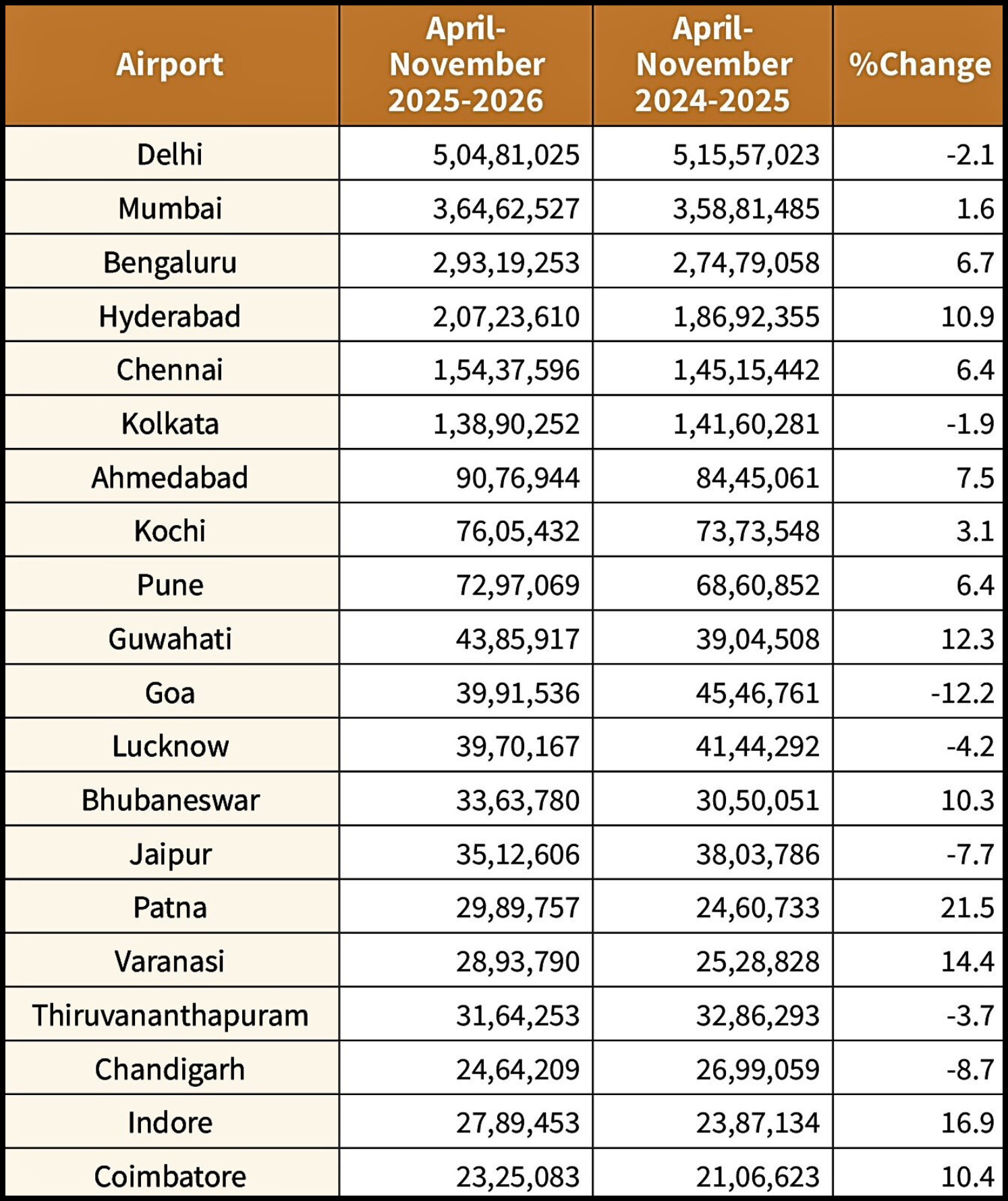
Source: Airport Authority of India
Sky-High Rents, but High-Value Returns
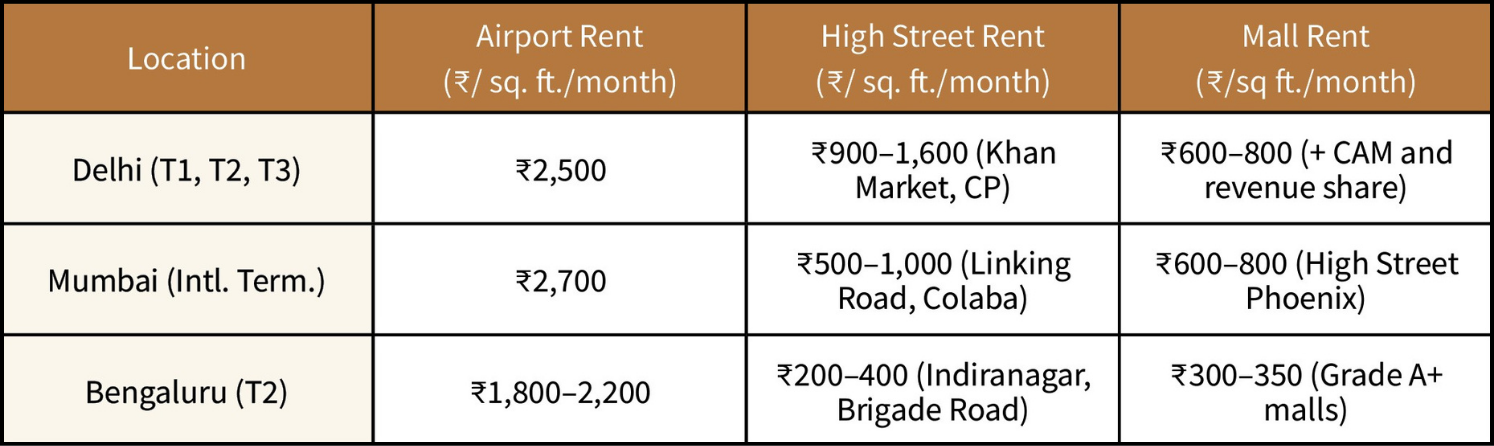
Airport shop rentals are rising fast, often outpacing even top malls and high streets. At Delhi Airport, retailers at international terminals (T1, T2, and T3) pay around₹2,500 per sq. ft. per month, much higher than prime high streets like Khan Market or Connaught Place, where rents range from ₹900-1600 per sq. ft., and far more than Grade A+ malls, which charge about ₹600-800 per sq. ft., plus extra costs like CAM (Common Area Maintenance) and revenue share.
Mumbai Airport charges even more, around ₹2,700 per sq. ft. per month at its international terminals. In comparison, high streets like Linking Road or Colaba Causeway typically range between ₹500-1000 per sq. ft., while top-performing malls like High Street Phoenix charge about ₹600- 800 per sq. ft.
At Bengaluru’s Kempegowda Airport, Terminal 2 rentals fall between ₹1,800-2,200 per sq. ft., still much higher than the city’s high streets like Indiranagar or Brigade Road, which range between ₹200-400 per sq. ft.. Even top malls, which charge around ₹300–350 per sq. ft., remain far below airport rates.
Retailers see airport stores as a smart long-term investment. Consumers’ intent to shop at airports is noticeably stronger, driven by travel-related occasions such as vacations, business trips or gifting needs. Being present at airports also boosts a brand’s image and provides access to international customers. “While the operational costs are higher, the enhanced brand exposure and quality footfalls make travel retail a highimpact channel for us,” said Rajesh Jain.
Some retailers also pointed out that most airport leases are structured as a combination of a base rent or a percentage of sales, whichever is higher.
“While the rental cost per square foot is often higher, the turnover rate at airports can offset these costs due to the steady stream of travellers,” stated Kamal Khushlani.
Similarly, Akhil Jain mentioned, “Airport retail comes at a premium. However, this is balanced by the high footfall and quality of traffic at airports. While high streets and malls offer broader shopping windows, airport retail is about speed, convenience and immediate conversions — making the value per square foot quite competitive.”
The core collection at airport stores mirrors what is available at retailer’s key retail locations. However, the curation is more compact and carefully selected to match traveller needs such as comfortwear, layering options, accessories such as bags, sunglasses, scarfs, perfumes and easy-packing styles.
Even the pricing remains consistent across all locations to maintain brand consistency.
“The selection is heavily influenced by the nature of transit shopping — quick decisions, gifting needs and last-minute wardrobe upgrades. Seasonal travel edits and capsule collections tailored for comfort, layering or weather shifts are often rotated at airport stores,” said Akhil.
Likewise, Kamal Khushlani pointed out, “We offer a core collection that aligns with our brand identity, but we also curate our airport assortment based on traveller’s needs, like keeping more options of topwear in all airports and winterwear at international airports.”
Buoyed by the momentum, many retailers are now gearing up to double down on airport retail and expand their presence across key terminals.