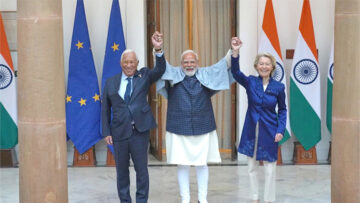
India’s apparel and textile industry has welcomed the signing of the India–European Union Free Trade Agreement (FTA), describing it as a landmark development that could significantly alter India’s competitive position in the European market and accelerate export growth over the coming years.
The Apparel Export Promotion Council (AEPC) said industry sentiment has turned strongly positive following the conclusion of the agreement. AEPC chairman Dr A. Sakthivel said the deal marked a decisive moment for the Indian apparel sector and was expected to deliver a substantial boost to exports, with industry estimates suggesting shipments to the EU could potentially double over the next three years. He said the provision of zero-duty access for Indian garments and clothing would materially enhance India’s competitiveness in the European market, where exporters have long faced tariff-related disadvantages.
According to industry projections, Indian apparel exports to the EU could grow by 20–25% year on year after the FTA becomes operational, compared with the current growth rate of about 3% in the region. AEPC said the agreement would enable Indian manufacturers to compete more effectively on parameters such as quality, design and sustainability, rather than primarily on price.
Dr Sakthivel said the FTA eliminates tariffs on 100% of apparel tariff lines, significantly improving market access across all EU member states. He noted that the European Union is the world’s largest apparel importer, with total imports valued at around $202.8 billion in FY 2024–25. Major EU markets such as Germany, France, Spain and Italy already source substantially from India, and the agreement is expected to further expand exports to these economies.
While the EU accounts for nearly 28% of India’s total apparel exports, India’s share of the EU’s overall apparel market stands at only about 2.9%. AEPC said the removal of tariffs would give Indian exporters a level playing field against competitors such as Bangladesh, Turkey and Vietnam, which have enjoyed duty-free or preferential access to the EU market.
The Confederation of Indian Textile Industry (CITI) has welcomed the conclusion of the free trade agreement between India and the European Union, describing it as a timely and significant development for the country’s textile and apparel sector, and has called for its early implementation.
Ashwin Chandran, chairman of CITI, said the removal of tariff barriers under the agreement would enhance the competitiveness of Indian textile and apparel products in the EU market, with the potential to enable exporters to grow their revenues from the region over time.
At the same time, Chandran said Indian textile and apparel companies must intensify their focus on innovation and sustainability to strengthen the differentiation and appeal of their products in the European market. He added that such an approach would help exporters move up the value chain and achieve stronger revenue outcomes.
Industry players have echoed this optimism. Pallab Banerjee, managing director of Pearl Global Industries Ltd, said Europe represents a larger overall market for garments than the United States, noting that while India’s apparel exports to the US stood at about US $ 5.5 billion, exports to the EU were around US $ 4.5 billion. He said Pearl Global already services leading EU customers from its overseas production bases, with a smaller share sourced from India, and that roughly 20% of the company’s total revenue currently comes from the EU. The India–EU FTA, he said, is expected to significantly increase both volumes and the proportion of revenue generated from the region.
Banerjee also said that as the EU continues to tighten requirements around environmental, social and governance (ESG) compliance and end-to-end traceability, India is well positioned to emerge as a stronger sourcing destination.
Historically, Indian apparel exports have operated at a disadvantage in the EU due to tariff-free access enjoyed by competing countries, while Indian products were subject to duties of nearly 10% under the GSP regime and around 12% after its withdrawal. Industry bodies said this tariff differential has undermined India’s price competitiveness despite strong capabilities in quality, compliance and scale.
The elimination of these tariffs under the India–EU FTA is expected to help level the playing field and catalyse fresh investments in advanced synthetic raw materials, modern processing technologies and capacity expansion across the textile and apparel value chain. Over the medium term, this is expected to strengthen India’s position as a reliable, compliant and scalable supplier to the European market.