The outbreak of the novel coronavirus epidemic resulted in cancellation of fashion shows around the world. But few designers and brands have moved these shows to digital format now. Though the concept of virtual fashion shows has been there in the industry for quite some time, the challenges due to the pandemic led to the acceptance of the concept on a global level.
Virtual fashion shows are the application of a 3D virtual avatar wearing 3D garments and walking on a virtual ramp. These virtual models are lookalikes of the real-world models wearing the actual digital collections of brands and walking on the ramp just like a human model does.
The technology behind these virtual shows
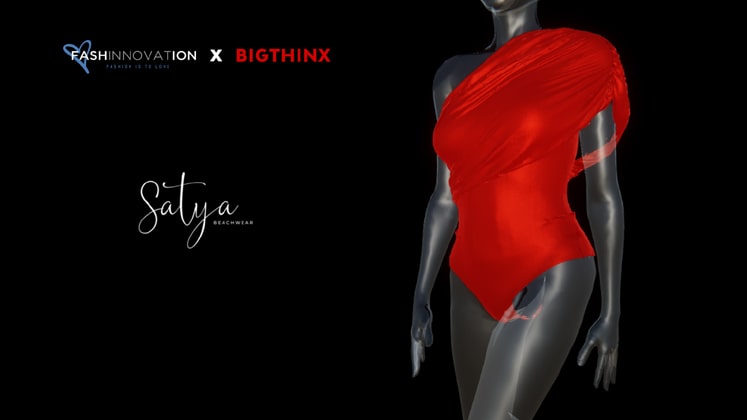
3D companies like CLO Virtual Fashion, 3DLook and Bigthinx have been integrating the concept of virtual avatars and virtual clothing in different areas of the fashion industry like sizing and sampling. Recently Bigthinx, a Bengaluru-based AI fashion tech company, collaborated with Fashinnovation and livestreamed the one of the first 3d virtual shows. It had virtual models and garments created in 3D design technique, all based on actual product design and correct measurements.
The company is a provider of AI-based solutions for e-commerce retailers that help the customers find their correct fit using just 3D body scans of customer bodies. The AI solution is trained with millions of body measurement data that helps it to generate the virtual avatar of the consumer bodies when scanned using their smartphones. The customers can then try different garments on their 3D lookalikes. “We spent a lot of time and efforts in digitising the material, so that they look and behave exactly they would in the real world,” commented Shivang Desai, Co-founder, Bigthinx.
Also Read: Bigthinx: Indian start-up transforms global fashion tech
Since the company had the technology of virtual clothing, digital avatars and 3D body scanners, they utilised it for the creation of the fashion show. For the show, real-world model avatars were created. For the creation of 3D avatars, real-life models were required to scan their bodies using their smartphones, and the Bigthinx AI created a 3D body avatar by reading all the 44 points of the human body, thus creating their lookalikes.
“The avatars that are produced look exactly like digital versions of real people. These are similar to video game characters and can be used with our digital clothing just the same way as clothing is worn in real life. They are then animated to walk, pose and behave like real people as well. Therefore, they can be made to walk a virtual runway show and even pose for virtual photoshoots,” commented Chandralika Hazarika, Co-founder, Bigthinx.
For the creation of garments, Bigthinx’s software uses an automated AI based fashion digitalisation pipeline which automatically recreates clothing in 3D from normal photos by extracting details such as colours, fabric properties, clothing cuts and variations, and much more. These digital clothes are then draped on the avatars to showcase exactly how it would look and behave in reality. Bigthinx’s AI is trained on datasets involving millions of images to identify and replicate the nuances and cuts of various kinds of clothing like necklines, sleeves, lengths, lapels, etc. This data had been carefully collected from the internet and several other sources over the course of years, and we keep collecting more data in an ongoing process to continuously improve the AI.

The video was being live streamed on YouTube and since then it has been a huge success in the global industry. “We are extremely proud to win the seventh edition of ‘The Mark Challenge’ hosted by International University of Monaco. We were among the top six teams to present our business model at the finale in front of the jury, which comprised investors and professionals of the industry. We at Bigthinx are ecstatic to have received the accolades and immense appreciation from all over the globe.”
For creating the 3D avatars of the garments from the designer collections, photographs of the original garments were taken. These photographs were uploaded to the system which is trained with AI to understand different attributes like colour, sleeves, neck, cut, etc. The AI then automatically creates a 3D garment from the scanned picture. The AI is trained to understand not only the texture of the garment, but also its surface, shine and thickness – and that’s what helps the solution to simulate the real garments into the 3D ones. “When we think about material, we are thinking about certain other factors like look, thickness, shine and other different properties. Our AI is trained to understand what kind of material is there in the picture and derive material properties from that to understand the reflectivity and thickness of the product. This helps us to simulate on any object,” explained Shivang.
Another amazing virtual show variation was carried out by Anifa Mvumeba, Founder, Hanifa, a fashion label. She created a virtual fashion show that was streamed over InstagramLive in which each garment appeared in 3D against a black backdrop, as it is worn by invisible models strutting down the catwalk.
The garment displayed did not have any human model to wear them; rather they were just 3D garments defining the complete curves, fall and look of how it would look on an actual human body. The concept of absence of any live human wearing the garment had an actual look of the garment with each detailing.
Digital models taking over the real-world models
Today these 3D virtual models are being used similar to the human fashion models performing tasks like display of collections, and few are even fashion influencers on Instagram with more than 1,000 followers. They can pose, walk and are being used on magazine covers as fashion icons. The best example is Shudu, the world’s first digital supermodel created using 3D technology by Cameron-James Wilson. Wilson, a real-life photographer, created the model as she wanted perfection. Shudu is today a virtual model being used on magazine covers, for fashion campaigns, and also has an Instagram account with 200 K followers.
Another such example is Miquela Sous, a half-Brazilian, half Spanish model and singer. She is the first virtual fashion influencer on Instagram with 2.1 million followers. The virtual model created by Trevor McFedries and Sara DeCou can attend fashion shows, and has advertised for brands like Prada, Chanel and Supreme. The model has also collaborated with brands like Japanese street label Ambush and digital publication Highsnobiety.
The concepts of 3D models and virtual fashion shows would be witnessing a boom in the current situation when the world is moving towards digitisation. India is also geared up as the Lakmé Fashion Week and Fashion Design Council of India (FDCI) are all set to host virtual fashion shows this year, as the shows were canceled due to COVID-19.
However, the biggest challenge that lies for virtual fashion shows is the bridge between the on-screen and physical presence to actually touch and feel the fabric to understand the thickness, softness, texture, etc. Though the technology has certain limitations, it offers solutions to many existing problems faced by the industry.
“We believe that even though digital fashion shows will not completely replace real ones, they will certainly become popular alternatives for brands that want to showcase numerous collections but don’t want to take on the burden and expense of real fashion shows. They will also become a leveling channel for e-commerce brands and upcoming designers who cannot afford to put on traditional fashion shows and can benefit from a digital medium. The short-term adoption is expected to be in the form of hybrid mediums which involve a combination of physical and virtual, delivering superior audience experiences. This approach is far cheaper and much more sustainable than traditional methods, and we expect to see widespread adoption in the near future. So, definitely virtual fashion shows will be a complement to physical fashion shows,” concluded Chandralika.
Also Read: Managing product catalogues on multiple online marketplaces